How to Implement Multiple Burden Resistors for a CT Leakage Current Sensor?

Thread Starter

kagoun

Joined Apr 19, 2024
12
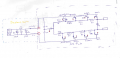
I have a circuit schematic for measuring leakage current using a current transformer (CT). I'm trying to understand how it works, but there are a few parts that don't quite make sense to me.
You can see the schematic in the attached image. In this schematic, T0 and T1 are the CT connection points.

I'm particularly trying to figure out the MOSFET structures used here. It seems like they were trying to make the burden resistor configurable (selectable). But since leakage current produces an AC signal, I'm not sure if the MOSFETs will work correctly under such conditions.

Do you also think this setup is intended to switch between different burden resistor values?

In my own design, I may also need to use 2 or 3 different burden resistor values, depending on the measurement range.
What would be a good way to implement that?
 

Attachments

Ian0

Joined Aug 7, 2020
13,117
In my own design, I may also need to use 2 or 3 different burden resistor values, depending on the measurement range.
What would be a good way to implement that?
Connect the largest value permanently.
Use relays to switch the other values.
You STILL haven't told us what the maximum output current of your CT is.

L1 and L2 are pointless. The CT already has a large value of inductance. Adding a couple of SMD inductors is a drop in the ocean.
 

Thread Starter

kagoun

Joined Apr 19, 2024
12
Connect the largest value permanently.
Use relays to switch the other values.
You STILL haven't told us what the maximum output current of your CT is.

L1 and L2 are pointless. The CT already has a large value of inductance. Adding a couple of SMD inductors is a drop in the ocean.


First of all, thank you for your answers to both this and my previous question.
The current transformer is intended to measure leakage currents ranging from around 5 mA up to 50 A. It has a turns ratio of 1:1500.
As for the schematics shown in the image — as you mentioned — the filtering doesn’t seem to be very well designed. It looks like they just added the filters they’re familiar with on the other parts of the circuit, without much optimization.
 

Ian0

Joined Aug 7, 2020
13,117
An 80dB range might be quite challenging. My clamp meter can manage 40dB, but 3.3uA input current is not impossible. I just wonder how much interference it might pick up. I presume that you are working with quite a limited bandwidth.
 

Thread Starter

kagoun

Joined Apr 19, 2024
12
An 80dB range might be quite challenging. My clamp meter can manage 40dB, but 3.3uA input current is not impossible. I just wonder how much interference it might pick up. I presume that you are working with quite a limited bandwidth.
Actually, I don’t intend to measure this entire current range with a single op-amp.
I’m planning to split the range across three different op-amps, each with a different gain, to cover three separate current ranges.
 

Ian0

Joined Aug 7, 2020
13,117
Actually, I don’t intend to measure this entire current range with a single op-amp.
I’m planning to split the range across three different op-amps, each with a different gain, to cover three separate current ranges.
There is a problem with that, unless you somehow disconnect the two op-amps that are not in use. If the high-gain op-amp is still connected, then it will be driven into saturation in which case it can send current back to the inputs and upset the other two op-amps. It will also contribute noise. In my opinion switching burden resistors with relays will be more successful.
Also, do you realise how little DC current it takes on the secondary to saturate a current transformer?
 

Thread Starter

kagoun

Joined Apr 19, 2024
12
There is a problem with that, unless you somehow disconnect the two op-amps that are not in use. If the high-gain op-amp is still connected, then it will be driven into saturation in which case it can send current back to the inputs and upset the other two op-amps. It will also contribute noise. In my opinion switching burden resistors with relays will be more successful.
Also, do you realise how little DC current it takes on the secondary to saturate a current transformer?

Actually, the circuit I currently have uses two op-amps, and based on the values I've measured so far, everything seems to be working fine. Also, the MCU sends 2.4 V DC to the CT connection point, and that part doesn’t seem to show any issues either.

I’ll definitely keep your points in mind when designing my own circuit.
Using a variable burden resistor is one of the solutions I’ve considered and might implement. I may even combine both approaches — using multiple op-amps and a variable burden together.

I expect to build and test the circuit in a week or two. I’ll post updates here once I make progress.
In the meantime, I’m open to any other suggestions as well.
 

MisterBill2

Joined Jan 23, 2018
27,362
My take on the question is that Neither do I understand how the circuit works! I doubt very much that it would work at all! The clamp diodes across the current transformer output will seriously affect any possible measurements.
Clamp diodes protecting any sensitive electronics would come after the range selection portion of the system.
 
Last edited:

MisterBill2

Joined Jan 23, 2018
27,362
You can use a single amplifier and a single string of resistors as the burden loads. Measure the voltage across all three resistors for the lowest current range, Measure the voltage across only two of the three resistors for the middle range, and then measure the voltage across only one resistor for the high, 50 amp, current range. No resistor switching, only the voltage measuring connection switched, and only one amplifier , with a constant gain setting.
But there will be quite a bit of tedious math in finding the value of those three resistors. BUT it makes the system much simpler, and safer, because there is never a chance for the burden resistors to become disconnected.
 

Ian0

Joined Aug 7, 2020
13,117
You can use a single amplifier and a single string of resistors as the burden loads. Measure the voltage across all three resistors for the lowest current range, Measure the voltage across only two of the three resistors for the middle range, and then measure the voltage across only one resistor for the high, 50 amp, current range. No resistor switching, only the voltage measuring connection switched, and only one amplifier , with a constant gain setting.
But there will be quite a bit of tedious math in finding the value of those three resistors. BUT it makes the system much simpler, and safer, because there is never a chance for the burden resistors to become disconnected.
That's a reasonable idea, but how much voltage would be across the entire burden resistor network at 50A, even though you are only measuring the voltage across the smaller resistor? CTs like to have a burden resistor as close as possible to zero for best accuracy, and they soon start to lose accuracy as the output voltage increases, due to the current flowing through the magnetising inductance which is non linear, and eventually due to saturation. I would suggest using a single burden resistor and either an amplifier with switchable gain or several amplifiers and switching their outputs. For 1A CTs I use a burden resistor of 0.05Ω which produces an output just in the right range for using a current shunt amplifier device to amplify it. Have I seen current shunt amplifiers with switchable gains?
 
Top