Motor Reversal EMF Protection.

Thread Starter

TEXAND

Joined Nov 24, 2021
9
I am a complete novice and am replacing a blown motor reversal board on my stair lift. The circuit below is an N-channel I made that seems to work okay on a breadboard with a 300 ohm resistor as the motor. Although it is a source follower, the loss of several volts is okay. Before I create a big solder mess on a perforated board, are there any diodes, capacitors, etc that I should add to prevent problems with back EMF, on/off spikes?
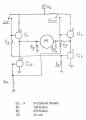
1637795010736.jpeg
 

LowQCab

Joined Nov 6, 2012
5,101
Your Circuit probably won't work.

R-Y Resistors do nothing.

You will probably smoke your FETs because of inadequate Drive-Voltage.

Back-EMF will not be a problem,
RFI spikes from a Brushed-Motor probably will be a problem

What is the DC-Resistance of your Motor ?

What are the Up and Down Switches connected to ?, ( 24-Volts ????? ),
can the Switches be connected elsewhere ?
.
.
.
 

Thread Starter

TEXAND

Joined Nov 24, 2021
9
Thank you, much-much. I need all the help I can get. I tried the conventional N-P, H reversal circuit but fried the mosfets. It worked great at 6 volts, but at 24, it cratered. I assume it was because of exceeding 20 Vgs. I like that circuit because I could touch gate to ground for up or down. Would a 12 Volt, voltage regulator work for the gates on the H circuit? As for this circuit, I can not test on a breadboard – too much current. The geared motor is rated at 24 volts, 33% duty cycle, 8.27 amps, 140 watts with a resistance of ~ 0.5 ohms. It will run at less than 24 volts, and that is not a problem. The mosfets are 30 volt, 260 amp. The up/down switches connect from 24 Volt to the gates of Q1 and Q2 respectively. Again, thanks for your help, John
 

Dodgydave

Joined Jun 22, 2012
11,395
You've probably fried the MOSFETs because they both turned on together and shorted the supply out.

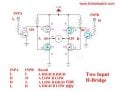
Here is one way how to drive an Hbridge..
64e759961b853c88fe7877b5b23b157d.jpg


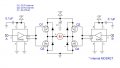
As for back EMF diodes , you put them across the fets like this diagram.

TC4420_hb.jpg
 

Thread Starter

TEXAND

Joined Nov 24, 2021
9
Maybe? I am not sure what i did, but I burned them up twice. I never connected the bridge to the motor. I had a voltmeter on the motor leads, and when i used 6 volts, it worked fine. When I connected to 24 volts, it fried. Do you think that it might have had something to do with exceeding the nominal 20 Vgs with a 24 volt supply?
 

LowQCab

Joined Nov 6, 2012
5,101
You have ~48- "Locked-Rotor"-Amps to withstand,
your current N-Channel-FETs should handle that easily.

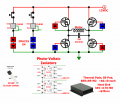
The trick is how to reduce the complexity of driving N-Channel-FETs on the "High-Side" of a Bridge.

Here is a simple, straight-forward way to do it ...........
.
.
.
Motor Control 2 FLAT .png
 
Last edited:

LowQCab

Joined Nov 6, 2012
5,101
Those P-Channel FETs may not survive your application, and are not necessary.
Your "Locked-Rotor-Amps" are around ~48-Amps,
this condition is likely to be a normal occurrence.
.
.
.
 

Thread Starter

TEXAND

Joined Nov 24, 2021
9
You have ~48- "Locked-Rotor"-Amps to withstand,
your current N-Channel-FETs should handle that easily.

The trick is how to reduce the complexity of driving N-Channel-FETs on the "High-Side" of a Bridge.

Here is a simple, straight-forward way to do it ...........
.
.
.
View attachment 253576
[/QUOTE
Yes. Yes. This will do it. Thank you so very-very much.

]
 

LowQCab

Joined Nov 6, 2012
5,101
The Driving LEDs were drawn up-side-down,
the Picture has been corrected now.

Just for additional information ...........
The Photo-Voltaic-Isolators are somewhat "slow" devices,
they are not appropriate for High-Frequency-Switching,
on the other hand, their slow response can be a bonus in the type of Circuit shown,
because their slow Switching ........
( maybe ~20ms depending upon the Gate-Capacitance of the chosen FETs ),
....... actually calms-down any Flyback-Spikes that the Motor may generate when
being abruptly switched-off.

The Circuit shown is shown with 2 Push-Buttons for clarity of operation only.
I don't know what your Switch configuration is,
but if BOTH Push-Buttons are pressed at the same time,
it is very likely that all the FETs could be smoked within a few seconds, if not instantaneously.
Or, You could simply melt some Wires and start a FIRE
if the FETs hold-out long enough, and if no Fuses blow.

A bullet-proof solution to this is a "Spring-Loaded" "Center-OFF" SPDT Toggle-Switch.
( Mom - Off - Mom )

If You have Push-Buttons,
let me know their exact configuration and location relative to one another for safety considerations.

If both Push-Buttons are SPDT, then making them "lock-out" each other is easy.

If they are SPST, ( just 2 terminals ),
then there is another Wiring trick that can be employed
using a couple of Diodes, that will force them to "lock-out" each other
and make a Short-Circuit scenario impossible.
.
.
.
 

Thread Starter

TEXAND

Joined Nov 24, 2021
9
Thanks for the warning. I think that I am safe. The switch on the chair arm for up/down is a SPDT (mom-off-mom), spring loaded. I don't think that is possible to connect both up and down. Again, thanks. john
 

LowQCab

Joined Nov 6, 2012
5,101
What ?!?!?!
And You didn't ask how to make a remote control Chicken-Coup-Door ???

( You wouldn't believe the number of requests )
.
.
.
 
Top