How do I design a Snubber for a DC motor with rotation reversal?

Thread Starter

raphaelprados

Joined Sep 5, 2024
6
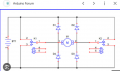
I'm working on a project that needs to have a motor's rotation reversal so that it can run clockwise or counterclockwise depending on an independent control from a microcontroller. I'm achieving the reversal by inverting the Vcc and Ground wires.

The microcontroller part of the circuit is working as expected, but I wanted to know if, in case I include an RC Snubber for circuit protection, I should make any changes to the original design to accommodate the rotation reversal.
 

Reloadron

Joined Jan 15, 2015
7,855
If things are running well and the uC is working fine I would not overly worry about it. However you could always place a 0.1 uF capacitor across the motor.

Ron
 

schmitt trigger

Joined Jul 12, 2010
2,027
Unless you’re using an electrolytic cap, which would be highly unlikely on a snubber, the ceramic capacitors don’t have a polarity.

EDIT; Crut’s suggestion is a good one.
 
Last edited:

MisterBill2

Joined Jan 23, 2018
27,159
Unless you’re using an electrolytic cap, which would be highly unlikely on a snubber, the ceramic capacitors don’t have a polarity.

EDIT; Crut’s suggestion is a good one.
I have seen capacitors across MANY DC motors, and 0.1 is the most common value. So that seems to be because it works. Mostly the capacitors are ceramic disk types.Adding lots of diodes is interesting and certainly a good way to complicate things a lot. and to reduce whatever inductive transients might possibly be generated, you could use a 0.47 MFD disk capacitor instead of a 0.1 device.
 

LowQCab

Joined Nov 6, 2012
5,101
Inductive-Transients may not be the problem ..........
Brushed-Motors are infamous for producing Component-smoking RF-Hash.
A "Common-Mode-Choke", along with small Ceramic-Capacitors placed everywhere, would be good insurance.
.
.
.
 

MisterBill2

Joined Jan 23, 2018
27,159
Form post #1 I see that the reversing scheme is not clearly defined yet. So the noise reduction scheme is also not defined yet.
There are two different arrangements available, the first has two modes aside from "stopped," which are:: "Run CW" and "Run CCW".
The other mode scheme is to have one control for direction: "CW/CCW" and a second control for Run/Stop".
Each mode has benefits and shortcomings, so the selection will not be a trivial effort, it will require being familiar with the specific application.
 

MisterBill2

Joined Jan 23, 2018
27,159
I hope you are not reversing the supply wires TO the microcontroller!
If the motor is powered directly from outputs of the microcontroller, diodes will not work. Normally small DC brush-type motors just have a disc capacitor across the terminals.

More details will allow us to make a lot less generalized suggestions!
 

MaxHeadRoom

Joined Jul 18, 2013
30,557
I'm working on a project that needs to have a motor's rotation reversal so that it can run clockwise or counterclockwise depending on an independent control from a microcontroller. I'm achieving the reversal by inverting the Vcc and Ground wires.
The microcontroller part of the circuit is working as expected, but I wanted to know if, in case I include an RC Snubber for circuit protection, I should make any changes to the original design to accommodate the rotation reversal.
If using a Micro, why do it the cruder way?
It is customary to used a Mosfet H-Bridge type circuit?
What is the function for the motor?
https://tahmidmc.blogspot.com/2013/01/using-high-low-side-driver-ir2110-with.html
 

MisterBill2

Joined Jan 23, 2018
27,159
More important than the motor function is the motor current requirement with the application's loading. It might even be possible to drive the motor directly from the I/O outputs, depending on the current required.
 

MaxHeadRoom

Joined Jul 18, 2013
30,557
Apart from the current/voltage requirement, how would that be done with a simple Micro sink/source, 20ma 3.3v output.
 
Last edited:

MisterBill2

Joined Jan 23, 2018
27,159
We have no clue about the motor size. I am thinking of the cell phone vibrator size motor. If the motor is larger then more driver circuitry would be required.
 
Top