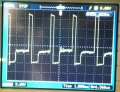
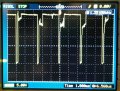
The PWM display should look cleaner, for one, that is if it is generated properly, Normally the DC supply is typically at Least 10% above the motor rated voltage for a PWM controller.
Look for drift or change over time.
Are you sure on the LM324?
Probably two 12 volt backup light bubs in series will make a fair load, and you can observe the change in brightness easily. Then trace the rectified mains voltage from the 167 volts at that filter cap and see where the voltage drop is. That is the input to the switching power supply and so some place there is a big drop.
GOOD LUCK on figuring that 18 pin IC, that has to be a custom programmed device not available to anybody.
If there is an inductor in the switching supply that may be where the problem lies. Although inductors seldom fail.
Now a question: Did this problem just al happen at once? Or did performance deteriorate over some time?
After pulling the label and cleaning, the chip is definitely a 14-pin LM324N. Without magnification I had thought it was scratched out, but it isn't. Chip has 25V on it's power pins. Which is good, because that's what I'm expecting the motor max voltage to be.
I honestly don't remember if the problem happened at once or deteriorated over time. I've had it removed from the mini-mill for at least 5 years because it stopped working altogether. And I finally decided to not have it sitting on the floor. It *used* to work just fine. I *think* performance deteriorated and then finally stopped, but can't say for sure.
I'm not sure which semi you're referring to, but the item at the very top of the image, next to "SIEG" is labeled as U2, has four pins, and marked "V613Y 817C" (optocoupler). The item connected to a heatsink to the right of the transformer is labeled as U1, also has four pins, and marked as "5L0380R" (Fairchild Power Switch).
I soldered up two small 12V auto bulbs for a test lamp and connected it to the motor controller as a load. No light. So I tested it with just one bulb and it worked fine. It even ramped up in brightness like it should. Okay, one of the lamps got fried when I soldered it, I guess. That's fine. But the brightness was actually variable...That's interesting...
So I tried the motor as the load again. And it seems to work just fine! What?! The controller ramps up the speed, there aren't any faults getting triggered, it doesn't cut in and out when below the 1/3 setting. It's as if all the testing somehow fixed it. I really did nothing to the board other than poke around with the multimeter and try the lamp load.
I'm going to take new scope traces to see if the waveform is different.
OK, now it is working as intended. So here is a guess, based on experience, but offered ony as a guess because I have not seen it up close. " There is an intermittent connection someplace" is the guess. It could even have been a metal chip or partice causing a shorted circuit, or a failed connection in a component, or a cracked solder connection. And the "just poking around" fixed it, maybe for just a while, maybe for good. My choice would be to re-solder every connection on the board, which would not take very long at all. That part is cheap and easy, at east for some folks. And if it makes the fix permanent so much the better. But if the fault is a failed connection inside a device that could leave it not working again.
The only TO-220 device is what I mentioned above as U1. And, no, this controller does forward and reverse. A one-way milling machine power feed wouldn't be much use.
Thanks for the help, guys. This was a good, although unsatisfying, conclusion. I hope next time some component fails outright with a burn mark surrounding it.
I'll add this, for anyone reading this thread and wanting to troubleshoot their similar motor controller...
The only signal I could safely probe with the oscilloscope was the output to the motor, since those pins are floating and not referenced to anything. The power supply in this controller is NOT isolated from mains with a transformer. Connecting the scope ground anywhere else in the circuit is likely to create a short and damage the controller or your expensive scope.
I'll add this, for anyone reading this thread and wanting to troubleshoot their similar motor controller...
The only signal I could safely probe with the oscilloscope was the output to the motor, since those pins are floating and not referenced to anything. The power supply in this controller is NOT isolated from mains with a transformer. Connecting the scope ground anywhere else in the circuit is likely to create a short and damage the controller or your expensive scope.
The important diagnostics for this problem can be done with a voltmeter, a scope is not required. The waveform when not operating correctly was similar to when it was working right, and so that part is not the problem. And the switcher power supply was functioning, just not supplying enough voltage. That was also apparently, also affecting the PWM frequency,it appears. So at this point a schematic and a voltmeter are the tools required.
AND, if any scope measurements are needed, a small, adequately voltage rated, capacitor in series with the input probe is what you need.. Just don't connect the scope "ground" to anything. With the scope's high input resistance a 0.005 cap should display what you need to see.
The only TO-220 device is what I mentioned above as U1. And, no, this controller does forward and reverse. A one-way milling machine power feed wouldn't be much use.
I did not see any devices that would be capable of the FWD/REV control?
That is why I alluded to the TO-220 device.
For FWD/REV there is normally 4 switching devices and the LM324 would not be capable of providing the motor current?
I did not see any devices that would be capable of the FWD/REV control?
That is why I alluded to the TO-220 device.
For FWD/REV there is normally 4 switching devices and the LM324 would not be capable of providing the motor current?
I wish I knew. I wish I had a schematic! Now that it's working again I have little incentive to reverse engineer it. Out of curiosity I'll check the LM324 pin voltages in FWD and in REV.
I did not see any devices that would be capable of the FWD/REV control?
That is why I alluded to the TO-220 device.
For FWD/REV there is normally 4 switching devices and the LM324 would not be capable of providing the motor current?
Max, look at the picture of the control panel in post #1. There is a 3 position toggle switch to select direction. In a mill that would never be done automaticly.
Max, ook at the picture of the control panel in post #1. There is a 3 position toggle switch to select direction. In a mill that would never be done automaticly.
I didn't see it right away, but the FWD/REV function is done through the 3P3T switch on the front panel. The control board simply produces the voltage. I had to revisit this as it failed again after reassembling it back in the case.

 Facebook
 Google
 GitHub
 Linkedin