Motor controller troubleshooting

Thread Starter

upand_at_them

Joined May 15, 2010
939
Hi all...hoping you guys can guide me on this...

I have a power feed unit for my mini mill that has stopped working. It throws a fault as soon as I turn it on, but even after clearing the fault it will fault again on turning the speed above zero. At low speeds the motor will come on briefly before the fault is triggered. I do have test equipment, but I'm not sure where to begin. The motor appears to fun fine (I think?) when run from a separate power supply, but it does give off a burning smell. I checked for continuity across the motor leads and I get around 5 ohms, and tried every rotational position of the armature.

I'd like to check out the control board as well - perhaps on my Rigol scope - but given that the motor can be driven forward and reverse I wasn't sure what to do with the probe ground lead and didn't want to risk damaging anything.

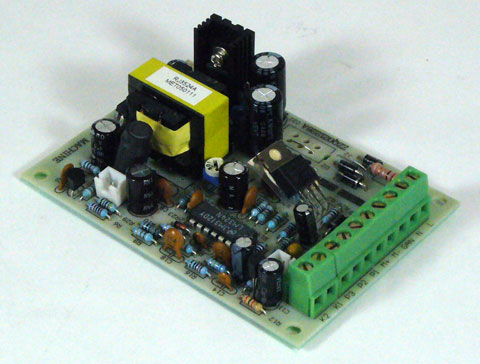
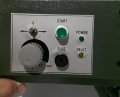
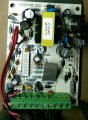
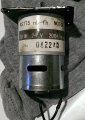
I would appreciate some guidance on further testing. Attached is a picture of the motor and a stock photo of the control board (haven't pulled the board yet as I'll have to unglue several items from the face panel first.

Regards,
Mike
IMAG1399.jpg

IMAG1401.jpg
 

MaxHeadRoom

Joined Jul 18, 2013
30,654
That is quite a small motor, but 5ohms does not really tell anything, but sounds about normal.
Check from an external supply such as a automotive battery, and run it for a spell off load and see if it overheats or other symptoms.
Are the brushes OK?
 

Thread Starter

upand_at_them

Joined May 15, 2010
939
Motor is: 2 1/2" long, 1 3/4" wide. Brushes look okay, just looking through the openings in the side of the case. Pulling the motor apart requires uncrimping four tabs...which may not be straightforwardly simple since the back bearing protudes in the way of me using a punch on the tabs.

What is run it for "a spell"? I've run it for about two minutes. Smells, no smoke though. The smell may not, however, be much more than the non-powered smell. Arcing at the brushes, which I assume is normal. The motor does vibrate more than I thought it should.
 

Thread Starter

upand_at_them

Joined May 15, 2010
939
I tested the motor some more, using an external power supply. Speed ramps up fine from 5V to 24V. I ran it for 5 minutes without the gearbox attached and 10 minutes with the gearbox attached and the motor didn't heat up at all.

I reconnected the motor to the control board and it didn't throw a fault this time (which is odd), but it acted flaky. At low settings the motor would cut off and on, verified with a multimeter as an issue with the control board (not steady power out). At high settings the motor ran smoothly, but at low speed. In fact, the entire setting range didn't alter the motor speed much at all. Motor is 24V, but the control board output never got above 11V.
 

MisterBill2

Joined Jan 23, 2018
27,501
For a diagnostic check on the motor, use your meter to read the resistance between the motor leads and the motor housing, no disassembly needed. It should read open circuit. If there is any reading below 10,000 ohms then there may be some damage.
The motor tag says 24 volts and ten watts, which implies a bit less than half an amp at rated output.
If the motor gets hot running from the controller then there is probably excessive voltage to the motor. Use your meter to check that voltage. It may be more than 24 volts.
The tag states 200RPM, so it must be a gear motor, possibly the gears are now binding.That can happen.
 
Last edited:

Thread Starter

upand_at_them

Joined May 15, 2010
939
Hi Bill,

Between each lead and the motor housing is indeed open circuit. With the motor running from a power supply, current limited to 1A, it was only running about 250mA. But it seemed strong. Running from the controller it appeared very weak.

Running from the controller there is no heat and no excessive voltage, as the controller never put out more than about 11V. Gearbox is fine, no binding.

I think I should now move to troubleshooting the controller.
 

Thread Starter

upand_at_them

Joined May 15, 2010
939
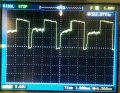
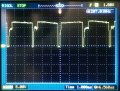
Here's two scope shots. First at about 1/3 speed setting. Second at about 3/4. Hardly any noticeable change in actual motor speed though. And notice that the peak voltage drops.

At 100% setting the scope trace does show 100% duty cycle, but only at about 11.8V. So, yeah, something is wrong. Does ~300Hz for the PWM rate seem too low?

1/3 control setting:
IMAG1402.jpg

3/4 control setting:
IMAG1403.jpg
 

MaxHeadRoom

Joined Jul 18, 2013
30,654
Usually heat indicates high current, voltage does not usually do it unless really excessively high.
Sound like you may have an issue with the controller?
300Hz is unusually low for PWM, generally the PWM freq. would start at about 5Khz-6Khz for most drives, with some going up to 20Khz.
 

MisterBill2

Joined Jan 23, 2018
27,501
The PWM function seems to be OK, but as the voltage seems to be a bit less than half of what is expected, it may be a power supply issue. So my suggestion is to verify first that the supply input is set for the correct mains voltage. If there was a burning smell than something is not right. It could be a failed rectifier diode or a leaking filter capacitor. It may even be a failed connection in the mains voltage selection part of the circuit.
Looking at the picture of the representative circuit board it should not be difficult to find the power supply part of the system. And probably the overheating component is not the failed part. Usually that is the case.
And the PWM frequency may be OK. The higher frequency is usually selected to avoid producing any audible switching frequency sound from the motor, because many would complain about it. The lower frequency is less demanding of switching speed.
 

Thread Starter

upand_at_them

Joined May 15, 2010
939
Managed to pull the control board out of the enclosure. Verified the power. No mains selection. It appears to be 110V only.
- Line and Neutral (no ground) come in to the board
- voltage verified as 120V AC at the terminal block
- Line passes through a [current limiting?] resistor (brown, black, silver, gold, white)
- Line and Neutral go though bridge rectifying diodes
- voltage after the diodes is a steady 167V DC
- nothing appears burnt or damaged on the component or solder side of the board
- no smell or smoke
- haven't checked for hot components (have IR temp gun), but I was not indicating any heat issue above
- rechecked with motor attached (to be sure), and problem still exists
 

MaxHeadRoom

Joined Jul 18, 2013
30,654
Seems odd that the mains would go to a bridge? There appears to be a small transformer on board for the P.S.
Do you have a model/make of the board?
 

Thread Starter

upand_at_them

Joined May 15, 2010
939
Seems odd that the mains would go to a bridge? There appears to be a small transformer on board for the P.S.
I thought it was odd too, but the mains go directly to the bridge diodes. I'm guessing the transformer is for the PWM? Haven't tested that far yet.

Do you have a model/make of the board?
Board is:
SIEG MACHINE
ZZQ021226A

actual board:
IMAG1405.jpg
 

MisterBill2

Joined Jan 23, 2018
27,501
I think that I see 5 volts per division for the scope trace photos, how do you measure 11.8 volts? AND, because I see no serious droop of the voltage on the PWM wave form, I would guess the supply is OK. Unless, of course, that is a no-load signal that we are seeing. Please let us know about that.
In post #1 you do mention a burning smell, so something must have been hot.
That could be in the power switching section, which is in the deep shadow part of the photo.
And what is that black object between R4 and D6?
Also, the top of C1 looks very slightly bulged. et us know iif that is just an illusion, or is it really bulged a bit.
 

Thread Starter

upand_at_them

Joined May 15, 2010
939
I think that I see 5 volts per division for the scope trace photos, how do you measure 11.8 volts?
The ~11.8V was at the full pot setting (100% duty).

because I see no serious droop of the voltage on the PWM wave form, I would guess the supply is OK. Unless, of course, that is a no-load signal that we are seeing. Please let us know about that.
Scope traces were with the motor connected and show about 15V peak at the 1/3 pot setting (low) and about 12.5V peak at the 3/4 pot setting (high). That seems significant to me. Peak voltage continues to drop and gets to about 11.8V at the full setting (100% duty). This would explain why the motor doesn't appear to increase in speed at all from 1/3 all the way to max setting.

In post #1 you do mention a burning smell, so something must have been hot.
From the motor. And it has that smell whether running or not. I'm discounting this as an issue.

And what is that black object between R4 and D6?
Inductor L1. Probably for the PWM oscillator?

Also, the top of C1 looks very slightly bulged. Let us know iif that is just an illusion, or is it really bulged a bit.
It's just an illusion. All caps are perfectly flat, without any hint of bulging.
 

MisterBill2

Joined Jan 23, 2018
27,501
OK, so now we know. At this point it looks like the driver system has developed a resistance in the motor current path. No matter what, it makes sense to monitor the drive supply voltage to see if that drops as the load increases.
 

MaxHeadRoom

Joined Jul 18, 2013
30,654
I would run the motor from another source for an extended period and see if anything transpires.
If it proves OK , there is quite the selection of DC PWM controllers on Ebay for very cheap $$$.
Most running around $10.00 , they generally do need a DC supply however. which is not very demanding for that power of motor.
They have the reversing option and PWM freq. typically 15Khz.
 

Thread Starter

upand_at_them

Joined May 15, 2010
939
Yeah, that's an option. I can buy the exact same controller board from the original vendor of the power feed unit for $120 and be assured it fits the enclosure. Funds are tight right now and I was hoping to find the culprit in this one since...it's gotta be SOMETHING. There's a finite number of components on this board. :)
 

Thread Starter

upand_at_them

Joined May 15, 2010
939
I can still test that chip, I think. From the "stock" photo it appears to be a LM324N quad op-amp. My board has a label over a scratched-out chip.
 
Top