Most Effective Way to Use Generator Output

Alec_t

Joined Sep 17, 2013
15,125
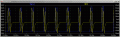
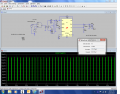
the voltage across the capacitor remaining constant during the generator output interval
Exactly what you'd expect for a low-impedance battery being charged very slowly.
I guess this waveform would seem only reasonable with the battery having a zero series resistance
The waveform is virtually the same for any reasonable battery resistance, e.g. 1 Ohm.
rather strange glitches
They're only a few pA in your screenshot! Probably a simulation artifact. However, I'm puzzled as to how you ran that sim; when I run it, the I(C1) current is peaking at around 24mA, not pA, at the 19-19.5 sec interval in the sim :confused:.
DynoWaveform.gif
 

Thread Starter

madsi

Joined Feb 13, 2015
107
I can't begin to explain the math. I think it is pretty complicated due to the sine wave and the time constant of the capacitor, the switch time of the chip, etc., but I did simulate it. Alas I didn't save often enough and it is very slow to run. But here is what I think the basic problem is:
It takes a few cycles to charge up the cap to the turn on voltage of the IC, but this only happens when you first start so it is not a big loss.
Once the voltage reaches the turn on the chip quickly tries to rise to 4.2 volts, but above the battery voltage the battery looks like almost a short - maybe 1/2 ohm, so it discharges the cap very quickly. This pulse does charge the battery but only for a short time until the capacitor voltage falls below the turn off voltage of the chip. Once the chip turns off the capacitor must be recharged, but now it looks like a short to the generator so the loss in the generator is high and it is slow to charge. This is what makes it inefficient.
Without the cap as soon as the voltage rises above the turn on point the chip turns on and a very short pulse of current is delivered to the battery and the input quickly falls due to the 150 ohms in the generator. But as soon as the chip turns off the voltage instantly rises to the next level of the sine wave and charges the battery again. This is the motor boating we talked about earlier. Both do it, but the one with the cap wastes the energy lost in the 150 ohms of the motor during both charge and discharge.
Thanks a Zillion ronv, I may be a simpleton, but the math doesn't seem to me to be that complex!

Are we talking about the same chip MCP1624? Once the voltage rises to >.67 volts the chip turns on, before that startup voltage the IC appears as a virtual open-circuit.

Once turned on the chip presents the RdsOn of the chip MOSFET to the capacitor(< .6ohm) and current increases in the inductor(4.7 uH) in a few uSec to reach the current limit of approx 50mA( at the startup Vin.)
The chip then turns off and the chip output voltage attempts to rise to deliver the output set voltage of 4.18V, but would not succeed unless the battery was already fully charged. In any case the inductor (.3-ohm DCR) would dump almost all the energy stored in the inductor to the battery giving it a small packet of charge energy.
Because the 4500uf has only been partially discharged by the short turn on time of the chip's MOSFET, the voltage across of the 4500uf drops slightly.
This process continues at 2-uSec rep. rates(500KHz) until the 4500uf input cap is discharged to approx. <.3V and the chip turns off and the voltage across the capacitor slowly begins to charge again with a time constant of T= R(150 ohms) *C(4500uf), guess taking maybe about may take multiples of T to reach .67V turn on, and this actually takes approx. >12T (because of a 25% duty cycle and 10mph bike speed=8 pps with about 16 mSec pulse on time for each 125mSec period of the generator output)
 
Last edited:

Thread Starter

madsi

Joined Feb 13, 2015
107
Exactly what you'd expect for a low-impedance battery being charged very slowly.
The waveform is virtually the same for any reasonable battery resistance, e.g. 1 Ohm.
They're only a few pA in your screenshot! Probably a simulation artifact. However, I'm puzzled as to how you ran that sim; when I run it, the I(C1) current is peaking at around 24mA, not pA, at the 19-19.5 sec interval in the sim :confused:.
View attachment 81086
Thanks again, the simulation made me realize how the capacitor serves no useful purpose without a boost converter with a very low internal resistance battery if Vout of the generator (open circuit) is just a little greater than Vbat.

I donno, using the same LTSPICE ver 4.22w, that's what I get when I click the mouse on the 4500uf??? I choose the interval of the displayed simulation to see whats going on at a 10mph output. I admit I am a noob with LTCSPICE and I really want to learn how to use it. I don't know how to create the excellent simulation you've created, will take me some time to become an expert user like you.

But it proves your point, the capacitor doesn't have any effect once charged to approx Vbat Li-ion.
However, charging the 4500 cap to >Vbat just wastes some energy because of the 150/1 load mismatch and its time constant to recharge the capacitor to Vin>Vbat with additional losses due to the schottky bridge each generator pulse.

Now, that being said..what about with a MCP1624 boost converter added to this 150-ohm 4500uf circus?
 
Last edited:

Thread Starter

madsi

Joined Feb 13, 2015
107
The results of the analysis so far leads me to take a guess..how can any type of boost converter be more efficient than without?
Without the battery and capacitor and any boost chip, almost all the mismatched generator output power is delivered to the battery.

A boost chip can only serve to do better at low bike speeds where the open circuit voltage of the generator was less than the Vbat..in other words when there might be so little of energy offered by the generator to charge the battery that this area of operation should be ignored.

As I get it, the instantaneous power induced and stored in the generator coil is = I*E and if the generator is unloaded, any other than snail speeds should quickly kick the voltage output to >Vbat.

In other words, if the power to charge the battery was being supplied by a solar cell array, the boost chip would be an excellent harvester of energy, but I am just getting to realize how an incompetent generator works in the same scheme.

Maybe I finally understand what is really going on?
 
Last edited:

Thread Starter

madsi

Joined Feb 13, 2015
107
Someone has suggested using a buck converter rather than a boost, to charge the battery. The problem I see with this approach is to hold off the buck converter until Vin reaches >>Vbat and charging a large 4500uf storage capacitor would take quite a long time with mismatch and bridge losses in each pulse interval adding up. Holding off some boost converters is not that difficult, most have UV protection.

A typical buck converter would need >8V to start operation but would operate until Vin drops below a much lower voltage. These chips are made to control an external MOSFET for HV SMPS circuits..but there are other species of these chips.

If theory says that the IE product of the generator voltage output rises quickly to match the storage cap voltage, what if there is some efficiency really gained by this approach?
It seems to me that so much time is spent charging the cap, nothing is gained by this approach.
 
Last edited:

wayneh

Joined Sep 9, 2010
18,126
[responding to #164] Sounds right to me, except that the generator must overcome the rectifier drop and the battery emf in order for any charging to take place. Without the booster, the question is how often this will happen. The booster after the rectifier helps with overcoming the battery emf, at the expense of some efficiency. But as I noted before, most of the energy you will ever produce comes at high speed riding when the booster is just in the way.

You could overcome the rectifier drop using a transformer, which you ruled out, or by using an active rectifier.
 
Last edited:

Thread Starter

madsi

Joined Feb 13, 2015
107
I checked the waveform acr
Thanks again, the simulation made me realize how the capacitor serves no useful purpose without a boost converter with a very low internal resistance battery if Vout of the generator (open circuit) is just a little greater than Vbat.

I donno, using the same LTSPICE ver 4.22w, that's what I get when I click the mouse on the 4500uf??? I choose the interval of the displayed simulation to see whats going on at a 10mph output. I admit I am a noob with LTCSPICE and I really want to learn how to use it. I don't know how to create the excellent simulation you've created, will take me some time to become an expert user like you.

But it proves your point, the capacitor doesn't have any effect once charged to approx Vbat Li-ion.
However, charging the 4500 cap to >Vbat just wastes some energy because of the 150/1 load mismatch and its time constant to recharge the capacitor to Vin>Vbat with additional losses due to the schottky bridge each generator pulse.

Now, that being said..what about with a MCP1624 boost converter added to this 150-ohm 4500uf circus?
Exactly what you'd expect for a low-impedance battery being charged very slowly.
The waveform is virtually the same for any reasonable battery resistance, e.g. 1 Ohm.
They're only a few pA in your screenshot! Probably a simulation artifact. However, I'm puzzled as to how you ran that sim; when I run it, the I(C1) current is peaking at around 24mA, not pA, at the 19-19.5 sec interval in the sim :confused:.
View attachment 81086
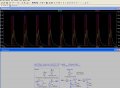
I checked again using LTSPICE at s=19 to s=19.5 and also s=19 to s=19.7 same crazy glitchy waveform clicking on C1, ok current readings on bat1.

What's worse if I increase battery series resistance Rser=1.5ohm the C1 current waveform stays the same and I know this cannot be right!! This is the only change made in your simulation.

Update: clicked on simulation and "Run" again and the current waveform looks quite different on C1 versus without it. Perhaps integrating the area under the curve dt yields the same area=power delivered to the battery.

For those without LTSPICE, Red = current into bat w/o cap.
Grn = current into bat with 4500 cap.
Blu = Vgen with 150 ohm source res.


Isn't the 4500 cap doing just that..integrating the current into the battery?
 

Attachments

Last edited:

Thread Starter

madsi

Joined Feb 13, 2015
107
How do I see the total energy delivered to the battery over the interval in the simulation in both with and without the 4500 capacitor?
 

t_n_k

Joined Mar 6, 2009
5,455
I was thinking about an analytical approach of some kind. How complex might this turn out to be?

There are obviously many options. Some may be difficult to quantify - others may not. So I'll look for a simple case to start with which may lead to a more general analysis - about which I'm not sure at this stage.
As a first step I set some constraints and make some simplifications. If they seem inconsistent with the problem at hand I offer them solely as the means to a "solution".
I propose the following:
Generator + Capacitor + Converter + Battery.
I set the following constraints:
The rectified generator output is a simple rectangular pulse of amplitude E at period T with Duty D.
The Converter is ideal and is so configured in design to maintain its input current at a constant pure DC value when its input voltage is greater than or equal to a value Vmin. The input current is chosen by design to ensure that at maximum generator output [at a 'practical' maximum bicycle speed], the maximum available charge can be delivered to the battery.
I now consider the analysis at maximum generator output.
There are two phases to consider.
1. The discharging phase.
Capacitor C discharges from a maximum value of Vmax down to Vmin over a time interval (1-D)*T
Hence the Converter constant input current will be given by
\(I_{in}=\frac{C\(V_{max}-V_{min} \)}{\(1-DT\)}\)

2. The charging phase.
This can be derived as
\(V_c(t)=\( E-RI_{in}\) ( 1-e^{-\frac{t}{RC}} )+V_{min}e^{-\frac{t}{RC}}\)

Vc reaches a maximum Vmax at time t=DT.

Hence
\(V_{max}=\( E-RI_{in}\) ( 1-e^{-\frac{DT}{RC}} )+V_{min}e^{-\frac{DT}{RC}}\)

Eliminating Vmax from the two equations leads to the proposed constant Converter input current Iin

\(I_{in}=\frac{(E-Vmin)(1-e^{-\frac{DT}{RC}})}{R[\frac{(1-D)T}{RC}+(1-e^{-\frac{DT}{RC}})]}\)

Knowing Iin will lead to the value Vmax. Presumably one could, knowing the voltage current profile then come up with the power flow - not sure at this stage if it is possible to provide a complete analytical solution.

In any event the next analysis case might be for a lower than maximum generator output where the capacitor voltage reaches Vmin before the generator output pulse cycle repeats.

One might also be able to come up with an analysis in which the Converter input conditions are based on a constant battery power control strategy.

Is there any value in all this? I don't know, but it confirms an analytical approach isn't trivial, even for cases which are more ammenable to such an approach.
 

Alec_t

Joined Sep 17, 2013
15,125
How do I see the total energy delivered to the battery over the interval in the simulation in both with and without the 4500 capacitor?
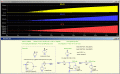
You can use the .MEAS command. Here's the dynamo.asc sim which shows the currents I(Bat1), I(Bat2) and I(C1) when Rser is set as 1.5 Ohms for Bat1 and Bat2.
DynoWave2.gif
Note the added .meas commands to measure (in this case) the integrated charge current over the 50 sec period. Use View/Spice error log to see the results.
I'm still not seeing the glitches you are ????.

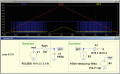
And here's another sim for you to play with; a simplified model of the converter, which outputs a constant 4.2V and draws a constant 50mA provided its input voltage is initially above 0.7V and doesn't drop below 0.3V.
ConverterSim.gif
 

Attachments

Last edited:

ronv

Joined Nov 12, 2008
3,770
I was thinking about an analytical approach of some kind. How complex might this turn out to be?

There are obviously many options. Some may be difficult to quantify - others may not. So I'll look for a simple case to start with which may lead to a more general analysis - about which I'm not sure at this stage.
As a first step I set some constraints and make some simplifications. If they seem inconsistent with the problem at hand I offer them solely as the means to a "solution".
I propose the following:
Generator + Capacitor + Converter + Battery.
I set the following constraints:
The rectified generator output is a simple rectangular pulse of amplitude E at period T with Duty D.
The Converter is ideal and is so configured in design to maintain its input current at a constant pure DC value when its input voltage is greater than or equal to a value Vmin. The input current is chosen by design to ensure that at maximum generator output [at a 'practical' maximum bicycle speed], the maximum available charge can be delivered to the battery.
I now consider the analysis at maximum generator output.
There are two phases to consider.
1. The discharging phase.
Capacitor C discharges from a maximum value of Vmax down to Vmin over a time interval (1-D)*T
Hence the Converter constant input current will be given by
\(I_{in}=\frac{C\(V_{max}-V_{min} \)}{\(1-DT\)}\)

2. The charging phase.
This can be derived as
\(V_c(t)=\( E-RI_{in}\) ( 1-e^{-\frac{t}{RC}} )+V_{min}e^{-\frac{t}{RC}}\)

Vc reaches a maximum Vmax at time t=DT.

Hence
\(V_{max}=\( E-RI_{in}\) ( 1-e^{-\frac{DT}{RC}} )+V_{min}e^{-\frac{DT}{RC}}\)

Eliminating Vmax from the two equations leads to the proposed constant Converter input current Iin

\(I_{in}=\frac{(E-Vmin)(1-e^{-\frac{DT}{RC}})}{R[\frac{(1-D)T}{RC}+(1-e^{-\frac{DT}{RC}})]}\)

Knowing Iin will lead to the value Vmax. Presumably one could, knowing the voltage current profile then come up with the power flow - not sure at this stage if it is possible to provide a complete analytical solution.

In any event the next analysis case might be for a lower than maximum generator output where the capacitor voltage reaches Vmin before the generator output pulse cycle repeats.

One might also be able to come up with an analysis in which the Converter input conditions are based on a constant battery power control strategy.

Is there any value in all this? I don't know, but it confirms an analytical approach isn't trivial, even for cases which are more ammenable to such an approach.
Wow, ask me if I'm impressed. :eek:
I like your concept of getting maximum power from the generator. Theow in a couple of derivatives and your home free. :D
 
Last edited:

wayneh

Joined Sep 9, 2010
18,126
The rectified generator output is a simple rectangular pulse of amplitude E at period T with Duty D....
That's a nice simplifying assumption, but not even close to reality. Worse, each magnet that passes will give a different pulse due to alignment and air gap issues. We're 171 posts in and still have no idea how the coil behaves, things like its core saturation, coil inductance and so on.

It gets worse when you consider that any converter will behave differently than the data sheet, when it is operated consistently at the edge of the operating range.

I'd love to take an analytical approach, or even a simulator approach, but empirical data is the thing we need.
 

ronv

Joined Nov 12, 2008
3,770
Ahh, the goldilocks IC.

This one is very similar to yours except it has maximum power point like many have suggested:
http://cds.linear.com/docs/en/datasheet/3105fa.pdf
Lucky too it has a spice model.
A bit about the simulation.
I delayed the start to get past the initial charge of the big cap so we could compare without that. You can change that by edit spice analysis and setting the time to start saving data to a shorter time period. This will show the time where there is no charge to the battery as the cap charges.
I set the MMPT resistor to a compromise between the big cap and the little one. This can be tuned to get optimum results - see data sheet.
When using the big cap you need to add some resistance in series with the cap otherwise the chip goes into current limit trying to discharge the cap into the battery. I used 1 ohm for this.
I used 15 Ufd for the small one and 1500 Ufd. for the big one.
Both then deliver about the same amount to the battery.
To disable MMPT you can make that resistor .1 ohms or take it out. This will let you see the difference.
To see the power over time hold down ALT and click the little thermometer over the part you want to measure. To see the average over the time period then hold down CTRL and click on the label at the top of the waveform screen.
 

Attachments

Thread Starter

madsi

Joined Feb 13, 2015
107
I just had a chance today to read the new replies, thanks to everyone who has contributed.
I will have time later to think more carefully about this new info, but right now,

Here's what amazes me:

Suppose NASA was going to send a bot to Mars and of course, they were worried about ExplorerBot, how could they compute how long the batteries would last in this environment, with so many possibilities of how far it could get wondering around on the Red Planet.
Could you imagine NASA engineers saying, "We can't figure this out, we need more data!" And then the project leaders saying, "We can't give you data, we don't know exactly the what, when, where or how long we going to do anything there until we get there!"

wayneh says, "I'd love to take an analytical approach, or even a simulator approach, but empirical data is the thing we need.

In this case, unlike the greater complexities of NASA Mars Program's team had to face, all one needs to get empirical data to model this generator problem is to get your hands on a small motor to twirl magnets across the face of a an example of the actual generator in question, and it is no more than a cheap axle-mounted LED flasher that can be found in almost any country's Walmart or equiv.

I got my motor free from a discarded toy truck, superduper magnets from a discarded 8GB harddrive head positioner, I got my flasher AKA generator free from a discarded bike.

PS: ok, I had to pay $.60 ea for a few MCP1624 to play with, the rest of the parts were salvaged.
 
Last edited:

Thread Starter

madsi

Joined Feb 13, 2015
107
The quite expensive LT3105 does have a lot of info, but the data sheet talks about non-pulsative power sources, like how to harvest power from thermocouples or solar cells or even Peltier generators, didn't even consider the two nails in a lemon possibility.
 

ronv

Joined Nov 12, 2008
3,770
But all of those have their ups and downs, just a matter of how fast. :)
You threw away a couple of buck already. How's that working by the way?
A spec like above would get you thrown out of the project managers office. :mad:
For a troll your pretty funny. :D

PS. How did T_N_K's math look to you?
 

t_n_k

Joined Mar 6, 2009
5,455
All the best engineering on the planet can let you down and you are soon in a cold dark place flyng by the seat of your pants. Apollo 13 ... etc.
 

t_n_k

Joined Mar 6, 2009
5,455
@wayneh
I fully agree that my approach is a gross oversimplification. Madsi appears to assert in post #162 that the math can't be all that complex.
It seems to me that that math will become quite challenging as one tries to make a realistic analysis.
 

wayneh

Joined Sep 9, 2010
18,126
Oh my yes. I once needed to model a "simple" bridge rectifier, so that I could infer things about the AC signal based on what I could observe on the DC side. Anyway, it was anything but simple. The diodes show a different drop depending on current and temperature, which are related to each other as well.

Basically, any real-world device can be very difficult to model beyond the gross properties.

That's why, if you want to put a man on the moon, you engineer out the unknowns to the point that they are contained within a manageable envelope. You hope there are no unknowns that are ... unknown to you. I recall hearing the gas seals on the Apollo spacecraft were designed for a 100-year leak rate, i.e. no appreciable leakage in a century. That meant they didn't have to worry about a leak budget. On and on with a thousand other challenges.
 

Thread Starter

madsi

Joined Feb 13, 2015
107
I've made every effort to contact and ask the mfg. of the axle safety flasher if they could send me a SPICE model of the generator within, but so far, no reply! Is it because of my Chinese writing to them is from Translate.Google.com?

Is it because I forget to wish them a Happy New Year?
 
Top