Most Effective Way to Use Generator Output

Thread Starter

madsi

Joined Feb 13, 2015
107
We do a puzzle to get excited on how to solve it. I will never be happy celebrating my ignorance.
I still get excited when I talk to someone over the phone thousands of miles away, if as we were together in the same room, it is now so ordinary.
So even now, while my battery is slowly running down I still refuse to be satisfied to just watch the flashing of my bike light and not fully understand exactly how it works, I wake up each morning to find someways to understand more, to figure out the why and how. I can further my enlightenment.
 
Last edited:

Thread Starter

madsi

Joined Feb 13, 2015
107
A boost converter in my scenario is working exactly like a joule thief..but the engineering analysis of why it should be better in any instantiation of posible variants of it or other circuits has not yet been proven.
 

ian field

Joined Oct 27, 2012
6,536
No, just tells me a constant current boost converter may not be the best idea.
You've just ignored the point I was making!

A boost converter will draw more current from the generator and suppress its voltage output.

Chances are, the generator at least approximates to a current limited source.

Using a step-down converter lowers the current draw and, hopefully allows the voltage to flourish.

You just might get a little more power out of the generator that way - its not much, but its not nothing.
 

wayneh

Joined Sep 9, 2010
18,126
You just might get a little more power out of the generator that way - its not much, but its not nothing.
The effect is large, even if the total power we're talking about is not much.

I built an alternator to generate power from a rotating disc with magnets in it. The power I could get from this device depended entirely on the load placed on it. I used a bank of resistors to map it out. At high resistance, the voltage was barely drawn down but there was so little current that little power was made. At a short, there was a big load on the spinning disc and a lot of current produced, but no voltage and thus no (useful) power.

The optimum of course was in between. I needed a load of 10-100Ω or so in order to get anywhere near peak power into that load.

It took me a while to realize the impact of the inductance of my coil, and the resulting effect of rpm on impedance. As the disc rpm increased, the frequency of the pulses went up and more power was available because the magnets were moving faster. You might think this would allow you to power a heavier load, but instead the load resistance had to be increased to get to peak power, to match the frequency-increased impedance of the coil.
 

ian field

Joined Oct 27, 2012
6,536
The effect is large, even if the total power we're talking about is not much.

I built an alternator to generate power from a rotating disc with magnets in it. The power I could get from this device depended entirely on the load placed on it. I used a bank of resistors to map it out. At high resistance, the voltage was barely drawn down but there was so little current that little power was made. At a short, there was a big load on the spinning disc and a lot of current produced, but no voltage and thus no (useful) power.

The optimum of course was in between. I needed a load of 10-100Ω or so in order to get anywhere near peak power into that load.

It took me a while to realize the impact of the inductance of my coil, and the resulting effect of rpm on impedance. As the disc rpm increased, the frequency of the pulses went up and more power was available because the magnets were moving faster. You might think this would allow you to power a heavier load, but instead the load resistance had to be increased to get to peak power, to match the frequency-increased impedance of the coil.
Apparently bicycle dynamos are a bit of a precarious balancing act.

As you say, the inductance is a big deal - it (supposedly) stops the bulbs blowing when you go down a hill too fast.

The precarious bit is the PTC characteristic of a bulb filament makes it tend toward being a constant current load, while the generator is actually a PM alternator - which is also more or less constant current.
 

Thread Starter

madsi

Joined Feb 13, 2015
107
The effect is large, even if the total power we're talking about is not much.

I built an alternator to generate power from a rotating disc with magnets in it. The power I could get from this device depended entirely on the load placed on it. I used a bank of resistors to map it out. At high resistance, the voltage was barely drawn down but there was so little current that little power was made. At a short, there was a big load on the spinning disc and a lot of current produced, but no voltage and thus no (useful) power.

The optimum of course was in between. I needed a load of 10-100Ω or so in order to get anywhere near peak power into that load.

It took me a while to realize the impact of the inductance of my coil, and the resulting effect of rpm on impedance. As the disc rpm increased, the frequency of the pulses went up and more power was available because the magnets were moving faster. You might think this would allow you to power a heavier load, but instead the load resistance had to be increased to get to peak power, to match the frequency-increased impedance of the coil.
This is what Nicola T. said to me on one occasion:

If "more power was available because the magnets were moving faster.." then there is more power to be delivered to the load even at a constant load.

The power delivered to the load by any generator or voltage source depends on the value of the load placed upon it.

The internal impedance shouldn't change much with speed over the working ranges of speeds of a generator. If it did the alternator in your car wouldn't work except at idling speed, even the old bottle generators on bikes wouldn't work except at one speed. There is something else going on with your generator. In fact what happens with car alternators and bottle generators is that their output increases rather linearly with speed.

It could be that the magnetic field of your generator was not reaching deep into the length of the coils of your generator, but flux was only affecting the first portion of the coil. In this case the remainder of the coil not affected by the flux acted like a series connected inductive impedance instead of a generator winding. With the faster rise times and frequency of the voltage that occurs with increased speed the constant inductance presented by the non-flux affected portion of your generator coils were acting like an inductor and its impedance was preventing an increase of output current with speed.

For a generator to work properly the magnet field of the rotating magnet should permeate all of the coil. Ihe pickup coil of my bicycle is wound on the middle of the E on laminated steel and the back end of the laminations are connected to a u-shaped piece of iron that forms the E shape and so all of the coil length is tightly coupled magnetically to the rotating magnets.
 
Last edited:

Thread Starter

madsi

Joined Feb 13, 2015
107
Apparently bicycle dynamos are a bit of a precarious balancing act.

As you say, the inductance is a big deal - it (supposedly) stops the bulbs blowing when you go down a hill too fast.

The precarious bit is the PTC characteristic of a bulb filament makes it tend toward being a constant current load, while the generator is actually a PM alternator - which is also more or less constant current.
An incandescent lamp doesn't behave like a constant current load, just the opposite..it does tend to behave more like a resistance that increases proportionally to the voltage across it in a non-linear way, so it behaves somewhat like a constant power load.
 
Last edited:

wayneh

Joined Sep 9, 2010
18,126
There is something else going on with your generator.
No, not really. My coil had an inductance of something like 50mH and a DC resistance of ~1Ω (I don't recall the exact details). At 10Hz, the impedance is R+ƒ•L = 1+10•0.05=1.5Ω and that climbs to R+ƒ•L = 1+100•0.05=6Ω at 100rpm. Six is more than 1.5.
 

ian field

Joined Oct 27, 2012
6,536
An incandescent lamp doesn't behave like a constant current load, just the opposit..it does tend to behave more like a resistance that increases proportionally to the voltage across it in a non-linear way, so it behaves somewhat like a constant power load.
OK then - we'll just pretend that bulb filaments don't have a PTC characteristic.
 

Thread Starter

madsi

Joined Feb 13, 2015
107
Today I breadboarded a LM27313 boost converter and hooked it up to my "bike generator simulator" (That's simulator not STIMULATOR")and found that it is not suitable at all because it will lock up(will not start to switch) when Vin reaches 2.7V when fed with the low-current output and 150-ohm source resistance of my generator.

However, it works ok as a boost from the battery voltage (2.7-4.2V) to get +5V for the MCU, it's output is very clean, but it has a 2mA current use when switching and drains the battery 10x as much in microamps when shut down(45uA) due to a recommended 92uA of current required for the voltage setting/voltage divider resistors. Due the idiosyncrasies of the chip, it will lock up if I try to increase the voltage setting resistors, possibly due to the 60nA bias current of the FB pin. I can use > 1 meg voltage(total divider resistance) setting resistors with the MCP1624.
So, the LM27313 is no good for the harvesting front end of my bike energy harvesting scheme, so I've eliminated this scenario.
 
Last edited:

Thread Starter

madsi

Joined Feb 13, 2015
107
I also discovered, that even with 4500uf of capacitance loading the generator output, that in just attempting measuring the Vin resistance of the MCP1624 harvesting circuit with my fluke voltmeter that uses <1mA on the 2000 -ohm FS range, that the MCP1624 will pulse a continuous train of packets of charge into the Li-Ion battery. That' seems impressive..bit is it the most efficient scenario? The circuit is operating and stable at Vin around .37V., just like the spec sheet says it would.

Once thing now fascinates me. When I view the stock of MCP1624 devices at Farnell, they only have at most a stock of <200 of any of the MCP1623/1624 variants, but they show >12000 in-stock for some of the MCP1640 variants..does this tell me something about which chip is better?

The MCP1640 and MCP1642 are remarkable similar when comparing spec sheets
 
Last edited:

ian field

Joined Oct 27, 2012
6,536
A positive temperature coefficient device does not in any way make a constant current source.
IF you even bothered to read what I said - I used the term "tending toward".

While current does increase with an increase in voltage - it goes some way short of being in proportion to it.
 

ronv

Joined Nov 12, 2008
3,770
If you want to prove it to yourself, you can put a small white LED ( ~3.5v Vf) across the output of the booster in place of the battery. Then try it with and without the big capacitor. I think you will be able to see the difference in power as it is about 2 to 1.
 

Thread Starter

madsi

Joined Feb 13, 2015
107
If you want to prove it to yourself, you can put a small white LED ( ~3.5v Vf) across the output of the booster in place of the battery. Then try it with and without the big capacitor. I think you will be able to see the difference in power as it is about 2 to 1.
Thanks again for your input..I only wish you could explain to me in greater detail why this is so. You again offer a "fix" that gives no math proof or circuit simulation data values to justify your results.

I am seeking to understand well exactly what I am trying to do from an engineering standpoint and I have always had an interest in power supplies, and right now I am fascinated in low power circuits, and I am fascinated and interesteds in solving problems in harvesting energy.

If I just needed to get my bike light to function well, it is easy enough with a variety of "fixes": i.e.
(1)high power external auxiliary battery pack mounted on the frame or rear basket.
(2)throwing money at the problem and replacing my old bike with a sleek $5000 sports bike that has a powerful generator built into the rear transmission to charge the battery with.
(3)buying another model of battery-less safety flasher blinker of higher quality with maybe a 2x to 4x more output.
(4)Adding a large solar panel to the bike.
(5)Adding an increasingly rare, antique, highly encumbering bottle generator to the front wheel to really help transform my joy of biking into a dreadful experience.
(6)etc..etc.

The fact is that, at this moment in time in the furtherance of my goal to teach myself electronic engineering, I am very interested in making my circuits work by using a more engineering approach to solve circuit design problems rather than spending too little time using math and too many hours or days or even weeks just fiddling, diddling, tweaking around to get my projects to work half the way I wanted and intended them to.

I do understand the importance of experimentation in the process of circuit design engineering. Empirical methods are needed at least to fully understand the practical and theoretical complexities of a design problem and discovering bottlenecks, limitations and misconceptions. I am certain this insight also helps in better modeling the problem to then use an analytical engineering approach to make a best design, to make a well-functioning design solution.
 
Last edited:

Thread Starter

madsi

Joined Feb 13, 2015
107
This is what I understand know about my charging problem with an incompetent generator:

The generator output is essentially a pulsed sine wave AC source with a 150-ohm source impedance.
Therefore, some means of rectification is needed to harvest its energy into DC to charge the battery.

The output of this generator increases in proportion to speed but is always discontinuous and once rectified it presents itself to the load as two halves of a sinewave in a pulse-train having about a 25% duty cycle.

Unloaded, the output of the generator will reach peaks that exceed the battery voltage even at coasting speeds.

At 10mph, the unloaded output voltage could be well above 20V peaks(using a full-wave schottky bridge) at 8-PPS, while only 3-5 volts are needed to force charge into the battery( over the wide voltage range of charge states.)

Crude measurements with a DVM indicate peak shoirt-circuit currents <20mA, 2-4mA at bike coasting speeds, 10mA at 10mph.

Therefore, applying the rectified generator output directly to the battery results in wasteful a clipping of only the the peaks of this weak signwave output, and because of a >150/1 mismatch in source/load and a considerable power loss just in the bridge rectifier, much power is wasted.

Now, add a 4500uf energy storage capacitor to the rectified output:

The 150/1 mismatch still occurs each pulse with the voltage across the capacitor rising slowing, with rectification starting at generator output voltages <.5V peak.
Even at a slow biking speed, the voltage generated will rise quickly(because the inductance of this sinewave generator output is unloaded) to a >capacitor voltage and so will increase the voltage stored in the capacitor with each pulse, and the capacitor voltage slowly rises.

When the capacitor voltage reaches >(bridge drop+battery voltage) charging will occur at the very start of every subsequent sinewave pulse and nearly all of the generator output voltage waveform is applying power to the battery even with the same wasteful 150/1 source/load mismatch.

But this is more efficient than without the capacitor.
 
Last edited:

Thread Starter

madsi

Joined Feb 13, 2015
107
Consider now the efficiency of adding a very efficient boost converter (with 4500uf capacitor to Vin) to charge the battery:
The filtered, rectified output of the generator now is converted at high efficiency to charge the batterywhenever the generator creates ab input voltage to the converter >.67V (MCP1624.)
Again, nearly all of the generator output waveform current is being used and quickly charges the capacitor to >.67V and charging takes place.
Efficiency of the boost converter will vary somewhat with bike speed, from 60 to >90%.

My guess is that adding a boost converter may not help because:
Even if the generator output(without 4500uF) is only clipping the generator output waveform, the rectified sinewave rises quickly(unloaded) to the battery voltage, and once Vgenout >VBat all of the mismatched-limited generator output developed in the inductance of the generator winding is delivered, even if conduction/charging starts near the peak of the rising sinewave.

Is this so?
 
Last edited:

Alec_t

Joined Sep 17, 2013
15,125
When the capacitor voltage reaches >(bridge drop+battery voltage) charging will occur at the very start of every subsequent sinewave pulse. .... But this is more efficient than without the capacitor.
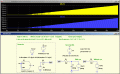
I (and Spice) beg to differ. At the very start of each pulse the voltage is not enough to charge the battery at all. Here's a sim of the charging which occurs, both with and without the cap, where bike speed goes from 0 to 25mph over a 50 sec period.
BatteryChargeCompare.gif
The two graphs show the same charging profile :(.
 

Attachments

Thread Starter

madsi

Joined Feb 13, 2015
107
I (and Spice) beg to differ. At the very start of each pulse the voltage is not enough to charge the battery at all. Here's a sim of the charging which occurs, both with and without the cap, where bike speed goes from 0 to 25mph over a 50 sec period.
View attachment 81072
The two graphs show the same charging profile :(.
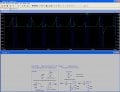
Thanks Alex_t, but the simulation seems intuitively inconsistent with actual operation. In the screen capture .jpg below the voltage has an inaccurate waveform with the voltage across the capacitor remaining constant during the generator output interval and rather strange glitches as well
I guess this waveform would seem only reasonable with the battery having a zero series resistance..a perfect voltage source and the generator output voltage peaks exactly constant during the scope shot.
 

Attachments

ronv

Joined Nov 12, 2008
3,770
I can't begin to explain the math. I think it is pretty complicated due to the sine wave and the time constant of the capacitor, the switch time of the chip, etc., but I did simulate it. Alas I didn't save often enough and it is very slow to run. But here is what I think the basic problem is:
It takes a few cycles to charge up the cap to the turn on voltage of the IC, but this only happens when you first start so it is not a big loss.
Once the voltage reaches the turn on the chip quickly tries to rise to 4.2 volts, but above the battery voltage the battery looks like almost a short - maybe 1/2 ohm, so it discharges the cap very quickly. This pulse does charge the battery but only for a short time until the capacitor voltage falls below the turn off voltage of the chip. Once the chip turns off the capacitor must be recharged, but now it looks like a short to the generator so the loss in the generator is high and it is slow to charge. This is what makes it inefficient.
Without the cap as soon as the voltage rises above the turn on point the chip turns on and a very short pulse of current is delivered to the battery and the input quickly falls due to the 150 ohms in the generator. But as soon as the chip turns off the voltage instantly rises to the next level of the sine wave and charges the battery again. This is the motor boating we talked about earlier. Both do it, but the one with the cap wastes the energy lost in the 150 ohms of the motor during both charge and discharge.
 
Top