Mosfet open discussion

Thread Starter

q12x

Joined Sep 25, 2015
2,227
It's the voltage that the MOSFET just starts turning on.
But from what I understood so far, it is very bad design to power the gate at very low voltages because it will put the mosfet into ohmic mode (linear region), when will start to heat up, become as a resistor, instead of permitting all the current through it. So my logic so far was to use max VGS to avoid that ohmic mode at lower voltages. -Whats your philosophy about properly driving a mosfet from the gate perspective?
 

Thread Starter

q12x

Joined Sep 25, 2015
2,227
Elaborate more than this please. You said you can teach me more about mosfets and I believed you, but now when Im asking you these questions you are either evasive or not willing to help anymore. Why are you so reticent? We only have one life and limited time after all, before everything goes to shit. So make the best of every moment as much as you can. It is my philosophy at least and Im trying to influence you into it. To be the best version of yourself no matter what.
- Do you want me to stop asking all these mosfet questions from now on? Yes or No.
 

dl324

Joined Mar 30, 2015
18,340
Do you want me to stop asking all these mosfet questions from now on? Yes or No.
I'm not withholding any help. My answer said it all. Sometimes you use a MOSFET in its linear region and sometimes you don't.

The current sources I posted in post #2 had the MOSFETs operating in linear mode. The MOSFET in post #11 was also operating in linear mode. All of the MOSFETs in the linear voltage regulator in post #95 were operating in linear mode.

The PWM circuit used for testing current capacity operated the MOSFETs in cutoff or saturation mode.
 

Thread Starter

q12x

Joined Sep 25, 2015
2,227
Ok then, so you say you are intentionally drive the mosfet in ohmic mode/linear region, to get hot, and not to drive all the current through it? Not to open it fully? Why you do that? Whats the gain from using it like that?
 

dl324

Joined Mar 30, 2015
18,340
so you say you are intentionally drive the mosfet in ohmic mode/linear region, to get hot, and not to drive all the current through it?
In all of the MOSFETs in the linear circuits I mentioned, only one MOSFET would ever get hot. The pass transistor in the voltage regulator.
Not to open it fully? Why you do that? Whats the gain from using it like that?
Linear circuits rarely have a device fully on or off.
 

Thread Starter

q12x

Joined Sep 25, 2015
2,227
What circuit I should make next to deepen my understanding about mosfet? Also with your comments about it and what to look for.
 

sarahMCML

Joined May 11, 2019
698
If you want more output voltage, increase your input from 5V to something higher. That will also increase the drive to the MOSFET gate, which will drive it properly and stop it getting so hot. The resistor that you have changed to 4.7k is the current limiter for whatever is being tested, so might/will need changing again if the voltage becomes too high!
 

Thread Starter

q12x

Joined Sep 25, 2015
2,227
All this tests I did here were for A09T smd mosfet type [ link ]
I spent the past 5 days trying to find a way to protect the Gate from ESD.
I totally failed.
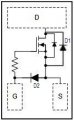
- The only visible protection that I could observe was to add D1. This is protecting -my best guess- the weaker internal diode of the mosfet against Power On/Off from my varPSU. It happened 2 times to burn/damage the mosfet from this particular case. D1 visibly helped.
- But the Gate was still a mystery to protect it. I inserted D2 but not because of damage protection. Simply because it worked in the circuit. If and when I inserted a diode from G to D, I got a lot of eroneous voltages of the mosfet. He really didnt like that diode there.
So at that point is impossible to protect. Adding D2 does not interfere with the mosfet functionality. So I leave it there just because. But not for a serious reason. I actually think it is a wrong decision to leave it like that because if a high neg Voltage spike occurs or comes from Source, it will surge completly on the Gate through that diode and it will beat the purpose of protection.
This is my experiment and Im very disapointed about it. Ahhhh...what a failure.
And no one here commented anything about this problem from my 2 posts I asked about it so far.
If you know something I dont know. do tell me.
Screenshot_1.jpg
I interchangeably used rectifier 1N4148, Schottky SS24 and TVS 9V diodes. Mosfet DS was getting 5V from varPSU while its Gate 12V from ATX PSU.
TVS 9V diode only used in parallel with D1 and it mest up the mosfet, erroneous conducting.
 
Last edited:

Thread Starter

q12x

Joined Sep 25, 2015
2,227
Question: - How do you usually use a mosfet? As a linear/resistive mode driver? or as pulsed driver?
Please share here all your circuits you made both with linear and pulsed. Make a list and brag with it. I personally like bragging - but I like other people bragging. Its the best way to learn something new and a bit more fun and sometimes competitive.
So put here a LOOONG list with ALL your mosfet circuits you made in your LIFE !
And where possible, a description of something peculiar or interesting.
Im personally looking right now for mosfet circuits, and I find some interesting ones that I will make soon. But I want some interesting ones from amerika or england too. So, put them down.
Or put another way, what circuits with mosfets you suggest I try to deepen my knowledge and the feel when working with mosfets. Because you probably know me already, at least some of you, I like to learn through practice, shooting 2 rabbits with 1 shot.
 
Last edited:

dl324

Joined Mar 30, 2015
18,340
I watched about the first 10 minutes of the video.

You seem to have the nomenclature about the switch backwards. When the switch is closed, the MOSFET should be on. Not the other way around as you mentioned.

You also talked about gate current. In MOSFETs, there's a small current associated with charging the gate capacitance, but the actual device performance depends on the gate voltage, not current. In an enhancement mode MOSFET, the gate voltage induces a channel between the source and drain to form.

You talked about gate capacitance when you turned off the gate supply causing the voltage you measured. That had to be due to the capacitance in the power supply and not the gate cap, which is very small in AO3400.

Regarding the diode between the gate and drain causing erroneous readings. That's because the gate voltage was being affected by the drain voltage. It couldn't be more than the diode voltage drop above the drain, so it wasn't turning on completely. That's why MOSFETs with built-in gate protection tend to use zener diodes that clamp the gate to a voltage around Vgs(max).

You mentioned that we should be advanced enough to include ESD protection but that has consequences. The protection adds parasitics (capacitance) which is often detrimental to device performance. In your case, the diode caused the circuit to misbehave.

EDIT: You also mentioned that the drain-source voltage should be 0V when the MOSFET was on. That voltage depends on the on resistance and drain current.
1731951357582.png
 
Last edited:

Thread Starter

q12x

Joined Sep 25, 2015
2,227
The protection adds parasitics (capacitance) which is often detrimental to device performance.
yes I catch that point too but in the very end of the movie. Thats when it comes to high freq like RF and such. I also mention some Texas Instruments remarks on this subject. You should jump near the end of the video when Im presenting a 3d model I made. I also managed to find 2 solutions for ESD protection if you really didnt watch it. But thanks for trying. All Im doing and showing is experimentation on stuff no one is talking about. I am not selling anything there.
 
Top