Mosfet open discussion

BobTPH

Joined Jun 5, 2013
11,523
Apparently the mosfet is very capable of carrying 5A through it with a 0.5-ish V across the entire cct when my varPSU is switching automatically into A mode
Not with a 1Ω resistor in series.

What is the voltage across a 1Ω resistor with 5A flowing through it? Here us a hint:

V = IR
 

Thread Starter

q12x

Joined Sep 25, 2015
2,227
What is the voltage across a 1Ω resistor with 5A flowing through it? Here us a hint:
I didnt use a 1R when I did the 5A10Vexperiment.
But from the last experiment, with 5V 0.2A the PSU voltage was very close to the voltage over 1R, maybe with 10mV over. The difference was very little between the 2.
So 0.5V on the PSU VoltageMeter. Almost 0V in principle because, like I said, this was actually a PSU short.
I believe the 0.5V was from the internal resistance of the mosfet itself, which is very low, 28mOhms but still a little bit of resistance. And the wires and all.

You're seeing how long it takes your power supply to switch from CV to CA.
Correct.

That isn't what's happening.
The thing here is to protect the mosfet from burning, because of that pulse.
How would you do it?
 
Last edited:

Thread Starter

q12x

Joined Sep 25, 2015
2,227
I give up.
dont give up, we need you :)
- Ok, I play a bit in my sim, and a low pass filter is out of the question, because we are shorting + to - and this filter circuit is not having any room to function, because it is either +5V or 0V, the same for the Amperage that goes hand in hand with the voltage. Damn. The circuit Im having here is too basic to monkey with some other circuits in between, like I'm usually used to. It is definetly a challenge and only a special component -that I have no clue what it might be- can solve this problem. But Im not giving up yet.
 

dl324

Joined Mar 30, 2015
18,333
The thing here is to protect the mosfet from burning, because of that pulse.
How would you do it?
I'd operate the power supply in CV mode and use it at less than its maximum current rating, and operate the MOSFET at less than its absolute maximum ratings.
 

Thread Starter

q12x

Joined Sep 25, 2015
2,227
Ok. I want to test the mosfet how many Amps will conduct through it. You said some time ago, that I will be amazed how many.
And I want to see it with my own eyes. Thats why I got into the max 5Amps on the PSU and everything.
It might be a simple setup problem after all.
My question is how to --Really-- see some good Amps flowing through my mosfet, and also switching it at a few Hertz for the moment, like I did it manually from the switch in my movie there, and even 1kHz in the final future test - ofcourse all without damaging it.
 
Last edited:

Thread Starter

q12x

Joined Sep 25, 2015
2,227
I'd operate the power supply in CV mode and use it at less than its maximum current rating, and operate the MOSFET at less than its absolute maximum ratings.
it is funny that I got to the same conclusion myself too. Now this is pure telepathy.
mosfet_High Amperage SpikePulse when Mosfet Switching problem v1.jpg
 

Thread Starter

q12x

Joined Sep 25, 2015
2,227
some more experiments:
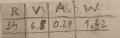
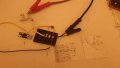
20241027_162030.jpg20241027_162035.jpg
varPSU display reading for V and A.
Im only interested on the LOAD power being drived and switched correctly, without the mosfet burning.
So far so good, the mosfet didn't got damaged while I was switching it's Gate like a maniac, probably the most was 10Hz, manualy.
This is the exact same experiment that I did in my movies. The difference now is that the varPSU didn't switched from V to A mode, like it was doing when I put the 1R, which it sees it as a dead short.
The W is not THAT great, but is considerably greater, compared to the NPN's experiment, which the strongest was 2N3773 at 1W, and NHS=No HeatSink.
The mosfet didn't warm up at all.
This particular resistor is a scrapped one, and it got to about 40 or 50*C <5min by finger testing. I believe it is a 5W resistor. All markings on it were erased. I personally measure it to 34R. And as you can see from V and A, it does confirm its resistance as well. I purposly dial to 6.8V and expected a 200mA and it did. In the idea of raising the wattage a little bit.
So my earlier idea, this one:
1730041474448.png
for the 10R, is about to be true. I didnt test it for 10R exactly but pretty close with my 34R here, and I was having this theory in mind all the time. In a sense, I test this theory in the same time.
Pretty cool, right? Personally, I LIKE IT !!
 
Last edited:

Thread Starter

q12x

Joined Sep 25, 2015
2,227
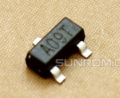
I managed to burn a couple more mosfets but the SMD ones. This A09T model. And it was at a very low D-S current. While the Gate was completely disconnected.
- What is a proper and solid protection, at least for the Gate of the mosfet. I remember something with a 12V zener diode. Right?
Can you give me your solution, please ? because you're more experienced with mosfets. Thank you.
 

dl324

Joined Mar 30, 2015
18,333
I managed to burn a couple more mosfets but the SMD ones. This A09T model. And it was at a very low D-S current. While the Gate was completely disconnected.
- What is a proper and solid protection, at least for the Gate of the mosfet. I remember something with a 12V zener diode. Right?
If the gate was floating, the device can be turned on at some state other than completely on. That increases power dissipation in the device. That's how I burned up an IRFZ44N.

If you're not applying excessive gate voltage, a pull-down resistor is sufficient unless you're physically touching the gate.
 

Thread Starter

q12x

Joined Sep 25, 2015
2,227
If the gate was floating
Yes the Gate was basically floating, connected only to a manual switch.
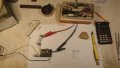
This is the setup Im using.
20241028_190509.jpg20241028_190719.jpg
I start to believe, maybe Im burning the mosfet with ESD ? because in my room I have a history with ESD easily forming on my fingers.
So.... a protection circuit ?
 
Last edited:

dl324

Joined Mar 30, 2015
18,333
Yes the Gate was basically floating, connected only to a manual switch.
This is the setup Im using.
If the gate resistor wasn't used, the MOSFET could have been biased on via the floating gate.

I did this making a test jig for IRFZ44N (put the gate resistor in the wrong place). Turned on the power supply and the MOSFET burned up before I could find the problem.
I start to believe, maybe Im burning the mosfet with ESD ? because in my room I have a history with ESD easily forming on my fingers.
So.... a protection circuit ?
I've been using an ESD grounding strap lately when handling static sensitive devices.
 

BobTPH

Joined Jun 5, 2013
11,523
There is nothing limiting the current in the circuit posted in #233. You are using a MOSFET to short the power supply. presumably with no heat sink based on previous photos.
 

Thread Starter

q12x

Joined Sep 25, 2015
2,227
There is nothing limiting the current in the circuit posted in #233. You are using a MOSFET to short the power supply. presumably with no heat sink based on previous photos.
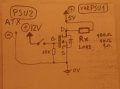
I forget to add the Load resistor - I replaced previeous img + I added the real circuit also. Revisit post #233.
Here is A09T datasheet - note the tr name is AO3400 but its marking is actually A09T.
1730137126220.png
 
Last edited:

Thread Starter

q12x

Joined Sep 25, 2015
2,227
I've been using an ESD grounding strap lately when handling static sensitive devices.
show me your ESD strap, please. Just curious.
I still have to learn this ESD lesson after so many years... still making rookie mistakes.
So, I changed the last burned mosfet, but this time with a ESD strap, and everything worked, perfectly !
 

BobTPH

Joined Jun 5, 2013
11,523
Never used ESD protection. Never had a problem. When I blow up a part it is always traceable to much current, too much voltage, or reverse voltage.
 

Thread Starter

q12x

Joined Sep 25, 2015
2,227
Check this out !
At 7V and 8V, varPSU1 entered into Amp mode automatically.
As you can see, I am exceeding my Load Resistor at 5W power rating at 8V. But I conducted the experiment very fast, I didnt linger.
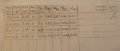
1730167673015.png
So, mister @dl324, you conducted some time ago some experiments with your mosfets, and... I remember you had some data.
Can you make a new mosfet experiment and collect the same values I have in my table here?
Ideally with a A09T SMD mosfet, but if you dont have one, you can use whatever SMD mosfet you may have around, even scrapped.
To be (relatively) in the same experiment ball park with my data I already collected.
I know - I know, I should had make this test with the IRFZ44N that you announced me you have it in your arsenal already. We will get to it too. But for now.. ... see if you can put a small SMD to the test, --for me--. Also provide the full circuit + table picture.
Always, thank you !
 
Last edited:

BobTPH

Joined Jun 5, 2013
11,523
Check this out !
At 7V and 8V, varPSU1 entered into Amp mode automatically.
How do you figure that?

At 5V you are seeing .47

By Ohms law, at 8V I expect .47 x 8/5 = .752

You measured .76

Off by about 1%. I see no evidence of current limiting kicking in. Most likely the small discrepancy is due to a change in the on resistance of the MOSFET due to higher temperature at the higher current, if not just the accuracy of your meter.

What is it you are trying to prove anyway?
 
Top