Mosfet open discussion

Thread Starter

q12x

Joined Sep 25, 2015
2,227
Today test !
I integrated this PWM Generator to get a 1% and 99% PWM.
It matters after all, even if I said id doesnt, for a simpler and direct view of the result.
More straight forward and easier to "read" these extremes. It looks more fancy professional look.
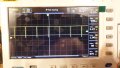
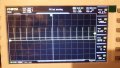
20240816_031351.jpg20240816_031358.jpg
20240816_031454.jpg20240816_031455.jpg
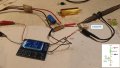
I originally try it with 1Ω 50W but both the mosfet and the res got very hot very quickly.
So I quickly changed the load resistor with this 100R here in the img, that was ready on my table.
The reading is exactly as before but this time with this PWM Generator and from 1-99% extremes. Better now !
Thank you mister @Danko for this unexpected handy tool, especially for my tests here.
In art is a saying "the devil is in the details" literally. And here as well it also applies.
 

Thread Starter

q12x

Joined Sep 25, 2015
2,227
So try using a variable resistor of say, 25K instead, and find the optimum resistance, as I did. It'll only take 5 minutes but is well worth while. Then you can measure it and replace with the correct fixed one.
Your 25k pot is way too small. You still believe its a small resistor value. In my case is even bigger than 47k for a slight better result but really not that much. I put a 100k POT and somewhere around 55-58k was a very tiny improvement at least from my angle that Im looking on my table all the time. But if I change the angle from perfect perpendicular 90*+ a bit over the top like 100*-120* view angle everything is messed up. From this 120* view angle is perfect with the 47k originally. With a 58k is better from my angle which is 60-75* view angle Im guessing. But it is changing the other views angles. Its like a sword with 2 cutting blades. You repair on one side but you mess up the rest. Its a very shitty display is what it is !
Very good idea with the potentiometer btw ! Bravo. Very good trick that I failed to think about by myself. That's why is good to have friends. Ok so in conclusion, I put back the original resistor which it was a 0402 smd package btw, very small and tricky to handle and I have only 1 at that dimensions. So If I loose it, im stupid. As "bad" as it is now from my angle, it is good from 120* angle. While I was writing to you here, I realized that I will work with this display most of the time from this 60*-75* view angle. So I changed my mind and I mounted a 56k resistor in place of that 47k. Now it is permanent because this will be used flat on the table as it is now, most of the time, and in future experiments and tests. And with this 56k, at this 60*-75* view angle, the screen is quite good enough, not as annoying as before, its a bit ameliorated, not perfect, but a bit better than before. And if its a bit more better, I'll take it. This new 56k is a 0604 package SMD, a bit larger and scraped. I had a bit of trouble soldering it to the 0402 pads but I manage it, with a bit of faith and luck.
Thank you again for your awesome trick with the pot. I swear I didnt think about it for a second. I will praise you to the end of time.
I made a movie about it too. Now is in editing mode. I will update you about it soon.
 

sarahMCML

Joined May 11, 2019
697
I made a movie presenting all the problems and finally the solution I settle to.
Given previous experience with these units I tend to think that the problem isn't with the LCD displays, but that the HT1621B chips used in these modules are sub-standard in some way. They are probably marginally working rejects.
 

Thread Starter

q12x

Joined Sep 25, 2015
2,227
Trust on my word, the display is a reject. The IC is fine, remember that I drive successfully that 3 digit multiplexed display in arduino and it looked alright with this IC. This time, its the display fault, its the backlight not completely or perfectly letting the polarization of the segment. My conclusions it is very dependable upon viewing angle. And you have to bend to its limits. And is exactly what I did there.
 
Last edited:

sarahMCML

Joined May 11, 2019
697
Trust on my word, the display is a reject. The IC is fine, remember that I drive successfully that 3 digit multiplexed display in arduino and it looked alright with this IC. This time, its the display fault, its the backlight not completely or perfectly letting the polarization of the segment. My conclusions it is very dependable upon viewing angle. And you have to bend to its limits. And is exactly what I did there.
Your I.C's that you purchased may well be fine, but that doesn't mean that the ones on these board are!
I just tried a different modification to mine which improves the display immensely. I removed my 50K variable resistor that was in place of the original 47K resistor, and instead attached the wiper of a 10K pot to pin 16. One end of the pot was then attached to pin 17 (VDD), and the other end to Gnd. When adjusted properly this totally eliminated the ghosting!

One thing that does seem to vary on these displays is the backlight brightness, the one I was using for this test being relatively dim, so I found shorting out R6, the series resistor, increased it slightly. It had hardly any voltage across it anyway so I considered it worth the risk!
 

Thread Starter

q12x

Joined Sep 25, 2015
2,227
So, getting back to the track.
- The only formula for checking the power dissipation over the mosfet in PWM mode, was this: Mosfet_P = V*I*0.1 (where 0.1 represents 10% duty). This is @dl324 formula and he used it for his aliexpress mosfet calculations and he was happy they are in the right specs with the datasheet. That's why he liked this thread about mosfets in the first place.
- Now, I did (some) homework, but I didnt manage to test everything. I found some equations for calculating a PWM mosfet, and they are way more complex than your little equation. Im not saying yours is wrong, Im saying is incomplete. Heck, my new equations as large and complicated as they are, I think they are also incomplete too. Because I sense some disparities in tests. But for the bigger picture, they did their job, and I think they clarified and also pointed more clearly the power dissipation on the mosfet in test and also on the load resistor, in PWM mode. But .... Im not totally convinced on the results, so I have to make a more thorough test, for multiple situations or extremes. If what I find turn out to be good "enough", THEN I am "game", to paraphrase my friend here. Hehehe, I know he likes my sense of humor. But as Im already suspecting, while keeping my expectations 50% cold and alert, something might fail miserably from these new formulas. Thats why I have to do some extensive tests to confirm or infirm their validity. They are from internet after all.
Wish me luck.
 

Thread Starter

q12x

Joined Sep 25, 2015
2,227
- I realized that I need a variable PSU for the Drain power line. Why? because to do what I have in mind, to get close and personal and stress to my liking the mosfet, in PWM mode, I need to vary the voltage. Once I can vary the voltage, the current will vary in the same time. So, having only a static PSU at 5V and 25A is not helping me at this point. But it is infinitely better than risking my bench variable PSU. Somehow, to make this ATX PSU which is fixed at the moment, to make it variable and to not loose power in the variation module. Thats what Im thinking. What I was doing all this time, I was changing the Load resistor between 1R and 100R and 470R, practically, switching the current up and down. It will be cool with a finer current/or/and/voltage variator.
- So my idea is to PWM the mosfet, without any load resistor! Or at most, with a 1R but not heating up at all, to remain room cool. This means to tweak the voltage (and current in the same time) down or up, as much as I need until I see the tr start warming up to 50*C (as to my standard).
This is what Im thinking. This will be the next step.
- About the "new" equation that I found, it boiled down to @dl324 equation after all, after 2 days of hammering it and thinking on it. I actually test it in real life and I got some results..but...again, inconclusive because I dont have all the cards(yet). I am still learning the mosfet at this point, so I will continue to make stupid mistakes until I wont.
 

dl324

Joined Mar 30, 2015
18,333
So my idea is to PWM the mosfet, without any load resistor! Or at most, with a 1R but not heating up at all, to remain room cool.
You're going to need a load resistor to be able to be able to measure the on voltage and calculate current.
 

Thread Starter

q12x

Joined Sep 25, 2015
2,227
To @dl324 check this out:
20241020_214741.jpg20241020_215527.jpg
You were right, (in your #167 post) a mosfet is switching a very large amount of current.
5A in the tests I did here. WOW.
 
Last edited:

Thread Starter

q12x

Joined Sep 25, 2015
2,227
I'm pretty sure I know what's killing your MOSFET's, it's the 470uF capacitor!
Yes, I was thinking it might be it but I didnt want to believe it. But you may be right. I didnt test it without it. I will do it now. It seems possible it is it like you say. Thank you.
---
Ok test done. I want to believe that it helped a little bit, removing my capacitor.
I presumably switched a little more time than before.
But in the end, it also became conductive uncontrollably, no Gate signal, like the other ones. Worse than before actually, a lot of current passed and heated up the mosfet through the Gate this time. So no matter what PSU(1or2) I was opening, it was heating up the mosfet, way beyond 100*C. It actually melted a bit harder my green plastic clamp. Maybe it is another capacitor at the output of my PSU, inside it, that is dumping the energy like you say. Only that mine was adding to the dumping a little bit, maybe. I can not tell with precision, but it might appear a bit slower this time to damage it/pierce it.
- Ok, I propose to imagine a spiky waveform when Im switching the Gate, primarily on the Drain-Source, because thats the real cause of damage. Give me or find a protection circuit for spikes that I can put on the Drain. Im also thinking on the Gate as well, to be paranoically careful, but later, first on the Drain.
 

Thread Starter

q12x

Joined Sep 25, 2015
2,227
So... I was right. When the PSU is switching from V to A, (meaning when Im turning ON the G) it spikes it's outputs.
Not so much from A to V.
I lowered everything down for a test mode:
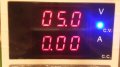
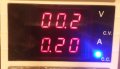
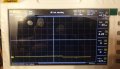
When Gate is OFF, I get this 5V on my varPSU. When Gate is ON, PSU is switching to A and I get that 0.20A continuous mode. I limited everything, the V and the A, both of them to be able to make this test very safely. So that what these 2 img means. Ok?
20241021_225820.jpg20241021_225826.jpg
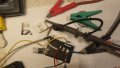
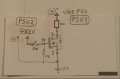
Here is the circuit:
20241021_225811.jpg20241021_225812.jpg
Previously, in all my movies I had a capacitor. After talking with England, I take it out in the premise he is the spiky element, the destroyer of mosfets. The problem is higher than him, it turns out. It will be interesting to see an output of a PSU like I have, something generic, similar, not perfectly exact.
I used 1R there to actually probe the current, not the voltage. Because I believe is an A spike. And again, I was right.
20241021_225801.jpg
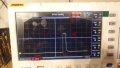
Here is what the osciloscope is showing, again reading the V over 1R that translates to Amperage Spike ! Ok, clear as mud ?
That 4V is actually 4A spike when Im turning ON the mosfet. So that 4A/0.20A=20 times greater than working in continuous mode at 0.20A. Right? When Im turning OFF the G, the spike is negligible.
Basically, I believe it wants to reach to the 5V but somehow it translates into Amps? Im very new to this type of spiking problems.
But I was running it at 10V in my experiments, so if it has the tendency to rise to 10V, lets say it reached 9V, this translates to 9A spike, so 9A/5A=1.8 times greater than continuous mode at 5A. Hmmm. Not that much... please be free to correct me any time. Im free thinking here. I'm trying to connect the dots.
The osciloscope horisontal is set to 100ms/div and the vertical is set to 1V/div. My probe was set to X1 (not X10).
So....in conclusion, when I was switching 5Amps in my other (filmed) mosfets,I was having spikes 20 times greater than that 5A so let's see 5*20=100Amps spikes hahahahahahaha. Ohohoaaa. But the mosfets resist for a couple of fast switchings, until they give up, like 10 or 15 rapid switching. For the slow rate switching...I guess, I imagine it will break up too, but much-much slowly in about 50 or 100 switchings, if they are very rare, not fast as I was doing it. Very interesting, right?
- Now, let's see if we can solve this problem, to limit or to completely cure this very high Amperage spiking problem.
I am showing you these tests to clearly see the problem it actually exists. Is not only my impression.
So, did you liked my experiment here? Very Nice eh? haha.
----
Addendum: Here is the proof that I'm actually measure the Amperage. The drop step you see in the img, is from the 200mA, as it continuously runs, down to 0V, when Im switching OFF the G of the mosfet. It does have a tiny negative spike though, but like I said, is negligible. I think that tiny spike is my PSU switching back to V mode.
20241021_234605.jpg
 
Last edited:

BobTPH

Joined Jun 5, 2013
11,521
Congratulations, you have discovered that a power supply cannot respond instantly to a sudden change in the load. Who knew?
 

Thread Starter

q12x

Joined Sep 25, 2015
2,227
C'mon Bob ! Be serious.
How to solve this problem? Im thinking to use a low pass filter with a range from 0-100Hz. Will that do any good?
 

BobTPH

Joined Jun 5, 2013
11,521
Get a better power supply? 60 msec transient response is pretty awful.

Where would you put a low pass filter? Slowing the rise time on the gate might help.

But this is not a real circuit anyway. Why would you place a load on the MOSFET that would kill it in 60 msec unless a separate circuit limits the current? If you only want 0.2A across a 1 Ohm resistor, why would you apply 5V to it? Oh, now I remember from your other thread. You think you can have 5V across a 1 Ohm resistor and vary the current through it.
 

Thread Starter

q12x

Joined Sep 25, 2015
2,227
Get a better power supply?
I actually got another one - but not for this experiment just a general purpose secondary PSU. Not to rely on that ATX PSU on my working table all the time. Having 2 varPSU is a good thing, but is a very expensive effort from my part. I had thinking on it for some years, and now I give up and took it. Im not sure how much time I will actually use it from now on, but is a small dream come true, I guess.

But this is not a real circuit anyway.
true, it is an experiment where I test the worse case scenario for a mosfet. Apparently the mosfet is very capable of carrying 5A through it with a 0.5-ish V across the entire cct when my varPSU is switching automatically into A mode. But because this 'bump' in the PSU when is switching, it is burning the mosfet - not burning but rather welding inside, because the S and D are conducting, indiferent of the G signal. So this experiment I did in this last movie was to actually visualize and confirm mostly your suspicions that it is coming from the PSU itself, because before, my UK friend was thinking that pulse was from the capacitor in the circuit, and I took it out, then the cap inside the PSU on the output, and then the mosfet itself doing that pulse. All interesting ideas and it is exactly what I need, more ideas on the table, I dont judge any of them, I only get inspiration to hopefully get to the real problem faster than doing it alone. Its the only reason. So I wanted to clarify which is the source of the switching because I live here near it and I can sense it more easy, where is comming from. So now you've seen it in action, a real Amp pulse or spike of 50ms long. Which is pretty long for a spike, thats why I call it a pulse, interchangeble ofcourse, it can be any of them, we will never know. Haha. So my idea is to add a passive low pass filter in the 1 to 100Hz range. I should stop talking and actually do it. But I wanted to get a confirmation first that is a good idea.
 
Top