Mosfet high and Mosfet low

Thread Starter

thedoc8

Joined Nov 28, 2012
162
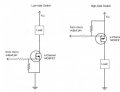
Why is high side called high side when load is between ground and the fet. Seems ground would be the low side. Same with low side, load connected to supply and fet, seems that would be called high. What makes one high and one low. Just seems the naming is backwards. Thanks


Below is the picture of high side and low side, what is correct...? This picture came from Electrical Engineering website.

What is correct....?
 

Attachments

Last edited:

djsfantasi

Joined Apr 11, 2010
9,237
Because the Fet is switching the high side. It is located between +V and the load. On the “high side”.

In the other case, the Fet is switching the ground lead. It is located between the load and ground. On the “low side”.
 

Thread Starter

thedoc8

Joined Nov 28, 2012
162
Because the Fet is switching the high side. It is located between +V and the load. On the “high side”.

In the other case, the Fet is switching the ground lead. It is located between the load and ground. On the “low side”.
Every example I find is opposite of what you said. On the examples I have seen, the load between the fet and ground is called high side.
Maybe I don't understand what you're saying I'll get a picture of the two examples.
 

shortbus

Joined Sep 30, 2009
10,050
Quote, thedoc8
"Every example I find is opposite of what you said. On the examples I have seen, the load between the fet and ground is called high side.
Maybe I don't understand what you're saying I'll get a picture of the two examples."

Your picture shows exactly what djsfantasi said. To put it another way, a highside switch has the mosfet source(Nmos) connected to the load, and a lowside has the mosfet source connected to the ground. The low side is easiest to do, it only need the gate to go higher than the ground voltage wise. But it isn't always possible to use a low side.
 

dl324

Joined Mar 30, 2015
18,326
Below is the picture of high side and low side, what is correct...? This picture came from Electrical Engineering website.
Both are correct.

An N channel MOSFET is used to switch the "low side" of the load and a P channel MOSFET is used to switch the "high side".

Sometimes the "side" you switch depends on the load. For instance, if you were switching a relay that had one side permanently grounded, you can only switch high side.

If you're using different voltages, e.g. a microcontroller operating at 3.3V and want to switch a BJT/MOSFET in a 5V system, low side switching with an N type device is easier. If you use a P type device, you need it to be biased off when the microcontroller output is HIGH. That's typically done with a pull up resistor and you need to limit current being forced into the output when it's HIGH. And you need to worry about the P device being on.
 

ebp

Joined Feb 8, 2018
2,332
It is the driver or switch that is "high side" or "low side."

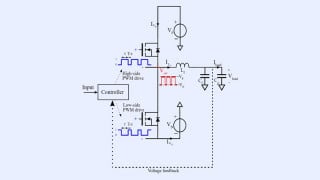
How the load is connected depends on the switch used. In a half bridge there are two switches. connected directly to each other - a high side switch and a low side switch. The load would be connected to the junction between the two switches and to an "intermediate voltage." For example, the high side switch might to to 400 V, the low side to 0 V, one side of the load to the junction of the switches and the other side of the load to 200 V. In a full bridge there two half bridges and the load connects between the junction points of each of them.

High side switches require high side drivers that are invariably more complex than low side drivers, especially with MOSFETs. If an N-channel FET is used as the high side switch then the high side driver must normally operate from a "floating" power supply that is several volts more positive than the main power supply. This is because a low side N-channel FET is operated in common source mode and the high-side is operated in common-drain mode (as a "source follower").
 

Thread Starter

thedoc8

Joined Nov 28, 2012
162
Thanks everyone, this has been driving me nuts. Thanks for the very good explanations, I get it now. :)
Quote, thedoc8
"Every example I find is opposite of what you said. On the examples I have seen, the load between the fet and ground is called high side.
Maybe I don't understand what you're saying I'll get a picture of the two examples."

Your picture shows exactly what djsfantasi said. To put it another way, a highside switch has the mosfet source(Nmos) connected to the load, and a lowside has the mosfet source connected to the ground. The low side is easiest to do, it only need the gate to go higher than the ground voltage wise. But it isn't always possible to use a low side.
I am dyslexic, so sometime I have to look several times before I get it. Thanks for the explanation.
 

Thread Starter

thedoc8

Joined Nov 28, 2012
162
Easy now, just look at the load, if one side is ground then I will be switching the high side. If the load is connected to supply Im switching the low side. Yea, really thanks a bunch.
 

shortbus

Joined Sep 30, 2009
10,050
Think you meant a high side switch is PMOS and the drain is connected to the load.
Am so used to working with N mosfets I completely missed the direction of the arrow in the link illustration.:( But what I said is how the N mos works, and did call that out.
 
Top