Mosfet having the Lowest RDS(on)

ebeowulf17

Joined Aug 12, 2014
3,307
I've used these on a 3V supply with 470 ohms base resistor no problems...
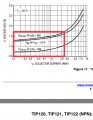
Sure, no problems at 3V, but the thread starter says their 555 output is only providing 1.7V. Looking at the TIP121 datasheet, Vbe(sat) for ~2.3A is ~1.7V. That leaves essentially no room for a current limiting base resistor, and no margin for error/parts tolerances, etc.

https://www.onsemi.com/pub/Collateral/TIP120-D.PDF

17BD5B86-048D-4B7D-B329-2AEC4D5CB5AE.jpeg

If you're also suggesting other changes that will improve the 555 output, then that could work, but at 1.7V it looks dubious to me.
 

Audioguru

Joined Dec 20, 2007
11,248

BobaMosfet

Joined Jul 1, 2009
2,211
With low voltage sources, e.g., the 3.0 V the TS is using, the lower voltage drop of a logic-level mosfet can be an advantage. For example, an RDS(on) of 3 mΩ at Vgs = 2.5V will give only a 7 mV drop at 2.9A (25 mW). Moreover, the devices are small and don't generate as much heat as a BJT running at 2.9A.
And did you have a part number in mind when you calc'd those numbers? There's a lot more to calculate for, than just RDS(on) and I'd like to pull the datasheet.
 
Last edited:

ebeowulf17

Joined Aug 12, 2014
3,307
And did you have a part number in mind when you calc'd those numbers? I just want to work through the thermal calc to see if the junction temperature will actually handle 2.3A.
At only 25mW (1/40th of a Watt) of dissipation, it would be hard to find a part that *can't* handle it!
 

ebeowulf17

Joined Aug 12, 2014
3,307
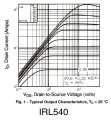
Here's a real world example - very bread and butter, common, easy: IRL540

https://www.vishay.com/docs/91300/sihl540.pdf

429FCBBE-92BB-4D2D-8F0E-D71945CDF64E.jpeg
Looking at the graph above, 2.3A is around 0.2Vds (assuming 2.5Vgs, as proposed in @jpanhalt 's example.) That would mean less than 1/2W dissipation, which is easy for a TO220 device.

I'm sure there are plenty of parts with better specs. This was literally the first logic level MOSFET I checked, and it would handle the load just fine with only 2.5V logic, even easier with 3 or 3.3V logic.
 

BobaMosfet

Joined Jul 1, 2009
2,211
When minimal voltage drop is a priority, it's often easy to find a MOSFET with low enough Rds to outperform any BJT. For me at least, this comes up pretty often. It has nothing to do with fashion, popularity, or understanding what my options are. The gate properties aren't the only properties to consider when weighing options.

As for this particular project, it's challenging either way you go. If you want to go BJT, that's a lot of current, so you'll need a lot of base current... possibly so much that you'll need two stages (darlington, etc.) If you need a second stage anyway, might be better to use a mix of technologies, or two MOSFETs, one acting like a gate driver of sorts for the other.

*** EDIT:
While I was typing, @jpanhalt beat me to it with a more concise answer.
Disregard, more posts occurred while I was typing. Much appreciated to you both for part numbers. I'm using this more as an educational exercise for myself.
 
Last edited:

jpanhalt

Joined Jan 18, 2008
11,087

BobaMosfet

Joined Jul 1, 2009
2,211
Here's a real world example - very bread and butter, common, easy: IRL540

https://www.vishay.com/docs/91300/sihl540.pdf

View attachment 181516
Looking at the graph above, 2.3A is around 0.2Vds (assuming 2.5Vgs, as proposed in @jpanhalt 's example.) That would mean less than 1/2W dissipation, which is easy for a TO220 device.

I'm sure there are plenty of parts with better specs. This was literally the first logic level MOSFET I checked, and it would handle the load just fine with only 2.5V logic, even easier with 3 or 3.3V logic.
Where did you come up with the TS wanting a Vds of 0.2? I couldn't find that (stupid bifocals)....
 

ebeowulf17

Joined Aug 12, 2014
3,307
TS wanted 2.3A. There was no mention of Vds, but lower is generally better since it means less dissipation and greater efficiency.

Vds at any given gate-source voltage and drain-source current depends on MOSFET specs. In the case of the IRL540 example, given the 2.3A current requirement and the suggested 2.5V or better available for the gate (assuming a switch to CMOS 555 timer,) the 0.2Vds number comes from the IRL540 datasheet, not the TS.

The low Vds number is helpful, because it means much lower power dissipation. Losing 0.2V at 2.3A = 0.46W of dissipation. If you used a Darlington with typical 0.9Vce at 2.3A, you'd get 2.07W of dissipation. Not only is this less efficient, but it probably means needing a heat sink for the Darlington while the MOSFET at the same current is running fairly cool even without a heat sink.
 

BobaMosfet

Joined Jul 1, 2009
2,211
TS wanted 2.3A. There was no mention of Vds, but lower is generally better since it means less dissipation and greater efficiency.

Vds at any given gate-source voltage and drain-source current depends on MOSFET specs. In the case of the IRL540 example, given the 2.3A current requirement and the suggested 2.5V or better available for the gate (assuming a switch to CMOS 555 timer,) the 0.2Vds number comes from the IRL540 datasheet, not the TS.

The low Vds number is helpful, because it means much lower power dissipation. Losing 0.2V at 2.3A = 0.46W of dissipation. If you used a Darlington with typical 0.9Vce at 2.3A, you'd get 2.07W of dissipation. Not only is this less efficient, but it probably means needing a heat sink for the Darlington while the MOSFET at the same current is running fairly cool even without a heat sink.
I appreciate your response, and I realize my mistake. It's been a long time since I did much with MosFETs because they are much more complex in terms of gain calculations (at least to me so I tend to avoid them for non-serious projects), and I was looking at Vds wrong (don't know why), which was messing up my thinking. Mentally I kept expecting it to be high, but I know better- it should be low for saturation because of low resistance ideally in saturation.
 

ebeowulf17

Joined Aug 12, 2014
3,307
I appreciate your response, and I realize my mistake. It's been a long time since I did much with MosFETs because they are much more complex in terms of gain calculations (at least to me so I tend to avoid them for non-serious projects), and I was looking at Vds wrong (don't know why), which was messing up my thinking. Mentally I kept expecting it to be high, but I know better- it should be low for saturation because of low resistance ideally in saturation.
Happy to help! Yeah, I can see where working out gain calculations would be trickier - so far I've only used them in fairly straightforward on/off switching situations, so never had to think in those terms. Using them in analog controls would undoubtedly be more challenging!
 

swr999

Joined Mar 30, 2011
58
... The gate is triggered by 555 timer because i need a delay before switching...
Just an idea: Rather than the 555 how about an 8-pin PIC (or other MCU of your choice) and do the delay in software. I understand though if you don't want to write any code :))
 

AlbertHall

Joined Jun 4, 2014
12,629
Just an idea: Rather than the 555 how about an 8-pin PIC (or other MCU of your choice) and do the delay in software. I understand though if you don't want to write any code :))
Funnily enough I have just used an 8 pin PIC12HV609 running on a 32kHz crystal for a 100 minute delay. The HV chips include a 5V regulator.
 
Top