Mosfet gate ringing

-live wire-

Joined Dec 22, 2017
959
If you operated at a high frequency and charged the capacitance up slowly, wouldn't you also have issues where it is not fully on and in the ohmic region for a longer amount of time, leading to greater power losses?
 

crutschow

Joined Mar 14, 2008
38,507
If you operated at a high frequency and charged the capacitance up slowly, wouldn't you also have issues where it is not fully on and in the ohmic region for a longer amount of time, leading to greater power losses?
Yes.
That's why any added resistance in series with the gate should be small enough that it doesn't significantly affect the MOSFET rise and fall time at the operating frequency of interest.
 

Thread Starter

cmartinez

Joined Jan 17, 2007
8,762
Ok ... I think I might be doing some progress in my understanding of this thing here ...

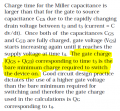
According to one of the documents I attached in post #20:

upload_2018-9-4_22-28-0.png

upload_2018-9-4_22-28-44.png

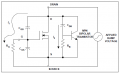
And this figure shows a Mosfet's equivalent circuit:

upload_2018-9-4_22-29-17.png

What I don't fully understand now is, why does the gate voltage keep increasing steadily after both Cgd and Cgs have been fully charged, instead of it reaching full potential? ... I mean, why does the gate behave as if there were a third capacitor when that component is clearly not being shown in the equivalent circuit?

To further explain, I've attached the datasheet of the NTP5864N mosfet:

upload_2018-9-4_22-35-19.png
In the table previously shown, it can be seen that Qgs = 7.3 and Qgd=10. But the total gate charge is much higher (31 nC) than the sum of the two. Where or how can that be represented in the equivalent circuit?
 

Attachments

crutschow

Joined Mar 14, 2008
38,507
In the table previously shown, it can be seen that Qgs = 7.3 and Qgd=10. But the total gate charge is much higher (31 nC) than the sum of the two. Where or how can that be represented in the equivalent circuit?
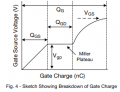
The difference may be due to the Miller charge, which is not included in the other charges.
See the figure below from this paper.
I think Qg corresponds to Qg(tot).

upload_2018-9-4_22-57-49.png
 

MrAl

Joined Jun 17, 2014
13,704
ringing problem
Ringing is usually caused by inductance in the source circuit. The inductance causes an apparent modulation of the gate to source voltage which turns the mosfet on and off repeatedly. So the first thing to check is the source leads going to the mosfet and the way the gate drive common connects to the source. All lines should be as short as possible and the gate drive common connected to the source with a separate line.
Even very small amounts of inductance in the source line can cause problems because the current is usually high when the mosfet is switching on and low when switching off.
 
Top