Audioguru again
- Joined Oct 21, 2019
- 6,826
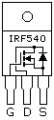
The diode is not added, it is inside the Mosfet.
Also Dave, what tools/simulator did you use for this?When I was checking out the use of MOSFETs for the first time I used this circuit and plotted this graph:
View attachment 255778
View attachment 255779
Ah, I initially just read the diode as part of the MOSFET symbol without paying any attention to the direction. Only now, on closer inspection, do I see that it looks like an external diode. Maybe my example wasn't directly relevant or helpful, sorry if that's the case.I'd be interested to see that Dave with a diode added as Wendy has in her OP.
And I'm assuming that it has been drawn the wrong way round by mistake.The diode is not added, it is inside the Mosfet.
That represents the parasitic diode that is inherent in all MOSFETs. There are two and one gets shorted to the source in three terminal devices.If you simply want to see, observe, measure the device's behavior over a range of gate voltages, then remove the diode. That may have some purpose in some design you have
That's just the way @Wendy drew it. She uses some drawing program like Paint for her schematics.It looks external because of the dots where it joins the MOSFET
Ahh OK that's fine then, so Wendy's results are a curiosity...That's just the way @Wendy drew it. She uses some drawing program like Paint for her schematics.
I didn't use a simulator I used real components. I measured the two voltages with two cheap multimeters and then plotted the results with MS Excel.Also Dave, what tools/simulator did you use for this?
You'll have to take the cover off and turn it round!the diode in question is built into the MOSFET.
View attachment 255799
The drawing shows a P-channel Mosfet with its diode correct but the schematic does not show the power supply polarity which must be negative for the P-channel Mosfet.And I'm assuming that it has been drawn the wrong way round by mistake.