MOSFET epiphany

Thread Starter

Wendy

Joined Mar 24, 2008
23,798
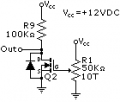
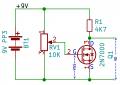
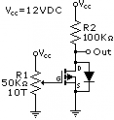
One of the common phrases I live by is it ain't what folks know that gets them in trouble it's what they know that ain't so ( courtesy of Mark Twain). I just ran into that big time with a MOSFET. I always thought MOSFETs had a linear region it was just very very hard to reach, apparently not. I verified this to myself with this experiment, which failed miserably. Oh well, back to the drawing board.
0.png

basically using a 10 turn pot I was unable to hit anything other than a one or a zero on the output.
 
Last edited:

dl324

Joined Mar 30, 2015
18,326
If your schematic reflects the device polarity and how it's connected, the body diode would always be conducting.

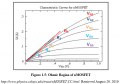
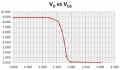
The ohmic region only covers a small range of drain-source voltages before the device goes into saturation:
1640129595778.png
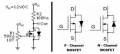
1640129625155.png

This info was from an undergraduate paper at UTAR by Gabriel Gan Kok Wai in 2011.
 

MrChips

Joined Oct 2, 2009
34,810
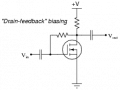
Try adding some negative feedback. Connect the top end of the pot to the drain instead of VDD (Vcc in your diagram).


1640130942457.png
 

Thread Starter

Wendy

Joined Mar 24, 2008
23,798
I'm hoping I can find a resistive region similar to a JFet. I'm going for something between 10K ohm and 100K ohms.
 
Last edited:

AnalogKid

Joined Aug 1, 2013
12,128
A power MOSFET such as the 540 is actually many smaller FETs in parallel. I suggest you start with a more "normal" part, such as a 2N7000. IIR this has a minimum Rdson of around 5 ohms. With a 100 ohm drain resistor you should see a noticeable non-saturated region as you adjust Vgs.

ak
 

Thread Starter

Wendy

Joined Mar 24, 2008
23,798
Again, I'm trying to use parts I have on hand.

i'm not sure what i am trying to do is practical or possible
 
Last edited:

BobTPH

Joined Jun 5, 2013
11,515
Looking at the datasheet, you will not see a large dependence of current on Vgs until you are at 1 or more amps of drain current.

Bob
 

crutschow

Joined Mar 14, 2008
38,504
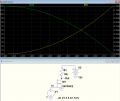
Here's the LTspice simulation of the Vgs versus drain current for a small N-MOSFET with a 10kΩ load.
As you can see the high transconductance of the MOSFET generates a large change in current for a small change in Vgs.
Your pot resolution is likely way too coarse to see this change, and thus just goes from 0V out to 12V with the minimum resolution change in gate voltage.

1640154990526.png
 

Ian0

Joined Aug 7, 2020
13,131
Normally it's far too easy to find the linear region. You know you've found it when you think it has enough gate voltage to switch it fully on, but it gets very hot and blows up.
Presumably, if you want the MOSFET in the linear region, then it is because you are making some sort of linear circuit such as an amplifier. When you apply feedback, the feedback will keep the MOSFET in its linear region.
 

Audioguru again

Joined Oct 21, 2019
6,826
The IRF540 is a power device. Its threshold Vgs is spec'd at 2V to 4V at a drain current of only 0.25mA. With a Vgs of 6V then its drain current is typically 70 Amps!
Such a low current of 0.25mA is when the Mosfet is almost turned off. With the very high drain load of 100k ohms then the drain current will be a little less than half at 0.12mA.
 

ApacheKid

Joined Jan 12, 2015
1,762
One of the common phrases I live by is it ain't what folks know that gets them in trouble it's what they know that ain't so ( courtesy of Mark Twain). I just ran into that big time with a MOSFET. I always thought MOSFETs had a linear region it was just very very hard to reach, apparently not. I verified this to myself with this experiment, which failed miserably. Oh well, back to the drawing board.


basically using a 10 turn pot I was unable to hit anything other than a one or a zero on the output.
If you simply want to see, observe, measure the device's behavior over a range of gate voltages, then remove the diode. That may have some purpose in some design you have but it interferes with the goal of measuring the device's behavior, that circuit above is measuring the device's behavior when it has a forward biased diode across its D & S terminals, that's a different thing altogether.
 
Top