Mosfet driver circuit

Thread Starter

ponjavic

Joined May 4, 2011
37
Hi guys. I'm trying to use a mosfet with PWM for peltier control.

In any case, intially I just want a circuit that conduct at 5V and does not conduct at 0V. I'm currently failing with this.

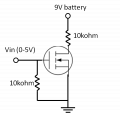
You can see my circuit below. What's weird is that there is always a voltage drop from 9V to 0V across the top resistor no matter what the voltage at the gate is. I would assume that if the mosfet was closed this wouldn't be the case.

I'm using this:
http://uk.rs-online.com/web/search/...searchProducts&searchTerm=708-4796+&x=38&y=14

And a 9V battery source.

I've also tried without the resistor. I just thought it might remove any potential charge that could build up.

Any insight would be appreciated.
 

Attachments

wayneh

Joined Sep 9, 2010
18,104
My guess is you've got the S and D pins reversed - an easy and common mistake. The Source should be grounded and the Drain at the bottom of the resistor.
 
There is always the possibility that the part is broken. Remove it from the circuit and measure the resistence between the source and drain. Flip the leads and measure again.
 

russpatterson

Joined Feb 1, 2010
353
Can you post more of your schematic? So you've got the "-" side of the 9V battery connected to the source of the MOSFET right? The drain is connected to the gound (low side) of the device you're controlling? The idea is to interrupt the low side of the circuit of the device you're controlling. Like installing a switch between the ground terminal of your device and the ground of your power supply (battery).

Is that a logic level MOSFET? If not you probably will need Vgs of 10V to switch it.
 

wayneh

Joined Sep 9, 2010
18,104
Try showing us a picture of your hook-up. Viewed from its front, the pinout is G-D-S. The gate is NOT the middle pin, and this is a common boo-boo.

I agree you might have a bad part, but you can't give up until we've completely ruled out the most common mistake - confusing the pins.
 
Last edited:

Thread Starter

ponjavic

Joined May 4, 2011
37
I'll update tomorrow guys, don't have access to the kit from home. It's very possible I've burned it, I have more so I'll try them.

I'll take some pics then, cheers!
 

Thread Starter

ponjavic

Joined May 4, 2011
37
Rookie mistake. MOSFET was broken because the first configuration i tried was source-D-S-resistor-ground. Then when I set up source-resistor-D-S-ground it wouldn't work. Just replaced the MOSFET and it works perfectly fine. The one I showed you is just for testing. I have a smaller logic one I will use for my circuit.

Many thanks.

Now to try the PWM and see if my cap and inductor can do what I want them to!
 

Thread Starter

ponjavic

Joined May 4, 2011
37
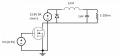
Hi guys, I've run this circuit with a 10k resistor, and it seems to do what it's supposed to but I'm still a little worried. Spice is telling me voltages could spike to about 30V with these values which would kill my peltier.

What do you think?

The circuit is below. The spice response to a 50% PWM 1kHz. Green is current and blue is voltage.
 

Attachments

kubeek

Joined Sep 20, 2005
5,796
What is the value of V2?
Is that supposed to be some kind of step up converter? Why do you need that diode?

ETA: ok now I see. How did you come to 1mH and 1000uF filter?
The transient on the start is OK, the peltier won´t really notice it as it is 10ms long.
 

Thread Starter

ponjavic

Joined May 4, 2011
37
What is the value of V2?
Is that supposed to be some kind of step up converter? Why do you need that diode?

ETA: ok now I see. How did you come to 1mH and 1000uF filter?
The transient on the start is OK, the peltier won´t really notice it as it is 10ms long.
I just played with the values in spice until I thought the ripple was small enough.

But what about the voltage spikes? Are they fine? Is it only the current supplied that matters?
 

kubeek

Joined Sep 20, 2005
5,796
Yes, the current is more important. Why do you need small ripple? It is a pletier so it has huge thermal capacity, that is a lowpass filter on its own. If the peltier doesn´t make a buzz, then you can leave just the transistor and its resistors.
 

Thread Starter

ponjavic

Joined May 4, 2011
37
The reasoning is to 1 protect the peltier and 2 more accurate current control but I suppose it might not really be necessary.

But now I've made it, and learned loads so why not :D

Now I'm going to see if it will blow up.
 

wayneh

Joined Sep 9, 2010
18,104
Now I'm going to see if it will blow up.
Keep an eye on the hot side temperature. In my experience the limiting factor is hot-side heat removal. This is because the TEC itself makes ~10X as much heat as it moves from one side to the other, and it all has to be taken away from the hot side. You need a good heat sink and fan.
 

Thread Starter

ponjavic

Joined May 4, 2011
37
Keep an eye on the hot side temperature. In my experience the limiting factor is hot-side heat removal. This is because the TEC itself makes ~10X as much heat as it moves from one side to the other, and it all has to be taken away from the hot side. You need a good heat sink and fan.
I'm heating :D
 

Thread Starter

ponjavic

Joined May 4, 2011
37
So apparently, the circuit works fine with a 10k resistor. As soon as I attach the peltier however the mosfet is always conducting, even though I'm using a 50% 500Hz wave.

It's the same circuit as I attached before. I've checked the circuit (as it is the same as the one I was using for the 10k) and I've checked that the mosfet is fine. My PWM is as expected according to the oscilloscope. Oscilloscope over the peltier shows a constant 13.8V.

Any ideas why this would happen? Basically it's like the mosfet is always on for some reason.

It's possible it has to do with the inductor and capacitor. I might just try the PWM peltier circuit without the filter like kubeek suggested, but I still think this should work...
 

Thread Starter

ponjavic

Joined May 4, 2011
37
Looks like the mosfet broke again :(

Maybe it can't take the high currents even though it's specced for it.

Ordered a new one with higher current capacity.
 
Top