Facebook
 Google
 GitHub
 Linkedin
Hello, I am trying to solve this exam circuit, with the specifics,
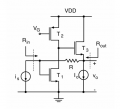
The circuit shown, where VDD = 2.5 V, VG = 1.6 V, and Io = 10µA, includes a small-signal, zero-average ideal current source is and a resistor R = 100 kΩ.
The circuit also includes a PMOS transistor and two NMOS enhancement transistors with the following characteristics:
T1: VTn = 0.5 V, k1 = 1/2 nCOXW1/L1= 4 mA/V^2;
T2: VTp = -0.5 V, k2 = 1/2 pCOXW2/L2= 1 mA/V^2;
T3: VTn = 0.5 V, k3 = 1/2 nCOXW3/L3= 100 µA/V^2;
Determine the operating point of the circuit, specifying the operating regions of the transistors, the currents in each branch, and the voltages at each node. Basically analysing the circuit in DC. So Ic can be ignored and considered as an open circuit in this question.
I'm finding difficulty in completing the question, I assume every mosfet is in saturation.
Focusing on the T2, applying the formula I get:
Id = k(Vsg-|Vt|)^2 = 0,16mA
And okay,
However, how do I keep going? On the node where T1, T2 and R meet (and also Vg of T3) I tried applying the KCL, let's call the node A:
It2 = It1 + Ir
And on the other node where R, T3 and Io meet, which I call node B:
It3 + Ir = Io
How do I keep going?
I had an idea of expanding the KCL on node A, while naming Vgs of T1 as Va:
It2 = It1 + Ir
0,16mA = k1(Va - Vt)^2 + (Va-Vb)R and solve by Va, however I don't have Vb either.
How do I keep going? Had it only been It2 and It1 then I would've simply solved for It1 = It2, R is giving me some trouble.
Another idea would be using a current divider on node B? But then again I'd have to assume T3 is on triode configuration and to access its gain voltage I need to learn voltage on node A first.
Help please?
Thank you and kind regards.
The circuit shown, where VDD = 2.5 V, VG = 1.6 V, and Io = 10µA, includes a small-signal, zero-average ideal current source is and a resistor R = 100 kΩ.
The circuit also includes a PMOS transistor and two NMOS enhancement transistors with the following characteristics:
T1: VTn = 0.5 V, k1 = 1/2 nCOXW1/L1= 4 mA/V^2;
T2: VTp = -0.5 V, k2 = 1/2 pCOXW2/L2= 1 mA/V^2;
T3: VTn = 0.5 V, k3 = 1/2 nCOXW3/L3= 100 µA/V^2;
Determine the operating point of the circuit, specifying the operating regions of the transistors, the currents in each branch, and the voltages at each node. Basically analysing the circuit in DC. So Ic can be ignored and considered as an open circuit in this question.
I'm finding difficulty in completing the question, I assume every mosfet is in saturation.
Focusing on the T2, applying the formula I get:
Id = k(Vsg-|Vt|)^2 = 0,16mA
And okay,
However, how do I keep going? On the node where T1, T2 and R meet (and also Vg of T3) I tried applying the KCL, let's call the node A:
It2 = It1 + Ir
And on the other node where R, T3 and Io meet, which I call node B:
It3 + Ir = Io
How do I keep going?
I had an idea of expanding the KCL on node A, while naming Vgs of T1 as Va:
It2 = It1 + Ir
0,16mA = k1(Va - Vt)^2 + (Va-Vb)R and solve by Va, however I don't have Vb either.
How do I keep going? Had it only been It2 and It1 then I would've simply solved for It1 = It2, R is giving me some trouble.
Another idea would be using a current divider on node B? But then again I'd have to assume T3 is on triode configuration and to access its gain voltage I need to learn voltage on node A first.
Help please?
Thank you and kind regards.
Attachments
-
 13.1 KB Views: 10
Last edited: