Model railway help

djsfantasi

Joined Apr 11, 2010
9,237
That's an interesting use of terms.
In the real RR world, the term "Block" has a different meaning, such as "signal block", meaning a track section with entry governed by signals. Or "Track Block", meaning a section of track that has been placed out of service for maintenance.

I guess I need to get used to the model RR terminology...:)
Model Railroaders usurped the term block when describing electrically isolated sections of track. Not all modelers understand nor know of the real railroad term.

I get your background. You’ve mentioned it before. So I feel like posting to bridge the gap in terms. I hope you find my posts useful.
 

eetech00

Joined Jun 8, 2013
4,705
Model Railroaders usurped the term block when describing electrically isolated sections of track. Not all modelers understand nor know of the real railroad term.

I get your background. You’ve mentioned it before. So I feel like posting to bridge the gap in terms. I hope you find my posts useful.
They are useful and welcome!
Thanks...
 
And lets not forget ABC, CTC, and TWC terms... :) Just to name a few more. Sorry, I'm not trying to confuse, but it is related to signaling on the full scale RR's. Like I said before, I was having a hard time understanding the OP's diagrams and such, but as what normally happens with me, it take a while to gel and sink in. :) Great thread though...
 

Thread Starter

RobertB72

Joined Feb 6, 2021
37
And lets not forget ABC, CTC, and TWC terms... :) Just to name a few more. Sorry, I'm not trying to confuse, but it is related to signaling on the full scale RR's. Like I said before, I was having a hard time understanding the OP's diagrams and such, but as what normally happens with me, it take a while to gel and sink in. :) Great thread though...
Incant believe how much I’ve learnt in a couple of days thank you to all
 

BobaMosfet

Joined Jul 1, 2009
2,211
OK.

The next thing we need is a table describing the light status based on the logical switch states.

Going forward, I'll call a electrical switch a "switch" and a track switch a "turnout".

What type of switches will be used to represent the state of each turnout?
Or will the switch actually control the position of the turnout?
As a former avid model railroader (HO-scale), I would recommend the following for simplicity:
  • Wire your LEDs in parallel, so that if one fails, it doesn't take a string out
  • Use the same LED for 3 colors, either one made to do 3 colors, or an RGB LED so you can do any color
  • Determine whether combinatorial logic arrays will do what you need, or an MCU
  • Automate it if you can, instead of manual signalling- manual will get tedious

IMHO
 

Thread Starter

RobertB72

Joined Feb 6, 2021
37
As a former avid model railroader (HO-scale), I would recommend the following for simplicity:
  • Wire your LEDs in parallel, so that if one fails, it doesn't take a string out
  • Use the same LED for 3 colors, either one made to do 3 colors, or an RGB LED so you can do any color
  • Determine whether combinatorial logic arrays will do what you need, or an MCU
  • Automate it if you can, instead of manual signalling- manual will get tedious

IMHO
The switching of the signals will be automatically controlled by the track switching
So when I change the turnout switch the signals will automatically go from red to green or green to red
 

BobaMosfet

Joined Jul 1, 2009
2,211
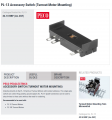
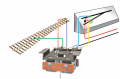
Just posting this here to help others reviewing this thread- more info:

1613585047677.png
and

1613585099877.png
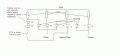
and more (see some electrical specs in upper image, above):

1613585289730.png

Hopefully this is useful (I found it online):

1613585384806.png
 

Thread Starter

RobertB72

Joined Feb 6, 2021
37
Just posting this here to help others reviewing this thread- more info:

View attachment 230687
and

View attachment 230688
Upper image has some useful electrical specs.
Been looking on eBay and Amazon for some starter electronic kits with breadboard and jumper cables leds resistors etc was surprised how reasonably priced things are
I’ve got a lot of time on my hands and will enjoy learning this I think
 
I’m designing a small model railway and want to use some led’s to make working signals
I’m going to mount two sets of signals at everywhere that the track splits at each set of points
Consisting of a red and green led on each post just simple traffic lights really
I want it so that a route can be seen but every set of these I’ve seen just indicate green to whatever way the point is set where as I want it that if the preceding point is set the other way any subsequent points will show red

I’m thinking of using on/on switches
Wiring each output terminal to one red one green from opposing signals
And then taking the negative of the green to the feed of the next switch
So that can only be green if the preceding switch is green and then linking the reds from the other feed so as soon as the first red is lit all following reds will be lit but can join this string at any point so the preceding ones won’t be lit but the following ones will be lit

at the end of the strings the negatives from the reds will just be earthed but the last green will feed a small string of leds to illuminate a panel for some sort of route display

I’m quite new to this although I think I have a reasonable understating of this
I use Reed relays mounted between the tracks and latching relays controlled by magnets fitted under the engines and n/c reeds to switch the signal back to red by releasing the latched relay. On my railway I set the points and the route and use switches on the point control to activate feather junction indicators.
I have smds as signals and black acetate for signal faces with heat shrink for signal shrouds. See my video here from around 3.00min.
https://youtube.com/@patrickwalker6039?feature=shared
 
Top