Mixed Voltage and Current source solution

Thread Starter

SamR

Joined Mar 19, 2019
5,470
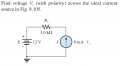
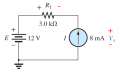
Here is the problem.
1741883082118.png
First I assign polarity.
1741883785471.png
Then KVL, E - IR1 - Vs = 0, 12V + -24V + -Vs = 0, .: Vs = 12V + -24V = -12V? BUT! 12V + -24V + -12V = -24V! and not 0 so...
Have I made a mistake in assigning polarity or...?
Also, why only multiply R1 by the current from the current source and not also add in the current from E?

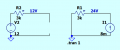
I also put it into LTS but then also confusion with which way the elements are placed with the correct current direction...
 

ericgibbs

Joined Jan 29, 2010
21,390
Hi Sam,
Remember, an ideal voltage source has zero internal resistance and an ideal current source has an infinite internal resistance.
E

Update:
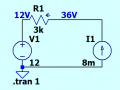
I also put it into LTS but then also confusion with which way the elements are placed with the correct current direction...
Hi,
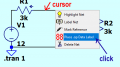
You can use this option in LTSpice
 

Attachments

Last edited:

Thread Starter

SamR

Joined Mar 19, 2019
5,470
That looks like what I got from LTS but the 36V puzzled me. Even if the other 2 12V were negative, it still doesn't zero out?

Remember, an ideal voltage source has zero internal resistance and an ideal current source has an infinite internal resistance.
I see that attributed to Malvino but Boylestad, Floyd, and Grob failed to metion that one. Boylestad has Voltage sources with a serial resistance value and Current sources with a parallel resistance value. Which, in this case, is missing?

I did consider converting the battery and resistor to a current source but they cannot exist in series.
 

crutschow

Joined Mar 14, 2008
38,316
Here is the problem.
................................
Then KVL, E - IR1 - Vs = 0, 12V + -24V + -Vs = 0, .: Vs = 12V + -24V = -12V? BUT! 12V + -24V + -12V = -24V! and not 0 so...
Have I made a mistake in assigning polarity or...?
Also, why only multiply R1 by the current from the current source and not also add in the current from E?
Your are overthinking.
So, you know the current through R1 is equal to the current-source's value of 8mA and its direction, so you can determine the voltage drop and its polarity across R1 from that.
E can have no effect on the current as that's determined by the current-source.
Then you just add E's voltage to that.
 

Thread Starter

SamR

Joined Mar 19, 2019
5,470
Then you just add E's voltage to that.
So, I do have the polarity wrong for the resistor! E + VR1 = VS, 12V + 24V = 36V and VS is 36V! Which due to the currents direction is actually -36V in the circuit.

PS Yes, I do tend to overthink things too much...
 
Last edited:

crutschow

Joined Mar 14, 2008
38,316
So, I do have the polarity wrong for the resistor! E + VR1 = VS, 12V + 24V = 36V and VS is 36V! Which due to it direction is actually -36V in the circuit.
What do you mean "due to it direction is actually -36V in the circuit"?
It's +36V.
 

Thread Starter

SamR

Joined Mar 19, 2019
5,470
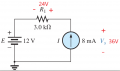
E + VR1 + -Vs = 0, 12V +24V + -36V = 0 .: Vs = 36V in opposing polarity ie -36V
Yes, the absolute value is 36V! The question does ask for the value of Vs with polarity.

1741890281090.png
 
Last edited:

WBahn

Joined Mar 31, 2012
32,703
Here is the problem.
View attachment 344466
First I assign polarity.
View attachment 344467
Then KVL, E - IR1 - Vs = 0, 12V + -24V + -Vs = 0, .: Vs = 12V + -24V = -12V? BUT! 12V + -24V + -12V = -24V! and not 0 so...
Have I made a mistake in assigning polarity or...?
Also, why only multiply R1 by the current from the current source and not also add in the current from E?

I also put it into LTS but then also confusion with which way the elements are placed with the correct current direction...
The thing to remember about ideal voltage and current sources is that an ideal voltage source will source or sink any amount of current necessary, be it positive, negative, or zero, to maintain it's programmed voltage across its terminals. An ideal current source will produce any amount of voltage across its terminals, be it positive, negative, or zero, to maintain it's programmed current through it.

Since you have a single loop in this problem, the current source will dictate the current in the loop, which will be 8 mA flowing counter-clockwise. The current is therefore flowing right-to-left through the resistor, which requires that the right-hand side be 24 V higher than the left-hand side. Now we can use the voltage source to find the voltage across the current source. Starting from the bottom of the current source, we just need to find a path to the top of the current source along which we know all of the voltage gains and add them up. The bottom of the current source is at the same potential as the bottom of the voltage source. We then gain 12 V to get to the left-hand side of the resistor and we gain another 24 V to get to the right-hand side of it, which is also the top of the current source. So the top of the current source is 36 V higher than the than the bottom of it.

The effect that the voltage source has is to force the current source to put out 12 V more voltage than it otherwise would have in order to get the 8 mA to flow through the circuit.
 

Thread Starter

SamR

Joined Mar 19, 2019
5,470
To me, it was a bit of a trick question as the 12V battery is sitting there with 0A current from it. At first glance I "assumed" the R1 polarity was defined by the battery's polarity and it was not.
 

BobTPH

Joined Jun 5, 2013
11,463
To me, it was a bit of a trick question as the 12V battery is sitting there with 0A current from it. At first glance I "assumed" the R1 polarity was defined by the battery's polarity and it was not.
The polarity you choose does not matter at all. The problem crept in when you did not make the current negative since it was opposite from the direction you assigned for the voltage drop across the resistor.
 

Thread Starter

SamR

Joined Mar 19, 2019
5,470
I initially set the polarity of R1 based on the battery which, in this case, was wrong because the actual circuits current was entirely from the current source. The battery was a "Red Herring" as it actually had no effect on the circuit. It just sat there and did nothing. In reality, it should have internal resistance giving a voltage drop due to the current across it. Which is why, to me, it was a trick question...
 

BobTPH

Joined Jun 5, 2013
11,463
initially set the polarity of R1 based on the battery which, in this case, was wrong because the actual circuits current was entirely from the current source.
The chosen polarity makes no difference. If it is “wrong” it just means the answer for the voltage will be negative.

In your case, you showed a voltage drop from left to right. But the current is flowing from left to right. Thus, when you put the voltage drop in the equation, I is negative, which you did not do, so your answer was wrong.

In this case, you can tell the direction of the current because it was given. But that is always the case. Everything works no matter which polarity you choose, but you need to be consistent. Look at any tutorial on KVL if you don’t believe me.
 

Thread Starter

SamR

Joined Mar 19, 2019
5,470
In this case, you can tell the direction of the current because it was given.
Yes, but I "assumed" there was also a current from the battery opposing the current source. I was wrong! Can an opposing greater current actually pass through a current source? That was part of my assumption. Apparently, it can pass through the battery in this instance.
 

crutschow

Joined Mar 14, 2008
38,316
The battery was a "Red Herring" as it actually had no effect on the circuit. It just sat there and did nothing. In reality, it should have internal resistance giving a voltage drop due to the current across it. Which is why, to me, it was a trick question...
Not really.
A real battery would likely have negligible impedance compared to 3.0k, so adding that battery impedance would have little effect on the solution.
The question was not a "trick", it was just to see if you understand what a voltage source and current source do when connected in series.
Can an opposing greater current actually pass through a current source?
No.
By definition, an ideal current source has an infinite resistance (its current is unaffected by the voltage across it), so the current passing through it is as stated by its value, no more, no less.
 

WBahn

Joined Mar 31, 2012
32,703
To me, it was a bit of a trick question as the 12V battery is sitting there with 0A current from it. At first glance I "assumed" the R1 polarity was defined by the battery's polarity and it was not.
The 12 V battery does NOT have 0 A through it. It has 8 mA flowing through it, but it is being charged and is acting like a load.

It does have an effect on the circuit. The voltage across the current source is not the same without it.

Without the battery, the current source is providing 192 mW of power, all of which is being dissipated as heat in the resistor. With the battery, the current source is providing 288 mW of power, 192 mW of which is getting dumped in the resistor and the rest, 96 mW, is getting dumped in the battery. How the battery responds to this depends on the type of battery and its present state of charge, neither of which we know and it doesn't matter for this analysis problem.
 

WBahn

Joined Mar 31, 2012
32,703
I initially set the polarity of R1 based on the battery which, in this case, was wrong because the actual circuits current was entirely from the current source. The battery was a "Red Herring" as it actually had no effect on the circuit. It just sat there and did nothing. In reality, it should have internal resistance giving a voltage drop due to the current across it. Which is why, to me, it was a trick question...
As pointed out previously, it does have an effect on the circuit.

I think you are grasping at straws thinking that having some internal resistance is going to change much. A typical car battery has an internal resistance of a few milliohms, so add a 10 mΩ internal resistance to your battery and see what changes? Heck, make it 10 Ω, which is a huge internal resistance, and see what changes. Not much.

Also, current does not flow "across" things, it flows "through" things. Similarly, voltage does not appear through things (the other sloppy terminology people use), but rather across them.
 

WBahn

Joined Mar 31, 2012
32,703
Yes, but I "assumed" there was also a current from the battery opposing the current source. I was wrong! Can an opposing greater current actually pass through a current source? That was part of my assumption. Apparently, it can pass through the battery in this instance.
Again, keep in mind what a voltage source (the battery) does. It will deliver or accept any current through it necessary to maintain the voltage at its terminals. The battery in your car is a fair approximation to an ideal voltage source over a very large range of currents, from microamps to hundreds of amperes, and in either direction (i.e., charging or discharging). The voltage across it stays relatively constant (not perfectly constant, it is, after all, not an ideal voltage source).

A current source, on the other hand, will produce whatever voltage is needed across its terminals in order to maintain its current output. Even if that means that it had to accept a negative voltage across it and act as a load.

An ideal current source cannot be forced to have a different current through it, just like an ideal voltage source can't be forced to have a different voltage across it.

A real current source (one having non-infinite internal resistance) will have a current that changes with conditions, just as a real voltage source (one having non-zero internal resistance) will have a voltage that changes with conditions.
 

MrAl

Joined Jun 17, 2014
13,667
Here is the problem.
View attachment 344466
First I assign polarity.
View attachment 344467
Then KVL, E - IR1 - Vs = 0, 12V + -24V + -Vs = 0, .: Vs = 12V + -24V = -12V? BUT! 12V + -24V + -12V = -24V! and not 0 so...
Have I made a mistake in assigning polarity or...?
Also, why only multiply R1 by the current from the current source and not also add in the current from E?

I also put it into LTS but then also confusion with which way the elements are placed with the correct current direction...
Hi,

I'd like to add a few tips for this circuit.

First, you can assume any polarity you wish for R1. It does not matter because the assumed polarity does not have to match the real world polarity.
If you assign plus to the left and minus to the right and call that voltage vR1 (as you are doing more or less) then if the final polarity as measured turned out to be minus on the left and plus on the right, then you would just get a voltage for vR1 that is negative. You would then see that since your original assumption was reversed, you just have to reverse the calculated voltage from some minus value to the same value only positive. If you originally assume plus on the right and minus on the left, then you would not have to flip the final polarity.

Second, try setting E=0 and solving for the voltage at the right side of the resistor using only the current source. That should give you some intuition about this.

Third, you can in fact convert the E source to a current source using Norton/Thevenin source conversion techniques as you do not end up with two current sources in series (which as you know would be nuts). You can do this because the equivalent would be E would change to a current source I but it would also have a resistor in parallel with it, and that is much different than just a lone secondary current source. The idea of the NT conversion here is that "A resistor in series with a voltage source is equivalent to a resistor in parallel with a current source", so it's not just a current source it becomes two circuit elements now.
I am sure you know how to calculate this so why don't you try it again using this idea?

Fourth, you could check your work using superposition. Kill the source E (set it equal to 0 volts) and calculate the voltage at the right side of R1, then open circuit the current source and restore the E source and calculate the new voltage again at the right side of R1. You then add the two resulting voltages to get the final voltage at the right side of R1. Once you have that you already the left side voltage so that pretty much finishes it. For linear circuits this is a valid method.
 
Top