Microwave repair: humming noise / fuse blown

Thread Starter

adam555

Joined Aug 17, 2013
858
Hi,

Yesterday when turning on my microwave I heard a strange humming noise; louder than the usual noise the microwave makes. It lasted for about 3 seconds and then stopped. Left it on as usual, but everything inside it was still cold. I opened it today and found that a fuse that goes from the high voltage capacitor to the high voltage transformer was blown. I thought about changing the fuse, but since I haven't fixed anything else I guess I will blow it again; in fact I tried it for a second without the fuse and the humming noise is still there.

Anyone knows what could be reason for the noise and for blowing the fuse?

Thanks in advance.
 

Thread Starter

adam555

Joined Aug 17, 2013
858
By the way, I also tested the high voltage capacitor and its internal resistor and they seem to be working fine.
 

Thread Starter

adam555

Joined Aug 17, 2013
858
If it's the transformer or the magnetron, or any other expensive component I'll just buy a new one. :(

Is there any way to test it?
 

Thread Starter

adam555

Joined Aug 17, 2013
858
Thanks Max, it's the magnetron.

I just tested it for a second without the fuse -as I don't have a replacement at home- and I couldn't hear the sound with the magnetron disconnected; so it must come from it.
 

Thread Starter

adam555

Joined Aug 17, 2013
858
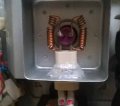
It's definitely the magnetron: I found a short to ground in the leads casing which leaks to the magnetron's chasis.

Right now I'm on my second attempt to fix it by isolating it with hot glue, but it's looking quite bad; the high voltage keeps to arching to the case.
 

Thread Starter

adam555

Joined Aug 17, 2013
858
I think I got it. I cut the part of the chassis that touches the leads casing -preventing the short- and the hot glue also seems to stop the high voltage arch. Now I don't hear the noise anymore and don't see any leak, but I still need to try it with the fuse in place; for which I don't have a replacement at home.

magnetron.jpg
 

alfacliff

Joined Dec 13, 2013
2,458
hivoltage dope, ( glyptol) is a good insulator, I used it on horizontal output stages in tv's for years. a few coats will stop 50kv or more. the part number from GC is 10-9002-A
 

Thread Starter

adam555

Joined Aug 17, 2013
858
Thanks for the advice. I'll replace the hot glue when it fails again.

I looked for a replacement magnetron, but this Panasonic model is more expensive than some new microwaves.
 

ian field

Joined Oct 27, 2012
6,536
Hi,

Yesterday when turning on my microwave I heard a strange humming noise; louder than the usual noise the microwave makes. It lasted for about 3 seconds and then stopped. Left it on as usual, but everything inside it was still cold. I opened it today and found that a fuse that goes from the high voltage capacitor to the high voltage transformer was blown. I thought about changing the fuse, but since I haven't fixed anything else I guess I will blow it again; in fact I tried it for a second without the fuse and the humming noise is still there.

Anyone knows what could be reason for the noise and for blowing the fuse?

Thanks in advance.
First of all - the transformer secondary is 2kV at easily enough current to fry you, the 4kV after the doubler isn't much less dangerous - and can jump further!

First of all unplug from the mains and unhook the crimp terminal that goes to the doubler from the tag on the transformer, fit a new fuse and plug it back into the mains - with the transformer still buzzes loudly with no load on the secondary; you've found the problem.

The capacitor can self-heal, I had one on the bench with a blown fuse and no obvious cause (random fuse blowing can be a dangerous fault in the door interlock!). Only with a detailed inspection, I found a "pimple" on the capacitor casing where the blast from a breakdown had dented it from the inside.

In rare cases, the magnetron can short, so disconnect the cathode/filament tags and run it again to check for loud buzzing. If the diode and capacitor are both OK, this test will leave the capacitor charged to over 2kV - you should get a fat spark discharging the capacitor with a screwdriver.

Some microwaves have an additional component in the HV section with a symbol like a sidac on it - these frequently fail S/C.
 

Thread Starter

adam555

Joined Aug 17, 2013
858
Thanks; it's working fine for now with the fix.

I realize how dangerous those voltages are, so before I even opened it for the first time I searched on the internet what to expect inside and how to handle it safely.
 

Thread Starter

adam555

Joined Aug 17, 2013
858
I tried to stay away from it, but couldn't resist giving it a try. You know that they say: curiosity killed the cat. ;)

I guess once the fuse is replaced it shouldn't be more dangerous than any other microwave developing the same problem; which seems to be quite common. Actually, I also found that fix on the internet.
 

Dr.killjoy

Joined Apr 28, 2013
1,196
I tried to stay away from it, but couldn't resist giving it a try. You know that they say: curiosity killed the cat. ;)

I guess once the fuse is replaced it shouldn't be more dangerous than any other microwave developing the same problem; which seems to be quite common. Actually, I also found that fix on the internet.
I believe satisfaction brought him back ..
I am glad you fixed it and it worked out great.. Keep it going and be safe..


Jay Sr
 

ian field

Joined Oct 27, 2012
6,536
Personal I would just buy a new microwave and stay away from the safety hazard..
Its a long time since I bought a microwave - some people in the flats just leave them in the corridor because they're too lazy to take them down to the bin room.

Most I bothered to rescue, only had very minor faults - on one, the only fault was a wrongly wired mains plug so the metal case was live.

Recently I won a microwave/grill combo - the only thing wrong was a blown bulb.

Its lined up ready to use - just waiting for the last rescue to conk out.
 
Top