Microphone capsule Driver

Thread Starter

Arjune

Joined Jan 6, 2018
354
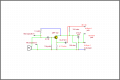
I bought a CAD gxl 1800 condenser microphone on Amazon but found that it had too much noise and gain. I removed the preamp board inside and added my own preamp using the mpf 102. Although not that sensitive, it is better now. I use my microphone to record my rap because I like to rap. The schematic is included here. You can wire it on a breadboard or make a printed circuit board which is about 1 and 1/4 in by one and a quarter inch. It fits in the microphone housing without a problem and the microphone housing serves as a shield. The microphone case is easy to open--you just have to unscrew the bottom. It is imperative that you use 1 Gigaohm resistors where specified. I would imagine if they were two gigaohms, the mic would be more sensitive, it's up to you. The 10 microfarad capacitor in the circuit has to be reversed or non-polarized. The bottom of the fet in the schematic is the source and the top is the drain and the one with the arrow is the gate. mic-capsule driver .pngmic-capsule driver .png
 
Last edited:

MisterBill2

Joined Jan 23, 2018
27,254
I question the validity of a circuit showing a one-gigohm resistor. WHAT value did the TS actually use?? Certainly current thru a resistor will generate a bit of noise.
I also question the three connections to the XLR connector, specifically the connection tying one of the phantom power feeds directly from positive to negative.
 

Thread Starter

Arjune

Joined Jan 6, 2018
354
How much noise are you seeing in given circuit?
With my circuit it's about 3% intermittent noise compared to the microphone voice volume. I'm guessing the noise could be due to my power supply used for phantom power. I think it has an output about 40 volts DC. I know it should be 48 volts DC but it works. I would have to open the box of my preamp that I made to be sure. I'm using an AC transformer I think that's about 10 volts as power input with a voltage tripler and a transistor filter for hum and maybe I didn't put a capacitor at the emitter of the transistor filter output to ground to neutralized possible noise from the transistor. With the original microphone circuit of the microphone the noise level is about 15% compared to The voice output level of the microphone. I'm sorry I don't know how to put this in decibels, I had a hard time understanding mathematics in high school. It's still very hard for me to understand math, probably because the state of theory in my brain is neutralizing easy understanding of math. It is possible that the microphone capsule of the CAD is faulty. All in all I'm satisfied with my mic preamp and I don't think I'll change anything. The preamp I made uses an op-amp to amplify the signal from the CAD microphone circuit I made in the microphone. I'm speculating that noise is also probably coming from the op-amp. I don't mean to confuse anybody but I'm having a difficult time with logic explaining the order of reasoning of what is the situation. As you all may know I I'm a schizophrenic from my profile.
 

Thread Starter

Arjune

Joined Jan 6, 2018
354
I question the validity of a circuit showing a one-gigohm resistor. WHAT value did the TS actually use?? Certainly current thru a resistor will generate a bit of noise.
I also question the three connections to the XLR connector, specifically the connection tying one of the phantom power feeds directly from positive to negative.
The phantom power in the preamp I built is not directly connected to the positive of the circuit but through I think a 4.7 k resistor. I would have to open the pre-amp mixer box to be sure. Sorry about the ambiguity but I'm hesitant to try things thinking I doubt I'll solve the problem no matter what I do because of my paranoia believing there are unknown forces limiting the capabilities of my mind and my ability to change the physical results I experienced due to my understanding of the circuit. Those resistors of the capsule positive and the gate of the FET are actually 1 gigaom I bought on eBay. It was 10 for about $10 and I don't have an instrument to measure that level of resistance to be sure it's 1 Gigaohm. I understand that the capsule capacitor is polarized and it has a resistance of several Gigaohms with a capacitance in Pico farads so I don't see why 1 Giga ohm shouldn't work although your question them. The input resistance of the mpf 102 should be several Giga ohms so I don't see why there would be a problem with that resistor at the gate. I can proudly say that the circuit works inside the CAD microphone. I don't mean to violate your confidence or integrity because of my limited understanding of electronics and my confidence of what I'm doing with my capabilities. The paradox of schizophrenia is that it forces you to be humble and initiating function to solve problems is with resilience because of uncertainty of end results because we are not directly controlled by time.
 

MrChips

Joined Oct 2, 2009
34,667
When drawing circuit schematics, use component identifiers such as R1, C2, etc.
This allows us to make reference to a specific component rather than having to guess which 1GΩ resistor you mean.
 

Thread Starter

Arjune

Joined Jan 6, 2018
354
When drawing circuit schematics, use component identifiers such as R1, C2, etc.
This allows us to make reference to a specific component rather than having to guess which 1GΩ resistor you mean.
I understand and agree with you Mr chips but you have to understand that I assume that people have insight like me. With insight you have possibility thinking that introduce unknown variables of thought at play that introduce query for ones speculation of other possibilities that question one for learning because of the unspecified. This is the trait of mental illness. Nevertheless I am in error and I would not deny that.
 

MisterBill2

Joined Jan 23, 2018
27,254
I understand and agree with you Mr chips but you have to understand that I assume that people have insight like me. With insight you have possibility thinking that introduce unknown variables of thought at play that introduce query for ones speculation of other possibilities that question one for learning because of the unspecified. This is the trait of mental illness. Nevertheless I am in error and I would not deny that.
I have a whole lot of insight, experience, and education. AND, I ALSO FAVOR IDENTIFYING COMPONENTS, the simplest way being with a letter and numbers in sequence ! Because MIND READING is not one of my abilities. So even just sticking a letter, in sequence, by each component will work.
 

Thread Starter

Arjune

Joined Jan 6, 2018
354
You don't seem to have humility for mental illness and does not respect my capabilities and individuality. Just like you want to be yourself I would like to be myself.
 

MisterBill2

Joined Jan 23, 2018
27,254
I intend no statement about mental health, nor about mental abilities, no intent at all!!!

My statement was about adding identification to individual components to help others participate in providing assistance.
My statement intended nothing else.
There is no reason to assume that others are as familiar with the circuit shown as you are.
There is no reason to think that all who see the circuit know what you know.
 

drjohsmith

Joined Dec 13, 2021
1,571
Interesting stuff @Arjune
What is your intention ?
There are many capacitor microphone circuits on line, and many phantom power receiveres. Generally, the 48 v of phantom power is applied across the two signals pins using a centre tap transformer , or capacitors, and the other side is the ground reference.

https://en.m.wikipedia.org/wiki/Phantom_power

https://www.eleccircuit.com/circuit-premic-condenser-into-electrical-signals/

Btw. I dont know how id solder a 1 giga ohm resistor , would not the solder flux be around this value .,
 
Last edited:

MisterBill2

Joined Jan 23, 2018
27,254
Interesting stuff @Arjune
What is your intention ?
There are many capacitor microphone circuits on line, and many phantom power receiveres. Generally, the 48 v of phantom power is applied across the two signals pins using a centre tap transformer , or capacitors, and the other side is the ground reference.

https://en.m.wikipedia.org/wiki/Phantom_power

https://www.eleccircuit.com/circuit-premic-condenser-into-electrical-signals/

Btw. I dont know how id solder a 1 giga ohm resistor , would not the solder flux be around this value .,
PHANTOM POWER is NEVER applied ACROSS the two signal sides of a microphone connection. It is applied identically to both signal pins relative to the shield potential line. Any other scheme, in violation of that standard, may instantly damage a microphone element far beyond repair.
 

drjohsmith

Joined Dec 13, 2021
1,571
PHANTOM POWER is NEVER applied ACROSS the two signal sides of a microphone connection. It is applied identically to both signal pins relative to the shield potential line. Any other scheme, in violation of that standard, may instantly damage a microphone element far beyond repair.
Thank you @MisterBill2
Is that not what I said, and backed up by the link I provided ?
There was an old system where 48v is applied to one pin of the din plug as it used to be , as the links @bertus shared, but yes thats a good way of killing a microphone .
 

Thread Starter

Arjune

Joined Jan 6, 2018
354
Interesting stuff @Arjune
What is your intention ?
There are many capacitor microphone circuits on line, and many phantom power receiveres. Generally, the 48 v of phantom power is applied across the two signals pins using a centre tap transformer , or capacitors, and the other side is the ground reference.

https://en.m.wikipedia.org/wiki/Phantom_power

https://www.eleccircuit.com/circuit-premic-condenser-into-electrical-signals/

Btw. I dont know how id solder a 1 giga ohm resistor , would not the solder flux be around this value .,
I have no instrument that can measure the resistance of the flux. I'm assuming it's higher than 1 giga ohms
 

drjohsmith

Joined Dec 13, 2021
1,571
I have no instrument that can measure the resistance of the flux. I'm assuming it's higher than 1 giga ohms
Unlikely, not least flux absorbs water and attracts dust etc
10 of Meg would be a good starting point per square.
( Sheet resistance like flux on a board, is measured in ohm per square )
And if you dont clean it , who knows.
Whats the size of your Gohm resistor ?
If your interested in this, look at the manufacturer's sites that make such high value resistors, they will have data ipon line as to how to mount, pad shapes, gaps on boards etc.
 
[QUOTE="Arjune, post: 1991905, mem .
[/QUOTE]
First of all, Kudos for your mod, and thanks for posting it. I would never suggest opening your mic, since your design works. But, it is strange that your top 1 GigaOhm resistor is not BEHIND the input capacitor ( like the bottom 1G). With an FET in emitter-follower mode, that is what is normally done. Also, you would add another 14M Ohm (about) to the top resistor to give the FET a negative bias (about 0.7 volts).
The J113 is a good replacement for the FET you chose, if people cannot find it.
For your OpAmp, the NE5532 is supposed to be very low noise.
 
Top