Measuring Transistors

Thread Starter

Milkgod

Joined Mar 9, 2017
21
Hello, I'm not sure how to go about measuring the voltages and current of the B/C/E of the transistor. Here is the circuit that I was tasked to create:
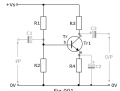
original circuit.PNG

and here is the circuit i created in multisim:
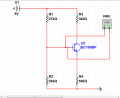
transistor circuit.PNG

9v was used as the VS because the task specified to use 5v+n n being a single digit number.

I need to measure

a) base voltage, Vb

b) emitter voltage, Ve

c) collector voltage, Vc

d) total current, It

e) base current, Ib

f) collector current, Ic

g) static current gain, hfe

I'd like to do it with the meter if possible so I can know how to use a meter in real life if i need to.
 

MrChips

Joined Oct 2, 2009
34,810
Look at the diagram from your simulator that you posted.
Look at the voltmeter XMM1.
Ask yourself what is the voltage being measured by XMM1?
You are measuring the voltage difference at the inputs of XMM1 which are connected to the same node in your circuit. Your measurement will be 0V.
Move the -ve lead to the XMM1 and connect this to GND instead.
 

Thread Starter

Milkgod

Joined Mar 9, 2017
21
Look at the diagram from your simulator that you posted.
Look at the voltmeter XMM1.
Ask yourself what is the voltage being measured by XMM1?
You are measuring the voltage difference at the inputs of XMM1 which are connected to the same node in your circuit. Your measurement will be 0V.
Move the -ve lead to the XMM1 and connect this to GND instead.
Thanks for that. Helped me get through the first few questions. If I have to work out the total current can I just measure the voltage of the whole circuit, resistance of the whole circuit and use that to work out the current?
 

MrChips

Joined Oct 2, 2009
34,810
To measure current, one way is to measure the voltage across a resistance. You don't know the total resistance of the circuit.
You can do this for R1, R2, R3, and R4 since you know the resistances.

Look at the node where R1 and R3 are connected. Measure the voltage across R1. Measure the voltage across R3. Calculate the currents through R1 and R3. What does this tell you about the total current through the circuit?

Do the same with R2 and R4.

How do you determine the current to the base of the transistor?
What is the current through R1?
What is the current through R2?
What is the current to the base of the transistor?
 

dl324

Joined Mar 30, 2015
18,326
If I were you, I wouldn't become too dependent on simulators at your current level of knowledge. You need to put in the time and effort to grasp the fundamentals or you'll be lost without a simulator.

Regarding measuring current. I'd suggest that you use Ohm's Law. Measure a voltage drop across a resistor and calculate current. Real meters can have noticeable effects on whatever it is that you're trying to measure. Reading voltages with DMM's is straightforward because even the cheap ones have high input resistance, but the same can't be said when it comes to measuring current.
 

Thread Starter

Milkgod

Joined Mar 9, 2017
21
If I were you, I wouldn't become too dependent on simulators at your current level of knowledge. You need to put in the time and effort to grasp the fundamentals or you'll be lost without a simulator.

Regarding measuring current. I'd suggest that you use Ohm's Law. Measure a voltage drop across a resistor and calculate current. Real meters can have noticeable effects on whatever it is that you're trying to measure. Reading voltages with DMM's is straightforward because even the cheap ones have high input resistance, but the same can't be said when it comes to measuring current.
Honestly I would through this whole course in the bin if it wasn't for the fact I've got less then 3 months or less before it ends. I don't intend on going into electronics after this at all. This whole course has put me off more then ever. Thanks for the advice. I measured the circuit resistance then used the Vs+ as the circuit voltage but I'm thinking now that this is probably not right.
 

MrChips

Joined Oct 2, 2009
34,810
Yes, we can see from your first post that perhaps electronics was not meant for you. Just for curiosity, I would like to know what course and undergraduate program at what university are you taking?

Did you do physics in GCSE?
Current, voltage and Ohm's Law should have been mastered in high school before moving on to electronic circuits.
 

dl324

Joined Mar 30, 2015
18,326
I don't intend on going into electronics after this at all. This whole course has put me off more then ever.
Electronics isn't for everyone. It takes a lot of effort to become proficient. If it was easy, everyone would be an electrical engineer...

I remember struggling with concepts early on, but giving up was never an option so I kept at it.

Somewhere along the line, you missed some basic concepts. What you're doing is like using a calculator to add a couple two digit numbers.

Since this is homework, I can't just tell you how to find the answers you're looking for; but it's pretty simple once you know where to start.
 

BR-549

Joined Sep 22, 2013
4,931
That's a shame. It does take a certain amount of faith when you first start out with this.

It's because it's so different and foreign from other things. And it's hard to observe without equipment. But, once you start getting the hang of it........there's nothing neater.

One needs to be fascinated and curious about working with the invisible forces.

Modern wizardry. Takes dedication.
 
Top