Measuring tiny currents

Thread Starter

Homebrew1964

Joined Nov 22, 2024
242
What would give me better accuracy when measuring really small currents.

measuring with a multimeter on the amps range or measuring the voltage across a resistor and applying ohms law?
 

WBahn

Joined Mar 31, 2012
32,933
What would give me better accuracy when measuring really small currents.

measuring with a multimeter on the amps range or measuring the voltage across a resistor and applying ohms law?
Depends.

What do you consider a "really small current"? Huge difference between trying to measure 1 mA vs 1 µA vs 1 nA vs 1 pA.

When you say "multimeter on the amps range" do you really mean on the amps, versus one of the millamp, ranges?

But the real determining factor is how much either measurement will disturb what is being measured.

If I have a circuit that is using feedback to control the current through the load, then I can put a large resistor in series with it and get a high resolution measurement while having very little impact by measuring the voltage across it. But, at some point, the presence of the meter will change the measurement because the current flowing through the voltmeter becomes a non-negligible portion of the total current. But if the load resistance is itself very large, then putting a large resistor in series with it can disturb the measurement too much.

At the end of the day, nearly all ammeters are actually measuring the voltage across a resistor that is placed in series with the load. The problem is that the circuit with and without the ammeter inserted can be significantly different and what you really want to know is how much current is flowing when the ammeter is NOT in the circuit, but all you do know if how much current is flowing when it IS. The advantage of measuring the voltage across a current sense resistor is that you can leave the current sense resistor in the circuit whether you are making the measurement or not. As a result, the current you measure with the voltmeter in place is nearly identical to what is flowing when it is not, provided the meter's resistance is significantly greater than the current sense resistor. Most modern DMMs have a voltmeter input resistance of 10 MΩ. As long as the current sense resistor is not more than about 100 kΩ, your reading is disturbed by less than 1%, which is on par with the intrinsic accuracy of most such meters. A 100 kΩ resistor gives you 1 V per 10 µA of current.
 

Thread Starter

Homebrew1964

Joined Nov 22, 2024
242
I can see this can get quite involved with many factors possibly affecting the measurement

I'll try this out on the bench when i get time and see what results i come up with.

thanks.
 

crutschow

Joined Mar 14, 2008
38,543
In particular, check out the burden voltage of your multimeter - it is often disappointingly large so can in itself influence the current being measured.
Yes, this is something to consider.
The full-scale voltage for common multimeters that have a 200mV minimum DC voltage range is 200mV when measuring current.
This can thus affect the accuracy of the current measurement if measuring current in low voltage circuits.
 

BobTPH

Joined Jun 5, 2013
11,557
Just to put that in perspective: On a range that measures uA (up to 200), that means a 1K resistor is inserted in the circuit.
 

Jerry-Hat-Trick

Joined Aug 31, 2022
829
Back in the day, when I was learning physics at school, we used a galvanometer which is a very sensitive moving coil ammeter, typically with a small mirror to deflect a beam of light giving a large optical movement for small deflections. Still probably a very practical way to measure small currents. Analogue moving coil meters typically have negligible resistance so they can be used to measure voltage with a high value resistor in series. If you are looking for a reliable way to measure low currents with minimal circuit disturbance I’d seriously consider using analogue
 

AA+

Joined Jan 4, 2014
7
My old Fluke 73 is 6mV/mA, on 320mA range is nearly 2V
You need an electrometer circuit, which is a perfect ammeter. Its only difficulty is that the current is measured at 0VDC. An electrometer circuit consists of one op-amp, (+) input grounded, (-) input as current entering, and (output) connected to (-) input with a resistor. The current readout is I = V/R, measure the output voltage to determine current.
Best wishes --- Allen Anway
 
The smallest current resolution I have found is with a pretty standard multimeter, which has 10MegOhm input resistance on the voltage ranges. Using the 200mV range, the current at full scale is 20nA, and the resolution is 10pA. Obviously the displayed number is 10 times too high, but that's easy to work with on the few occasions where I need to measure such low currents.
The worst offenders in terms of voltage drop with current measurements are the autoranging multimeters, with burdens much higher than 200mV on certain ranges (which of course a selected automatically). But note that 200mV can already be a problem when doing current measurements on 3V circuits. The industry should really change to a 20mV drop at full scale instead of the current standard of 200mV.
 

Rf300

Joined Apr 18, 2025
95
You need an electrometer circuit, which is a perfect ammeter. Its only difficulty is that the current is measured at 0VDC. An electrometer circuit consists of one op-amp, (+) input grounded, (-) input as current entering, and (output) connected to (-) input with a resistor. The current readout is I = V/R, measure the output voltage to determine current.
Best wishes --- Allen Anway
I think this is the best way to measure low currents. However the TS should not use the good old 741 OP-amp but look at TI or AD for an OP-amp with FET-inputs. Those avoid the errors caused by input bias currents.
 
If your meter has multiple current scales, you can reduce the effect it has on the circuit (making it use smaller value series resistor) by using the scales intended for higher current. The tradeoff is reduced resolution, which might be acceptable, especially if the meter has a high-resolution ADC (sometimes described as the number of "counts").
 

Danko

Joined Nov 22, 2017
2,176
No longer available AFAIK.
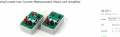
https://www.n-fuse.co/de/devices/ti...t-Measurement-Shunt-and-Amplifier-Device.html
1782182715077.png
Originally designed and sold by Dave Jones on the EEVBLOG, this derivative has several enhancements specifically for measuring varying currents on today's low power devices. Switch mode voltage regulators and the varying current draw of MCUs and RF chips require the determination of the current draw over time to calculate the total power consumption of a device. A storage oscilloscope is a perfect tool for this task and widely available. That's why the tinyCurrent features a BNC connector to reduce the picked-up noise while measuring with an and oscilloscope. Another problem is the high dynamics in power draw caused by the aforementioned reasons. This is addressed by the possibility to power the device from an external source with up to 5.5 V and the possibility to tweak the device for a higher maximum output voltage. Both measures combined lead to almost 3 times higher dynamic range
 
A common DVM has a 10 megohm input resistance, so its voltage range IS a nanoamp meter. Or a picoamp meter, depending on is voltage LS digit.

You can buy a teraohm resistor and an opamp and resolve femtoamps.
 
Top