Measuring tiny currents

Thread Starter

Homebrew1964

Joined Nov 22, 2024
264
I got around to measuring 450 nA and my result was that I actually measured 470 nA with a DMM and 450 nA measuring the voltage across the resistor and applying ohms law, I put this down to tolerances in the meter
 

WBahn

Joined Mar 31, 2012
32,967
I got around to measuring 450 nA and my result was that I actually measured 470 nA with a DMM and 450 nA measuring the voltage across the resistor and applying ohms law, I put this down to tolerances in the meter
Or tolerances in the resistor. The two measurements are just a bit over 2% either side of the average. What is the tolerance of the resistor that you used?

Also, assuming that the DMM is within spec, what are the bounds on each measurement? Do they overlap?

Are you taking the burden resistance into account? What about the voltmeter resistance?
 

Thread Starter

Homebrew1964

Joined Nov 22, 2024
264
Or tolerances in the resistor. The two measurements are just a bit over 2% either side of the average. What is the tolerance of the resistor that you used?

Also, assuming that the DMM is within spec, what are the bounds on each measurement? Do they overlap?

Are you taking the burden resistance into account? What about the voltmeter resistance?
My resistor was tested with an ohms range and found to be bang on its stated value but yeah I know...... Too many variables
 

WBahn

Joined Mar 31, 2012
32,967
My resistor was tested with an ohms range and found to be bang on its stated value but yeah I know...... Too many variables
What is the tolerance of the meter when measuring resistance?

It's a good exercise to work through the numbers at least once. It will give you a better appreciation for what your measurements actually mean (what they tell you and, just as importantly, what they don't tell you). It will also give you a better sense of how far apart two measurements need to be before they actually represent a disagreement.

If you provide enough information, we can walk through the numbers together.
 

Thread Starter

Homebrew1964

Joined Nov 22, 2024
264
Well my resistor is colour coded as 2.2 Meg ohm, actually measures 2.193 Meg ohm, it has a red tolerance band on it which is 2%.

My test voltage across the resistor is 1V and my measured current is 470 nA although i calculated it to be 450 nA.

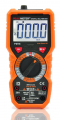
The DMM i used is a PM18 and the tolerance of that on the 6 Meg ohm range is ±(0.8% of reading + 5 digits).
I don't understand the +5 digits bit.
 

Attachments

WBahn

Joined Mar 31, 2012
32,967
Well my resistor is colour coded as 2.2 Meg ohm, actually measures 2.193 Meg ohm, it has a red tolerance band on it which is 2%.

My test voltage across the resistor is 1V and my measured current is 470 nA although i calculated it to be 450 nA.

The DMM i used is a PM18 and the tolerance of that on the 6 Meg ohm range is ±(0.8% of reading + 5 digits).
I don't understand the +5 digits bit.
The "five digits" refers to the tolerance in terms of the full-scale vale expressed in terms of the displayed resolution.

On the 6 MΩ range, your resolution on that meter is 1 kΩ (the amount represented by the last digit), so "5 digits" is therefore 5 kΩ.

Your reading is 2.193 MΩ, so 0.8% of that is 17.5 kΩ. So the total tolerance is 22.5 kΩ, or ±1.03% (which we can just call ±1.0%).

Hence, your resistor could be anywhere between 2.171 MΩ and 2.215 MΩ and a reading of 2.193 MΩ would be in spec. Notice how this means that that last digit is meaningless. For any reading above 0.625 MΩ, the tolerance is more than 10 digits, rendering that last digit of very questionable value.

When you say that your test voltage across the resistor is 1 V, where is that 1 V coming from and how is it being determined? What is the tolerance on it? Is it 1.00000000 V, or could it be 1.01 V?

Your meter likely has a 10 MΩ input impedance when measuring voltage. Putting it across the 2.2 MΩ resistor will result in the circuit see a resistance that has been reduced to 1.8 MΩ, which is a nearly 20% reduction.
 
Top