Facebook
 Google
 GitHub
 Linkedin

Hello again,This makes no sense. How are you going to preserve any previously established charge on one of the caps if you go trying to us it as your precharge cap during the middle of this process.
Think about what happens as you bounce back and forth between Steps 2 and 3. In Step 2, you charge Cs to nearly, but not quite 2 V. Fine. But, in Step 3, you lose everything you've gained, and then some, because your large cap drains Cs nearly all the way down.
If nothing else, think about the two positive plates of your capacitors that are continuously connected together as you go between Steps 2 and 3 back and forth. There is only so much total net charge on them, so all you can accomplish is shuttling it back and forth between the two caps, and thus accomplishing nothing each cycle.
Did I misunderstand your procedure? That's always a possibility.
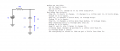
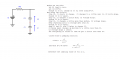
Let's see referring to my diagram with the two caps and R3 only, and with the battery E.
C1=C2/100 for example. In the diagram, CL=C2 and CS=C2/100 or something like that. CL is C-large, CS is C-small.
Charge C2 and C1 to 1v each.
Put C2 in series with E, provides us with a 2v source.
Charge C1 with that 2v source, gaining a little less than 2v on C1 and a little less on C2.
Now swap the roles of C1 and C2 such that C1+E is charging C2. That means a 3v source is charging C2, but this gets a little more complicated because C1 is so much smaller than C2.
Now we are starting with vC1=2v and vC2=2v, and the transfer starts when we connect them as above. C2 has 2v and E+C1 has 3v so we assume a small resistance in series like 1uOhm.
Now the question is, how much does C2 charge up to? Since C1 is 1/100 times C2, we can estimate for now that C2 charges up to 2.01 volts During that transfer, vC1 drops to 1.01 volts.
So we now have 1.01 volts across C1, and only 2.01 volts across C2, but 2.01v is still an increase and so is still worth looking into.
The question now becomes, how do we increase the voltage across C2 even more?
We repeat the process? This is where it gets funny.
If we swap the caps again, we now have C2 in series with E again, and C1 being charged from their sum voltage 1+2.01 = 3.01 volts.
Next C1 charges up to about 2.99 volts. C2 discharges to about 1.99 volts.
Now rearranging them, E+1.99+2.99=5.98 volts.
Using the formula I gave:
Vmax=(-(B+1)^m+(A+1)^n*(3*(A+1)^m-2)-A^3+1)/((A+1)^n*(B+1)^m)
and with A=100 and B=A and n=2 and m=2 we get:
vC1=2.990096 volts to that many digits, which should be a better approximation to the above 2.99 volts.
This seems to happen fast enough to not worry about too many iterations, and this suggests making m=n and of course B=A to get:
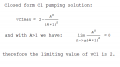
Vmax=-3/(A+1)^n-A^3/(A+1)^(2*n)+1/(A+1)^(2*n)+3
That's the voltage across the small cap in the end, and this clearly shows that the limiting value with n large is 3.
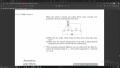
If this does not sound right, then you probably have to show a little more in your explanations. I would suggest using the 1,2,3,4 diagram I made to start with, and show the voltages after each transfer and how the caps are connected in each step. That will nail it.
I'll reply to the other post you made next but it's going to take a little while there's a lot in that post.