Maximizing Output Voltage with Two Capacitors and a Battery

WBahn

Joined Mar 31, 2012
32,940
One more thing I wanted to ask: do you happen to know of any method that could go beyond 4U? I’ve been thinking about it for a while — but even when alternating the roles of the two capacitors, the result still seems to converge to 4U. So if it’s actually possible to go beyond that, I guess it would require a completely different kind of approach.
Nice segue into what I had planned to ask you once you got the problem, as stated, solved.

Ask yourself what the effect might be of relaxing the requirement that the two capacitors be identical. Can you think of a way to a voltage greater than 4U? If so, what is the tradeoff involved?
 

Thread Starter

ViDa1313123

Joined Jul 27, 2025
22
Nice segue into what I had planned to ask you once you got the problem, as stated, solved.

Ask yourself what the effect might be of relaxing the requirement that the two capacitors be identical. Can you think of a way to a voltage greater than 4U? If so, what is the tradeoff involved?
Thanks again for your thoughtful question — it really got me thinking. I tried exploring the scenario you hinted at, where the two capacitors are not identical. I realized that by choosing very different capacitance values, the voltage redistribution after each parallel connection becomes asymmetric, and that might theoretically allow the voltage on one capacitor to climb higher than in the equal-capacitance case. I’ll definitely explore this direction more — it's a fascinating idea and I hadn’t considered the tradeoff in speed and energy loss over many cycles before.


However, I also wanted to ask you this:


Do you think it's possible to go above 4U total voltage using only the original setup — meaning two identical capacitors and a 1U battery, with only clever rewiring and charging strategies?


I’ve experimented with both strategies:
(1) keeping one capacitor always at 1U and charging the second step-by-step toward 2U,
(2) alternating roles between the capacitors.


In both cases, the total voltage asymptotically approaches 4U (1U from the battery, 2U from the fully charged capacitor, and 1U from the other). I've tried to think of any way to push beyond that using just the given elements and standard operations, but I haven't found a way — unless there's a completely different concept I'm overlooking.


I’d love to hear if you have any general pointers or ideas to consider. Either way, thanks for the inspiration — it’s been an incredibly fun challenge to think through.


Best regards,
 

WBahn

Joined Mar 31, 2012
32,940
With identical capacitors, I don't see any clever way to get more than 4U -- but that doesn't prove that one doesn't exist.

It would be a good exercise to plot the achievable voltage after N switching cycles and see if you can derive a function that, given how close to 4U you need to be, tells you the minimum number of cycles needed to get there.

With non-identical caps, you can get asymptotically close to 6U.

As before, plotting the final voltage as a function of the number of switching cycles and getting a function that returns how many cycles are needed to get there would be a good exercise. One thing to keep in mind is that the ratio of the two caps is an additional parameter at play.

As a check, your results for the non-identical case should reduce to the results for the identical case in the special case that the ratio of the two caps is unity.
 

MrAl

Joined Jun 17, 2014
13,722
Yes, thank you — I’ve understood it now. It really all comes down to the idea that I need to consider how the voltage distributes in the parallel configuration. I’ll take a closer look at the modeling with resistors now :)


One more thing I wanted to ask: do you happen to know of any method that could go beyond 4U? I’ve been thinking about it for a while — but even when alternating the roles of the two capacitors, the result still seems to converge to 4U. So if it’s actually possible to go beyond that, I guess it would require a completely different kind of approach.
Hi,

So you feel comfortable with the differential equations, or would you like to see it simplified more?

Yes the result is 2-1/2^n when U=1 volt, and that means that when put in series with the battery and the other cap we get 4-1/2^n (n is the number of cycles we use to charge and transfer charge).
That appears to be the limit for 2 capacitors. To get higher, we would have to use at least 3 capacitors and a more complex switching arrangement. Would be interesting to see how high we could get with that setup too, maybe 8v from a 1v source???

Usually if only caps are going to be used we would see either additional stages of the same circuit or we would see added diodes. There are at least 4 different topologies that use this method to get high voltage from a low voltage source like 3v

All these circuits suffer from lower available current though, that's where actual boost circuits come into play. They use an inductor, and the inductor has the ability to spike the voltage up by many times U. With one or two caps and one inductor we can get from 3v to 12v easy.

I have not actually looked into these cap circuits in a fairly long time. I see now a lot of charge pump IC's only going to 2*U.

Could there be a trick to get higher? The only thing I can think of offhand is to try to get a circuit that works at very high frequency so we can utilize the inherent inductance in the leads. I think that would be very tricky because of the ESR and the like.
Then we have the physical alterations to think about. What about building a special capacitor or dual capacitor that would be used for this. There are multi-lead capacitors out there but using two of those would probably be cheating, but if not, that would help a lot.
I think the main issue is all of these circuit are all overdamped, so we never get an easy voltage boost.

[LATER]
Here's an interesting idea but hard to implement:
Charge one capacitor, cut it down the center exactly, then you have two caps charged up to 1v. Put them in series, 2v.
Cut those in half the same way, put those in series, 4v.
Continue with this, 8v, 16v, 32v, etc.
This is purely theoretical without moving to careful laboratory procedures and conditions.

Since there is going to be a magnetic field associated with each cap while it is being charged, a small loop of wire to capture some of that energy may give us a boost over 4v with the original circuit with just two caps.
 
Last edited:

Thread Starter

ViDa1313123

Joined Jul 27, 2025
22
Hi,

So you feel comfortable with the differential equations, or would you like to see it simplified more?

Yes the result is 2-1/2^n when U=1 volt, and that means that when put in series with the battery and the other cap we get 4-1/2^n (n is the number of cycles we use to charge and transfer charge).
That appears to be the limit for 2 capacitors. To get higher, we would have to use at least 3 capacitors and a more complex switching arrangement. Would be interesting to see how high we could get with that setup too, maybe 8v from a 1v source???

Usually if only caps are going to be used we would see either additional stages of the same circuit or we would see added diodes. There are at least 4 different topologies that use this method to get high voltage from a low voltage source like 3v

All these circuits suffer from lower available current though, that's where actual boost circuits come into play. They use an inductor, and the inductor has the ability to spike the voltage up by many times U. With one or two caps and one inductor we can get from 3v to 12v easy.

I have not actually looked into these cap circuits in a fairly long time. I see now a lot of charge pump IC's only going to 2*U.

Could there be a trick to get higher? The only thing I can think of offhand is to try to get a circuit that works at very high frequency so we can utilize the inherent inductance in the leads. I think that would be very tricky because of the ESR and the like.
Then we have the physical alterations to think about. What about building a special capacitor or dual capacitor that would be used for this. There are multi-lead capacitors out there but using two of those would probably be cheating, but if not, that would help a lot.
I think the main issue is all of these circuit are all overdamped, so we never get an easy voltage boost.

[LATER]
Here's an interesting idea but hard to implement:
Charge one capacitor, cut it down the center exactly, then you have two caps charged up to 1v. Put them in series, 2v.
Cut those in half the same way, put those in series, 4v.
Continue with this, 8v, 16v, 32v, etc.
This is purely theoretical without moving to careful laboratory procedures and conditions.

Since there is going to be a magnetic field associated with each cap while it is being charged, a small loop of wire to capture some of that energy may give us a boost over 4v with the original circuit with just two caps.
Thanks a lot for your message — I really enjoyed reading your creative ideas! The "capacitor slicing" concept is fascinating as a theoretical construct. Of course, I understand that physically cutting a charged capacitor in half while maintaining its voltage and integrity is extremely impractical, but it’s a very clever way to conceptually think about increasing voltage by creating more series elements.

Also, the idea of capturing residual magnetic fields during the charge transfer via a small wire loop is something I hadn’t considered before. That’s quite interesting. Even if the energy involved is minimal, it’s still a valuable reminder that real-world effects — especially electromagnetic — can sometimes open doors that idealized models don’t.

I’ve also been thinking a lot about ways to push the output beyond 4U — or even to reach 5U with just the basic setup. So far, I’ve tried all kinds of capacitor switching schemes, including alternating roles (always charging one to 1U, then using it to top up the other), but all of them seem to converge on the 4U barrier due to the symmetric nature of the system and the equal capacitance.

If there is a way to break through that 4U ceiling without resorting to unrealistic physical manipulations, I’d love to explore it. But so far, I haven't found one — at least not with the current constraints of the problem.

Let me know if you think there’s any path forward — or even a wild idea that might be worth modeling!

Thanks again for all your insights and your openness to think outside the box.
 

Thread Starter

ViDa1313123

Joined Jul 27, 2025
22
With identical capacitors, I don't see any clever way to get more than 4U -- but that doesn't prove that one doesn't exist.

It would be a good exercise to plot the achievable voltage after N switching cycles and see if you can derive a function that, given how close to 4U you need to be, tells you the minimum number of cycles needed to get there.

With non-identical caps, you can get asymptotically close to 6U.

As before, plotting the final voltage as a function of the number of switching cycles and getting a function that returns how many cycles are needed to get there would be a good exercise. One thing to keep in mind is that the ratio of the two caps is an additional parameter at play.

As a check, your results for the non-identical case should reduce to the results for the identical case in the special case that the ratio of the two caps is unity.
thank you again — your insight opened up a whole new direction for me. I had been so focused on achieving exactly 4U with identical capacitors that I hadn’t fully considered the potential of using non-identical ones.

Your suggestion about relaxing the symmetry and treating the capacitor ratio as a tunable parameter really helped me understand the deeper mechanics of the system. I plotted the final voltage over several switching cycles for different ratios of C1 and C2, and it’s fascinating to see how the asymptotic limit rises toward 6U as C2 becomes much smaller than C1.

This has now become a new sub-goal for me — to explore whether there’s any configuration or manipulation that could push the output beyond 4U even with identical capacitors. While I haven’t cracked that yet, I really appreciate the conceptual spark you provided.

Let me know if you’ve ever seen a setup (even theoretical) that attempts to go beyond 4U with identical caps — or if it’s truly a hard limit. In any case, this has been a fantastic exercise in circuit intuition and asymptotic behavior.

Thanks again for your guidance — it’s been incredibly motivating.
 

MrAl

Joined Jun 17, 2014
13,722
Your suggestion about relaxing the symmetry and treating the capacitor ratio as a tunable parameter really helped me understand the deeper mechanics of the system. I plotted the final voltage over several switching cycles for different ratios of C1 and C2, and it’s fascinating to see how the asymptotic limit rises toward 6U as C2 becomes much smaller than C1.
Hello again,

Where are you getting 6U from? Is that a different circuit or something?

If we charge C2 (top cap) to 1v and U=1v, then we only have 2v to charge C1 (bottom cap). How can we possibly get the voltage on C1 to be greater than 2v and therefore set the limit again at 4v?

You might be doing something different, but for the circuit I posted earlier (top) I get this result:
Vmax=1/(A+1)^n+2 (and add that additional 2v from the battery in series with the other cap to get 4v)
where
n is the number of cycles, and
A is the ratio of C2 to C1, which means we make C2 a multiple of C1 using the factor A. If C1=3 then C2=12 if we make A=4 simply because 3*4 equals 12.
So if A=2, then the limit is:
1/3^n+2
and if we make A=7 the limit is:
1/8^n+2

All of these tend to a max of 2 volts because the denominator of that fraction tends to infinity and that means the fraction goes away leaving us with only the '2'.
Of course I could have made a mistake, but looking at the circuit and thinking about the voltage of the battery plus the 1v of the top cap only comes out to 2v, and that is what we use to charge the bottom cap. With no resonance or anything like that I don't see how we could charge the bottom cap to anything greater than 2 volts.
If the bottom cap was very small, it would charge very fast, but it does not have any voltage greater than 2 volts to work with.

Maybe you did something different?

We can't actually do this unless we had a laboratory with the right equipment, but the cap could be cut in half with a laser for one example. I guess we don't have to talk about this anymore though because we won't be doing that. It was just a thought experiment.

A completely different approach might be to vibrate one or both of the caps. The dielectric may show the piezo electric effect, or the expanding and contracting might change the capacitance slightly which might force the voltage to rise slightly.

If we could actually find a practical way to increase the voltage to beyond 4v it would make electronic history I think. It appears that it would take more than what we are working with right now though.
 
Last edited:

Thread Starter

ViDa1313123

Joined Jul 27, 2025
22
Hello again,

Where are you getting 6U from? Is that a different circuit or something?

If we charge C2 (top cap) to 1v and U=1v, then we only have 2v to charge C1 (bottom cap). How can we possibly get the voltage on C1 to be greater than 2v and therefore set the limit again at 4v?

You might be doing something different, but for the circuit I posted earlier (top) I get this result:
Vmax=1/(A+1)^n+2 (and add that additional 2v from the battery in series with the other cap to get 4v)
where
n is the number of cycles, and
A is the ratio of C2 to C1, which means we make C2 a multiple of C1 using the factor A. If C1=3 then C2=12 if we make A=4 simply because 3*4 equals 12.
So if A=2, then the limit is:
1/3^n+2
and if we make A=7 the limit is:
1/8^n+2

All of these tend to a max of 2 volts because the denominator of that fraction tends to infinity and that means the fraction goes away leaving us with only the '2'.
Of course I could have made a mistake, but looking at the circuit and thinking about the voltage of the battery plus the 1v of the top cap only comes out to 2v, and that is what we use to charge the bottom cap. With no resonance or anything like that I don't see how we could charge the bottom cap to anything greater than 2 volts.
If the bottom cap was very small, it would charge very fast, but it does not have any voltage greater than 2 volts to work with.

Maybe you did something different?

We can't actually do this unless we had a laboratory with the right equipment, but the cap could be cut in half with a laser for one example. I guess we don't have to talk about this anymore though because we won't be doing that. It was just a thought experiment.

A completely different approach might be to vibrate one or both of the caps. The dielectric may show the piezo electric effect, or the expanding and contracting might change the capacitance slightly which might force the voltage to rise slightly.

If we could actually find a practical way to increase the voltage to beyond 4v it would make electronic history I think. It appears that it would take more than what we are working with right now though.
Hello again,

thank you for your response.
Yes youre right. I feel like 4u is the limit given the equipement. So thank you for all of your helpful responses so far. I´ll keep thinking about this problem but I think (given the equipement) were done here. Thank you.
 

MrAl

Joined Jun 17, 2014
13,722
Hello again,

thank you for your response.
Yes youre right. I feel like 4u is the limit given the equipement. So thank you for all of your helpful responses so far. I´ll keep thinking about this problem but I think (given the equipement) were done here. Thank you.
I had just one more idea in case you are interested.
If we charge a capacitor to 1v and then separate the plates by twice the distance they were originally, I think the voltage goes up to 2v assuming nothing else changes.
Now for a really wild idea:
Set the capacitor in motion in a straight line along the axial center of the two plates at about 97 percent of the speed of light, then charge it to 1v.
Now let it come to rest, the plates move apart 2x, the voltage increases to 2v.
Of course I have no way to test that :)

Apart from some more radical ideas I don't think we can ever get more than 4x the original voltage. Sorry about that :(
 

WBahn

Joined Mar 31, 2012
32,940
Hello again,

Where are you getting 6U from? Is that a different circuit or something?

If we charge C2 (top cap) to 1v and U=1v, then we only have 2v to charge C1 (bottom cap). How can we possibly get the voltage on C1 to be greater than 2v and therefore set the limit again at 4v?

You might be doing something different, but for the circuit I posted earlier (top) I get this result:
Vmax=1/(A+1)^n+2 (and add that additional 2v from the battery in series with the other cap to get 4v)
where
n is the number of cycles, and
A is the ratio of C2 to C1, which means we make C2 a multiple of C1 using the factor A. If C1=3 then C2=12 if we make A=4 simply because 3*4 equals 12.
So if A=2, then the limit is:
1/3^n+2
and if we make A=7 the limit is:
1/8^n+2

All of these tend to a max of 2 volts because the denominator of that fraction tends to infinity and that means the fraction goes away leaving us with only the '2'.
Of course I could have made a mistake, but looking at the circuit and thinking about the voltage of the battery plus the 1v of the top cap only comes out to 2v, and that is what we use to charge the bottom cap. With no resonance or anything like that I don't see how we could charge the bottom cap to anything greater than 2 volts.
If the bottom cap was very small, it would charge very fast, but it does not have any voltage greater than 2 volts to work with.

Maybe you did something different?

We can't actually do this unless we had a laboratory with the right equipment, but the cap could be cut in half with a laser for one example. I guess we don't have to talk about this anymore though because we won't be doing that. It was just a thought experiment.

A completely different approach might be to vibrate one or both of the caps. The dielectric may show the piezo electric effect, or the expanding and contracting might change the capacitance slightly which might force the voltage to rise slightly.

If we could actually find a practical way to increase the voltage to beyond 4v it would make electronic history I think. It appears that it would take more than what we are working with right now though.
So, let's see how we can make electronic history.

Let's take C1 to be the smaller cap and make C2 a hundred times as big. Let's also set U = 1 V for simplicity.

Do you agree that we can use C1 to pump C2 to a point where C2 is charged to 2 V?

Thus we have C1 with a voltage of 1 V and C2 with a voltage of 2 V.

Now, disconnect C1 and C2 and place C2 in series with the battery. You now have 3 V across them. But C1 with it's 1 V charge in parallel with them.

What is the voltage across C1 after charge redistributes?

Because C1 is so small, the voltage decrease on C2 is just 1% of the voltage increase on C1. So if C1 rises by 2 V (to a total of 3 V), the voltage on C2 would only decrease by 20 mV. Hence, the total voltage will be just barely under 3 V. Now remove C2 and place it in series with the battery and C1 and you have a total voltage that is just under 6 V.

Viola! Electronic history has been made. Without any ODEs or cutting capacitors in half, or invoking relativistic velocities, or vibrating them, or anything else.
 

MrAl

Joined Jun 17, 2014
13,722
So, let's see how we can make electronic history.

Let's take C1 to be the smaller cap and make C2 a hundred times as big. Let's also set U = 1 V for simplicity.

Do you agree that we can use C1 to pump C2 to a point where C2 is charged to 2 V?

Thus we have C1 with a voltage of 1 V and C2 with a voltage of 2 V.

Now, disconnect C1 and C2 and place C2 in series with the battery. You now have 3 V across them. But C1 with it's 1 V charge in parallel with them.

What is the voltage across C1 after charge redistributes?

Because C1 is so small, the voltage decrease on C2 is just 1% of the voltage increase on C1. So if C1 rises by 2 V (to a total of 3 V), the voltage on C2 would only decrease by 20 mV. Hence, the total voltage will be just barely under 3 V. Now remove C2 and place it in series with the battery and C1 and you have a total voltage that is just under 6 V.

Viola! Electronic history has been made. Without any ODEs or cutting capacitors in half, or invoking relativistic velocities, or vibrating them, or anything else.
It looks like this could work. The problem might be that if C1 is so much smaller it might take a lot of cycles to get C2 to be 2v.
But why make C1 so small. If this works, then even C1=C2/2 should show a voltage increase above 4v.
Now we need some math to see what we can find out.
If we don't mind pumping C2 from C1 with 1000 cycles, we might see an error of only 0.1 percent with C1=C2/1000.
Next I'll take a look at the math and see what happens.

If this does work then we also should look into why this has not been done yet. Most of the charge pump IC's only double the voltage. Why would that be so. Maybe there are some chips out there that do better. We do have to think about how many cycles it takes to get C2 charged as that could be the reason. However, it does seem that there should be some way to deal with that too.
 

WBahn

Joined Mar 31, 2012
32,940
It looks like this could work. The problem might be that if C1 is so much smaller it might take a lot of cycles to get C2 to be 2v.
But why make C1 so small. If this works, then even C1=C2/2 should show a voltage increase above 4v.
Now we need some math to see what we can find out.
The ratio was chosen to be large in order to show that we could get close to a factor of six gain. A asymptotic gain that is simply greater than four can be shown with any mismatch.

The needed match is the same -- no ODEs required. Just simply allow C1 and C2 to be different values by introducing their ratio as a new parameter.

If we don't mind pumping C2 from C1 with 1000 cycles, we might see an error of only 0.1 percent with C1=C2/1000.
Next I'll take a look at the math and see what happens.
Since we know we are dealing with asymptotic behavior, we don't need to do any math to know that we will need far more than thousand cycles to get to the voltage on C2 within one part in a thousand of twice the supply voltage. How many cycles follows the same math as before.

If this does work then we also should look into why this has not been done yet.
That's why I asked the TS to consider the implications and tradeoffs involved. The main ones are pretty glaringly obvious with a bit of thought.

Most of the charge pump IC's only double the voltage. Why would that be so.
Because even playing the game used to get greater than 2x the voltage (even the 4x of original problem) with just two capacitors requires a significant increase in complexity because of the topology manipulations involved. Getting 2x (or close to 2x) using just a couple of diodes as passive switching elements is so much easier -- and higher voltage multiples are readily achieved by adding more capacitors and diodes.

Maybe there are some chips out there that do better. We do have to think about how many cycles it takes to get C2 charged as that could be the reason. However, it does seem that there should be some way to deal with that too.
Why should there be a way to deal with it? It's part and parcel of the tradeoffs. Want higher voltage, you are going to get less current. In this case, that manifests itself by moving less charge with each cycle.

Now that we've looked at the case of C2 > C1 and have found that we can get higher output voltage (but at the expense of a greater number of cycles to get there -- and much more ripple once we do), what about the case with C2 < C1? Does that result in us not being able to get to even 4x? What are the advantages and disadvantages of this situation?
 

MrAl

Joined Jun 17, 2014
13,722
The ratio was chosen to be large in order to show that we could get close to a factor of six gain. A asymptotic gain that is simply greater than four can be shown with any mismatch.

The needed match is the same -- no ODEs required. Just simply allow C1 and C2 to be different values by introducing their ratio as a new parameter.


Since we know we are dealing with asymptotic behavior, we don't need to do any math to know that we will need far more than thousand cycles to get to the voltage on C2 within one part in a thousand of twice the supply voltage. How many cycles follows the same math as before.


That's why I asked the TS to consider the implications and tradeoffs involved. The main ones are pretty glaringly obvious with a bit of thought.


Because even playing the game used to get greater than 2x the voltage (even the 4x of original problem) with just two capacitors requires a significant increase in complexity because of the topology manipulations involved. Getting 2x (or close to 2x) using just a couple of diodes as passive switching elements is so much easier -- and higher voltage multiples are readily achieved by adding more capacitors and diodes.


Why should there be a way to deal with it? It's part and parcel of the tradeoffs. Want higher voltage, you are going to get less current. In this case, that manifests itself by moving less charge with each cycle.

Now that we've looked at the case of C2 > C1 and have found that we can get higher output voltage (but at the expense of a greater number of cycles to get there -- and much more ripple once we do), what about the case with C2 < C1? Does that result in us not being able to get to even 4x? What are the advantages and disadvantages of this situation?
Hello again,

"Since we know we are dealing with asymptotic behavior, we don't need to do any math to know that we will need far more than thousand cycles to get to the voltage on C2 within one part in a thousand of twice the supply voltage. How many cycles follows the same math as before."

As it turns out, it looks like we don't need 1000 cycles. It could be much fewer.
This looks like the right formula:
Vmax=(-(B+1)^m+(A+1)^n*(3*(A+1)^m-2)-A^3+1)/((A+1)^n*(B+1)^m)

where
B=A and
n is the number of pumps of the first transfer, and
m is the number of pumps of the second transfer (to the smaller cap).
B must equal A because they are both the ratio of the large cap to the smaller cap. The reason for B is to keep the expression from defaulting to a stranger appearance in the software.
This seem to show that the limit is 3v as expected (before any further additions).

So the key is in the swapping of the caps after they are charged to some level, not before.
The result seems to follow with A=2 also and not that many cycles. This is most likely because we assume that there is no resistance to slow down the charging. In real life we would have that.
Now we just have to figure out why we don't see this being used in IC chips. It might also be because the current draw would have to be very tiny. Still, it seems it could be practical for some apps. The switching technique would be more complicated, but who cares about that when we are after a higher voltage, some way, some how.

I am not trying to force anyone to use ODE's. For me that is the preference, period.

Oh BTW, thanks for sharing your idea. Maybe this could make a difference in industry if it is not in place already.
 
Last edited:

MrAl

Joined Jun 17, 2014
13,722
Hello again,

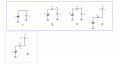
Here is a diagram of how it might work.

Since one cap is smaller than the other, we may have to repeat steps 2 and 3 a few times, then jump back to 1, 2, 3, then 2,3, then 2,3, then 2,3, then 1,2,3, etc.
Finally we can go to step 4.
Item 5 is just to show what we would get if the voltages did not quite get up to the full values. 5v from 1v still seems good. Current would be limited, but most of these kinds of designs always have that limitation.

To get down to the nitty gritty it seems we would have to do a full analysis with resistors and the like. That means ODE's or something else to get to a full analysis. We'd want to investigate how many 2,3 cycles we can get away with before we have to jump back to 1,2,3 again, as well as other effects.
The switching would be tricky, but that would not be too much of a problem.
 

Attachments

WBahn

Joined Mar 31, 2012
32,940
Hello again,

"Since we know we are dealing with asymptotic behavior, we don't need to do any math to know that we will need far more than thousand cycles to get to the voltage on C2 within one part in a thousand of twice the supply voltage. How many cycles follows the same math as before."

As it turns out, it looks like we don't need 1000 cycles. It could be much fewer.
This looks like the right formula:
Vmax=(-(B+1)^m+(A+1)^n*(3*(A+1)^m-2)-A^3+1)/((A+1)^n*(B+1)^m)

where
B=A and
n is the number of pumps of the first transfer, and
m is the number of pumps of the second transfer (to the smaller cap).
B must equal A because they are both the ratio of the large cap to the smaller cap. The reason for B is to keep the expression from defaulting to a stranger appearance in the software.
This seem to show that the limit is 3v as expected (before any further additions).
Where did this formula come from?

Why have different parameters for the number of pumps since one transfer has to be followed by the other?

I'm assuming you are talking about the switching protocol that I described and that you responded to. If you are talking about some other protocol, it would be nice if you said so and defined it.

In the protocol as I described, the amount of charge transferred at a given cycleis dependent on the voltage achieved at the prior cycle and the ratio of the capacitors. That gives us the voltage at the end of the current cycle, which in turn gives us a recurrence relationship.

That relationship is:

\(
V_2(n) = V_2(n-1) \frac{\beta}{\beta + 1} \; + \; 2V_0 \frac{1}{\beta + 1}
\)

where

\(
\beta \; = \; \frac{C_2}{C_1}
\)

If needed, I can walk through how that recurrence relation is derived.

If ß = 1000, then V2 gets to 1.5Vo (i.e., halfway from Vo to 2Vo) after 694 cycles. This is therefore the "half life" analog and is how many cycles are required to get half of the remaining distance to the asymptotic final value. To get to 1% of the final value (i.e. 1.98·Vo) takes 3914 cycles. To get to within 0.1% takes 6218 cycles.

So the key is in the swapping of the caps after they are charged to some level, not before.
Huh? Could you please explain what you mean by this?

The result seems to follow with A=2 also and not that many cycles. This is most likely because we assume that there is no resistance to slow down the charging. In real life we would have that.
Resistance has nothing to do with how many cycles, merely with how much time each cycle takes.

Take two capacitors charged to different voltages and referred to a common ground. Connect their other ends through a resistor. The final voltage of the system is the same regardless of the value of that resistor, since charge still can't be created or destroyed and the top plates of the capacitor plus the resistor is an isolated system.

Now we just have to figure out why we don't see this being used in IC chips. It might also be because the current draw would have to be very tiny. Still, it seems it could be practical for some apps. The switching technique would be more complicated, but who cares about that when we are after a higher voltage, some way, some how.
If we are talking about the switching protocol I described, it's because the increase in complexity outweighs the benefit from just using a traditional multi-stage charge pump.

If it's because of some different switching protocol that you seem to have in mind, it's probably because it doesn't work at all.
 

WBahn

Joined Mar 31, 2012
32,940
Hello again,

Here is a diagram of how it might work.

Since one cap is smaller than the other, we may have to repeat steps 2 and 3 a few times, then jump back to 1, 2, 3, then 2,3, then 2,3, then 2,3, then 1,2,3, etc.
Finally we can go to step 4.
Item 5 is just to show what we would get if the voltages did not quite get up to the full values. 5v from 1v still seems good. Current would be limited, but most of these kinds of designs always have that limitation.

To get down to the nitty gritty it seems we would have to do a full analysis with resistors and the like. That means ODE's or something else to get to a full analysis. We'd want to investigate how many 2,3 cycles we can get away with before we have to jump back to 1,2,3 again, as well as other effects.
The switching would be tricky, but that would not be too much of a problem.
This makes no sense. How are you going to preserve any previously established charge on one of the caps if you go trying to us it as your precharge cap during the middle of this process.

Think about what happens as you bounce back and forth between Steps 2 and 3. In Step 2, you charge Cs to nearly, but not quite 2 V. Fine. But, in Step 3, you lose everything you've gained, and then some, because your large cap drains Cs nearly all the way down.

If nothing else, think about the two positive plates of your capacitors that are continuously connected together as you go between Steps 2 and 3 back and forth. There is only so much total net charge on them, so all you can accomplish is shuttling it back and forth between the two caps, and thus accomplishing nothing each cycle.
 

Thread Starter

ViDa1313123

Joined Jul 27, 2025
22
Hi everyone,
I just read through your interesting chat and it’s super exciting! Thanks for sharing all these insights.
I just had one question as I couldnt derive it from your answers: Have you actually found a way to get more than 4U with identical capacitors (and without using diodes or any other extra equipment)? :)

Also, if I may ask—where did you learn all of this?
 

Thread Starter

ViDa1313123

Joined Jul 27, 2025
22
This makes no sense. How are you going to preserve any previously established charge on one of the caps if you go trying to us it as your precharge cap during the middle of this process.

Think about what happens as you bounce back and forth between Steps 2 and 3. In Step 2, you charge Cs to nearly, but not quite 2 V. Fine. But, in Step 3, you lose everything you've gained, and then some, because your large cap drains Cs nearly all the way down.

If nothing else, think about the two positive plates of your capacitors that are continuously connected together as you go between Steps 2 and 3 back and forth. There is only so much total net charge on them, so all you can accomplish is shuttling it back and forth between the two caps, and thus accomplishing nothing each cycle.
Hi,
thanks again for all your help. When I look at your recurrence formula, it still seems to confirm that the maximum total voltage with two identical capacitors is 4U, and with different capacitors it can approach 6U. This is because one of the terms in the solution gets smaller with each cycle and eventually vanishes. So even with your method, the final voltage still stays within those boundaries depending on the capacitor ratio.

That said, I was wondering: could you explain how exactly you derived the recurrence formula in the first place? Especially how you determined the two specific coefficients – the one in front of the previous voltage and the one in front of the charging voltage. Understanding your reasoning might help me better grasp the underlying mechanism.

Thanks again – your approach has already clarified a lot for me.
 

WBahn

Joined Mar 31, 2012
32,940
Hi everyone,
I just read through your interesting chat and it’s super exciting! Thanks for sharing all these insights.
I just had one question as I couldnt derive it from your answers: Have you actually found a way to get more than 4U with identical capacitors (and without using diodes or any other extra equipment)? :)

Also, if I may ask—where did you learn all of this?
I don't think it's possible with just a source and two identical caps. But, again, I can't rule out some clever approach that escapes me.

As for where I learned all of this, it's a combination of a heavy focus on understanding the fundamentals and being willing to apply them, combined with exposure to lots of different techniques to accomplish things over the years. Without both of those, you end up, by and large, lacking the tools needed to apply what you know in new ways.
 

WBahn

Joined Mar 31, 2012
32,940
That said, I was wondering: could you explain how exactly you derived the recurrence formula in the first place? Especially how you determined the two specific coefficients – the one in front of the previous voltage and the one in front of the charging voltage. Understanding your reasoning might help me better grasp the underlying mechanism.
It's a direct application of the fundamentals. In most engineering curricula, these are covered in Physics II and it is assumed that they only need to be reviewed on the first day of Circuits I.

To get the recurrence relation, simply imagine the situation after Step #n in which C2 has been working it's way up from some initial voltage (either 0 V or, if we want to get a leg up, Vo if we precharge it initially).

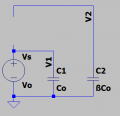
So the situation looks like this:

1754025057667.png

V1 = Vo
V2 = V2(n)

What is the charge on each cap at this point?

Q1 = Co·Vo
Q2 = Q2(n) = V2(n) / C2 = V2(n) / (ßCo)

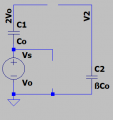
Now we move C1 from its charging position to its discharging location

1754025377624.png

When we connect the two sides, some charge, ΔQ(n), is going to flow from C1 to C2 and this will continue until the voltage on both sides are equal.

The charge on C2 when this is done, which will be the charge at the beginning of the next cycle, is simply Q2(n) + ΔQ(n) and the voltage at the start of the next cycle will be

V2(n+1) = (Q2(n) + ΔQ(n)) / C2 =(Q2(n)/C2) + (ΔQ(n)/C2) = V2(n) + (ΔQ(n)/C2) = V2(n) + (ΔQ(n)/(ßCo))

So we just need to find out how much charge is transferred during step n.

The new voltage on the left is going to be

V_left = Vo + (Q1 - ΔQ(n))/C1 = Vo + (Q1/C1) - ΔQ(n)/C1 = Vo + Vo - ΔQ(n)/Co = 2Vo - ΔQ(n)/Co

The voltage on the right is going to be

V_right = (Q2(n) + ΔQ(n)) / C2 = Q2(n)/C2 + ΔQ(n)/C2 = V2(n) + ΔQ(n)/(ßCo)

Since these have to end up the same:

V2(n+1) = V_left = V_right

Starting with V_left, we have

V2(n+1) = V_left = 2Vo - ΔQ(n)/Co

ΔQ(n)/Co = 2Vo - V2(n+1)

Plugging this into the expression for V_right, we have

V2(n+1) = V_right = V2(n) + ΔQ(n)/(ßCo)

V2(n+1) = V2(n) + [ΔQ(n)/Co]/ß

V2(n+1) = V2(n) + [2Vo - V2(n+1)]/ß

V2(n+1) + V2(n+1)/ß = V2(n) + 2Vo/ß

V2(n+1)(1 + 1/ß) = V2(n) + 2Vo/ß

V2(n+1)((ß+1)/ß) = V2(n) + Vo(2/ß)

V2(n+1) = [V2(n) + Vo(2/ß)][ß/(ß+1)]

V2(n+1) = V2(n)·[ß/(ß+1)] + Vo·[2/(ß+1)]
 
Top