MAX232 for ±25V from 5V supply

Thread Starter

or789

Joined Oct 15, 2019
20
Why am I under the impression that the circuit posted by the OP is intended to convert a PWM input signal into a linear output voltage?
Hi,
To convert PWM input signal to linear output voltage requries low pass filter. But here High pass filter is used.

Here Tout to Transmitting sensor do send continuous Signal.
 

cmartinez

Joined Jan 17, 2007
8,768
Hi,
To convert PWM input signal to linear output voltage requries low pass filter. But here High pass filter is used.

Here Tout to Transmitting sensor do send continuous Signal.
How familiar are you with LTSpice? Maybe it would be best if you saw what the circuit's output would look like using a simulator.
 

MisterBill2

Joined Jan 23, 2018
27,551
Why am I under the impression that the circuit posted by the OP is intended to convert a PWM input signal into a linear output voltage?
Probably because the OP did not adequately understand the actual and intended functionality of the MAX232 device. Since it is rather unique in using a charge pump to supply the higher voltages needed for traditional RS232 applications, that is why a search engine spotted it. And it would appear that the wickapedia explanation is a bit incomplete, as well.
 

ericgibbs

Joined Jan 29, 2010
21,444
hi,
As I understand the TS's project.
The input to MAX T1 pin will a short burst of 40kHz square wave TTL pulses. the MAX will convert these pulses into 40kHz at +/-9Vpk pulses.
These +/-9v pulse will drive a 40kHz ultrasonic transducer.
E
 

cmartinez

Joined Jan 17, 2007
8,768
hi,
As I understand the TS's project.
The input to MAX T1 pin will a short burst of 40kHz square wave TTL pulses. the MAX will convert these pulses into 40kHz at +/-9Vpk pulses.
These +/-9v pulse will drive a 40kHz ultrasonic transducer.
E
So the input frequency will be fixed?
 

cmartinez

Joined Jan 17, 2007
8,768
Also, the MAX232E, for instance, has a maximum output current of 10mA. That amounts to a maximum power of 80mW ... would that be enough to drive an ultrasonic transducer?
 

Thread Starter

or789

Joined Oct 15, 2019
20
hi,
As I understand the TS's project.
The input to MAX T1 pin will a short burst of 40kHz square wave TTL pulses. the MAX will convert these pulses into 40kHz at +/-9Vpk pulses.
These +/-9v pulse will drive a 40kHz ultrasonic transducer.
E
Hi,

Input pin to MAX T1 is from Atmel microcontroller. So it will send a 40Khz squarewave TTL signal to MAX232?

I still could not figure out why a high pass filter followed by a resistor(330 ohms) is used from the T1out pin for a Transmitter. Is it remove the low-level noise generated from MAX. and how do you calculate the values of it?

Thanks in advance.
 

cmartinez

Joined Jan 17, 2007
8,768
Hi,

Input pin to MAX T1 is from Atmel microcontroller. So it will send a 40Khz squarewave TTL signal to MAX232?

I still could not figure out why a high pass filter followed by a resistor(330 ohms) is used from the T1out pin for a Transmitter. Is it remove the low-level noise generated from MAX. and how do you calculate the values of it?

Thanks in advance.
I'm quite familiar with atmel's MCU's. What specific chip are you using?

Perhaps the filter is there to remove the DC component of the signal, in case it gets stuck on high.
 

ericgibbs

Joined Jan 29, 2010
21,444
hi 789,
I will run a LTSpice simulation of the project, post tomorrow.
My colleague @cmartinez has done an LTS sim , perhaps he will create a sim for the Filter network.?

E

BTW: Post your circuit of the receiver amplifier.
 

ericgibbs

Joined Jan 29, 2010
21,444
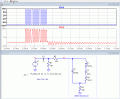
hi 789,
Its possible the designer had a push push drive design.

If you use T1 and T2 and can get the phasing correct, you will get this higher drive.
Note the bottom plot window.

E


BTW: Ringing is a fact of life with this type of circuit

AAA 013 19.09.gif
 

Attachments

cmartinez

Joined Jan 17, 2007
8,768
hi 789,
Its possible the designer had a push push drive design.

If you use T1 and T2 and can get the phasing correct, you will get this higher drive.
Note the bottom plot window.

E


BTW: Ringing is a fact of life with this type of circuit

View attachment 188169
Nice! ... can you post the asc file? I'd like to see how much power this circuit is drawing.

Hola, Presto #35
 
Last edited by a moderator:
Top