Hello all.
Does anyone know if it is allowed/legal/approved for USA to connect a 15 Ampere circuit breaker to a few (3) 15 Ampere rated receptacles/outlets in residential use with AWG#12 (Romex) wiring ?
Hello all.
Does anyone know if it is allowed/legal/approved for USA to connect a 15 Ampere circuit breaker to a few (3) 15 Ampere rated receptacles/outlets in residential use with AWG#12 (Romex) wiring ?
Sure, if the #12 wire gauge is approved (it will be) for the breaker/receptacles/outlets. It's still a 15A circuit even if you used 3/0 AWG (if it would fit and was a approved wire size for the electrical parts) .
Certainly using #12 wire for 15 amp outlets is totally safe and meets all code requirements. An inspector may possibly ask why, an OK answer would be that it is all that was on hand at the time. Certainly it does cost more for the larger gage, and it does take more effort to install. So certainly it would be approved. AND, it allows the option of changing to a 20 amp circuit breaker in the future if more current is needed.
12 wire with 20A breaker.
14 wire with 15A breaker.
It is just fine to use a larger wire size. (12 wire with 15A breaker)
It is OK to use 12 wire and use it everywhere. I do that to save on having two roles of wire. On the other hand I like having two types of wire so I can easily tell if that is outlets or lighting.
Receptacles/outlets are a little tricky. You can have a number of 15A outlets on a 20A breaker. But you can/have just one 15A outlet on a 20A breaker.
Hello all.
Does anyone know if it is allowed/legal/approved for USA to connect a 15 Ampere circuit breaker to a few (3) 15 Ampere rated receptacles/outlets in residential use with AWG#12 (Romex) wiring ?
Depends on what the load is on the original breaker. Certain loads require dedicated circuits for that load only. Furnaces, microwaves, fridges. The other thing to watch is what else is on that circuit.
When I gutted the kitchen for a rebuild, I ran several 12/3 240 shared neutral circuits (lots of spares in the main panel from former all electric heating) for the appliances on a ganged 20A breakers with 120VAC 20A GFCI sockets to make sure there was plenty of capacity for run several heavy loads at the same time. The wife uses a rice cooker, microwave and one of those air-fry things at the same time without overloads or circuit trips.
The fridge and oven hood are on another circuit. The original was just one 15A circuit for the entire room, crazy.
The modern requirement is something like this.
Kitchen Circuits
All kitchens are required to be supplied by two 20-amp circuits over and above any requirements for dedicated outlets for stoves, etc. These circuits shall not serve any lighting needs.
One of these branch circuits should be used for small appliance receptacles no more than 20 inches above the countertop. These outlets must also be GFCI-protected. The minimum two 20-amp circuits shall both supply receptacles serving the countertop space.
You can use 15A and 20A Receptacles interchangeably, under any circumstances when using a 15A-Breaker.
And, for "General-Convenience-Outlets"
You can usually use 6-Outlets per Breaker, ( Residential Construction only ).
You can use 14ga. or 12ga. Wire on a 15A-Breaker.
You will generally find that 15A-Breakers are only "approved for use with" a maximum of 12ga-Wire,
regardless of whether or not larger sized Wire may be
accepted by the physical-Terminal-Design of the Breaker.
You will generally find that most 15A and 20A Breakers are "approved for use with"
a maximum of 2-Conductors, and no more, regardless of Wire-Gauge. Some Breaker designs are rated for 1-single-Conductor-only.
Using any configuration that is NOT"approved for use with" voids the U/L approval of the device,
and may void your Home-Owners-Insurance if You burn your House down.
It will also not pass Inspection from a sharp Electrical-Inspector.
Using 12ga.-Wire on a 15A-Breaker is normally just wasting Money on heavier Wire, unless
the total Wire-Run for that particular Breaker is over ~100-feet in length.
The general rule for Wire-Runs over ~100-feet is to go up one standard Wire-Size for every ~100-feet.
For heavily used Outlets,
it is always preferable to up-grade to a 20A-rated Outlet,
( this goes for GFCI-Outlets as well ),
as they have much more robust physical-construction.
There's a good reason why they cost 4X as much as a generic-garbage-15A-rated-Outlet.
15A-Outlets are designed to be as dirt-cheap as humanly possible to manufacture,
and yet not fall apart in your hands, at least not right-away.
They're totally-junk for anything other than plugging-in a generic-Table-Lamp,
and even then, they're highly questionable.
"Arc-Fault"-Outlets are a ridiculous joke as far as I'm concerned,
but they may be required by Code in certain areas with New-Construction.
If you're going to be running 12ga-Wire,
You might as well run a 20A-Breaker, there's no reason not to.
( except possibly for very long Runs over 100-feet ). Running an under-sized-Breaker just invites "Nuisance-Tripping".
15A rated-Outlets WILL BREAK if you try to use them with 12ga.-Wire,
even though they may be supposedly "rated" for 12ga.-Wire, FAFO.
Never buy a 15A-rated-Outlet for any reason.
.
.
.
A very interesting situation arose from one of those dual-supplied kitchen outlets that I came across a while back. The attempt to install a GFCI outlet lead to trying to switch off the power at the breaker panel. So with a work-light plugged into the outlet and switching off the breakers one at a time, the light never went out. No single breaker controlled the power. Very puzzling indeed.
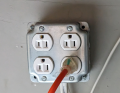
So pulling the outlet out of the box live revealed both sets of connections occupied by wires, as is common in residential kitchens of that era. Disconnecting one hot lead left the outlet live, and at that point a breaker was found that switched the power off. But a test light revealed that the disconnected wire was also live. That ws switched off at another breaker.
It appears that in the past the outlet had been damaged and replaced and whoever did it did not notice that the little jumper tabs on the original outlet had been removed. So that was how the problem of the forever-hot outlet was resolved. The jumper tabs were removed but the GFCI was not installed. It went into another kitchen outlet that was not dual circuit supplied.
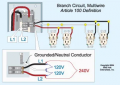
There was a period in N.A. electrical regs that mandated the use of both live L1 & L2 be fed to kitchen duplex outlets, each outlet were usually wired with the L1/L2 sharing the Neut, IOW 240v cable with common N.
For some reason, later the decision was reversed?
There was a period in N.A. electrical regs that mandated the use of both live L1 & L2 be fed to kitchen duplex outlets, each outlet were usually wired with the L1/L2 sharing the Neut, IOW 240v cable with common N.
For some reason, later the decision was reversed?
Much more likely the regulation was ignored. And at least in my area many of the government code inspectors are those who were unable to make it in business because of a lack of competence. (Yes, that is a direct slam)
There was a period in N.A. electrical regs that mandated the use of both live L1 & L2 be fed to kitchen duplex outlets, each outlet were usually wired with the L1/L2 sharing the Neut, IOW 240v cable with common N.
For some reason, later the decision was reversed?
I think the reason is , Safety, although the current in the neutral decreased as the power fed from each socket decreased as the loads became the same or similar for each outlet,
If the neutral were to go open circuit, one socket load could exceed its rated voltage value !
I think the reason is , Safety, although the current in the neutral decreased as the power fed from each socket decreased as the loads became the same or similar for each outlet,
If the neutral were to go open circuit, one socket load could exceed its rated voltage value !
+1
You can't use that kitchen broken tab duplex circuit now (old work is grandfathered) but you still can use it elsewhere in the house but I don't for the reasons stated.
I use a dual box with a separate duplex outlet for each hot.
+1
You can't use that kitchen broken tab duplex circuit now (old work is grandfathered) but you still can use it elsewhere in the house but I don't for the reasons stated.

 Facebook
 Google
 GitHub
 Linkedin