Facebook
 Google
 GitHub
 Linkedin

Hello friends,
Figure 2..
As gain is a function of frequency in an rf circuit and to make gain constant between two tuned circuits for whole passband and to achieve this special techniques are being employed and one of them is involving mutual inductance to manipulate the gain in predetermined way. The equivalent mutual inductance m is the sum total of various planned and unplanned coupling prevalent in the primary circuit.
The eq. mutual inductance m, seeks to maintains its value constant around every frequency of the vhf broadcast band. This is possible because m has two component one is fixed and other is variable with frequency. This variable component is higher at high frequency. This variable second component is subtracted from the fixed one so m is less at high frequencies and at lower frequencies vice versa making m a little high. So in both of these cases m has been observed to put its value apparently constant thus maintaing gain constant over the frequency range in demand.
The coupling circuit used to achieved constant gain is shown below..
In the figure 9.16B Xm should be independent of frequencies to bring gain constant .....
How exactly this is achieved..?
How this compensation works..?
Figure 1.
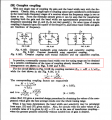
Figure 2.
Figure 2..
As gain is a function of frequency in an rf circuit and to make gain constant between two tuned circuits for whole passband and to achieve this special techniques are being employed and one of them is involving mutual inductance to manipulate the gain in predetermined way. The equivalent mutual inductance m is the sum total of various planned and unplanned coupling prevalent in the primary circuit.
The eq. mutual inductance m, seeks to maintains its value constant around every frequency of the vhf broadcast band. This is possible because m has two component one is fixed and other is variable with frequency. This variable component is higher at high frequency. This variable second component is subtracted from the fixed one so m is less at high frequencies and at lower frequencies vice versa making m a little high. So in both of these cases m has been observed to put its value apparently constant thus maintaing gain constant over the frequency range in demand.
The coupling circuit used to achieved constant gain is shown below..
In the figure 9.16B Xm should be independent of frequencies to bring gain constant .....
How exactly this is achieved..?
How this compensation works..?
Figure 1.
Figure 2.