Making electromagnet and not burn the Magnet

MisterBill2

Joined Jan 23, 2018
27,501
Amar Ram never said what is the core in the electromagnet so it is probably air or a small rusty nail then it barely produces any magnetism even at the extremely high current.
Given that the TS is a student it is likely that the application is not industrial. We do have some dimension information from post #12:
one electromagnet = 1 mm diameter copper wire having 60 turns on a 7cm diameter cylinder of 2 cm
I have two electromagnet both the coils are connected in series to each other. so if we add together that would 120 turns of 1mm copper wire on a 7cm

So a 2cm diameter cylinder, but no clue if it is wood, plastic, paper, aluminum, or steel. The material will make a difference. And still no hint about the application.

Older computer power supplies required a load on the 5 volt output in order to stay active. I am not sure if that is still the case with those supplies providing 3.3 volts or not. That may matter a bit.
 

Thread Starter

Amar Ram

Joined Dec 13, 2021
13
Please tell us what is the purpose of these electromagnet coils . Energised for half an hour, there must be a specific application in mind. Perhaps we can suggest an alternate approach. There is a whole lot of experience available in this site.
i understand but this is for a some prototype and other alternative approach there is none and i am sure about it .. and i found the resistance of the coil to be 0.9 ohms at dail set at 200 ohms in multimeter. I read some where that if i maintain my coils watt density less than 0.5 sq/in then its fine but cannot find for a formula of watt density for an electromagnet.
 

Thread Starter

Amar Ram

Joined Dec 13, 2021
13
@Amar Ram You need to find out the weight anticipated to be lifted and work back from there.
Usually DC powered magnets are very efficient when designed properly.
The largest I have worked on is on scrap yard cranes and these magnets operate at 100amps!
Down to small steel sheet material lifting of a around 8amps.
yes agreed electromagnets are very efficient when designed properly. but isnt it possible powering through computer power supply the magnet will take as much amps as it requires not more not less.
 

Thread Starter

Amar Ram

Joined Dec 13, 2021
13
Given that the TS is a student it is likely that the application is not industrial. We do have some dimension information from post #12:
one electromagnet = 1 mm diameter copper wire having 60 turns on a 7cm diameter cylinder of 2 cm
I have two electromagnet both the coils are connected in series to each other. so if we add together that would 120 turns of 1mm copper wire on a 7cm

So a 2cm diameter cylinder, but no clue if it is wood, plastic, paper, aluminum, or steel. The material will make a difference. And still no hint about the application.

Older computer power supplies required a load on the 5 volt output in order to stay active. I am not sure if that is still the case with those supplies providing 3.3 volts or not. That may matter a bit.
sorry its 60 turns , diameter 7 cm and length/height of cylinder is 2 cm.
 

Audioguru again

Joined Oct 21, 2019
6,826
He probably measured the 0.7 ohms of his meter cables plus the 0.2 ohms resistance of the coil.
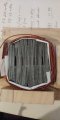
Why didn't he describe the photo?? Is the core of the electromagnet made from the paper pages of a book?

Only one end of the electromagnet is used.

The secret application might be to stick to or repel a person who has a Covid-19 vaccination.;)
 

MisterBill2

Joined Jan 23, 2018
27,501
Certainly the magnet coil will draw only as much current as the resistance requires for the voltage drop across the coil requires to equal the supplied voltage. With a resistance of 0.9 ohms that will be possibly quite a bit of current.
Now as for "density" as mentioned in post #22, " I read some where that if i maintain my coils watt density less than 0.5 sq/in then its fine but cannot find for a formula of watt density for an electromagnet. ", I am not sure what the reference is talking about at all. So how this applies to the question I don't understand.
There are some standard relationships that help evaluate transformers and solenoids, but I don't see how they relate to the questions. That is because of my poor mind-reading skills. I can sometimes make guesses based on context but not this time.
In post #25 I see that it looks like steel wire is used for a core. So now it is an electromagnet with a low-density steel core.
 
Last edited:

Thread Starter

Amar Ram

Joined Dec 13, 2021
13
He probably measured the 0.7 ohms of his meter cables plus the 0.2 ohms resistance of the coil.
Why didn't he describe the photo?? Is the core of the electromagnet made from the paper pages of a book?

Only one end of the electromagnet is used.

The secret application might be to stick to or repel a person who has a Covid-19 vaccination.;)
hahahaha nice one wish it was possible but no, covids are not magnetic )
 

Thread Starter

Amar Ram

Joined Dec 13, 2021
13
Its related to the question , how not to burn the copper wire, if i use a computer power supply ?
Can i use 3.3V with 25A. Or 5V with 18A. Or 5V with 2.5A ... which of these power supply is best to use on the electromagnet for at least 30 minutes and not melt the enamel ?
 

MaxHeadRoom

Joined Jul 18, 2013
30,654
By far the better PS version is the linear type.
Any of the supplies should work, the magnet just has to be designed for it.
It is the degree of a current created by suitable magnetic field.
You do not really require laminated if other solutions are present.
 

Thread Starter

Amar Ram

Joined Dec 13, 2021
13
By far the better PS version is the linear type.
Any of the supplies should work, the magnet just has to be designed for it.
It is the degree of a current created by suitable magnetic field.
You do not really require laminated if other solutions are present.
PS version ?
 

Alec_t

Joined Sep 17, 2013
15,117
Either the 3.3V or the 5V supply can power a properly designed electromagnet. From Ohm's Law, the wire resistance will determine the current drawn. In turn, the resistance is determined by the gauge and total length of the wire and can be found in online tables.
The cooling arrangement for the magnet, hence the maximum current which can be drawn safely, is unknown.
 
Top