I was going to suggest separate excited armature and fields, then I did some reading in one of my motor books. They say the series motor fields need to be rewound before doing that. Seems that separate excitation has a different field. But the same book says that winding turns in reverse rotation of the original field winding does cause a motor to change speed to a faster level. But it also said there is a ~10% limit to what is possible. Another way was to open the rotor to stator gap up, by machining one of them. But it seemed like you can't get a ~50% increase in speed.
I was going to suggest separate excited armature and fields, then I did some reading in one of my motor books. They say the series motor fields need to be rewound before doing that. Seems that separate excitation has a different field. But the same book says that winding turns in reverse rotation of the original field winding does cause a motor to change speed to a faster level. But it also said there is a ~10% limit to what is possible. Another way was to open the rotor to stator gap up, by machining one of them. But it seemed like you can't get a ~50% increase in speed.
Man... that felt like a bucket of cold water... but I'd rather you gave me the heads up... I'm going to start looking for a mechanical solution now, and maybe experiment with the independent PWM later on, if I find the time...
I've been thinking about your situation on this project but haven't put too much into finding a way around it. There are somethings I know about and will do some more looking. If you don't have a problem with me doing it. Things I've seen used in my years as a machinist.
... why on earth would I have a problem with that? ... quite the contrary! ... I appreciate your involvement and any ideas you might share.... many thanks!
... why on earth would I have a problem with that? ... quite the contrary! ... I appreciate your involvement and any ideas you might share.... many thanks!
I know you didn't want to show too much of the machine, but some info on how the drills are positioned would help. Or PM a photo of the heads, promise not to share or step on your work. Is the distance between the holes always the same, or does the machine drill them in varying places in the work? If I remember right this is a CNC. What would the 'optimum' speed be? Where I served my apprenticeship, custom machinery was one of our specialties. But this was before the days of CNC.
I know you didn't want to show too much of the machine, but some info on how the drills are positioned would help. Or PM a photo of the heads, promise not to share or step on your work. Is the distance between the holes always the same, or does the machine drill them in varying places in the work? If I remember right this is a CNC. What would the 'optimum' speed be? Where I served my apprenticeship, custom machinery was one of our specialties. But this was before the days of CNC.
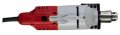
The motor's mounted on an feeding mechanism responsible for its up/down motion. But the drill motor itself is no mystery, it's Milwaukee's model 4253-1. The machine moves motor around to drill in programmed locations. But that part is working perfectly.
The bigger issue I see is how much more speed can you get at what sacrifice in torque and maximum realistic working power before you burn down the rotor due to over voltage/overcurrent/eddy current loss issues.
Theirs the hard fact of how fast the magnetic field of the rotor can actually move. Laminated silicon steel like they use in those motors will still have a top end frequency response limit and the magnetic field of the rotor is reversing every 1/2 turn so that has to start playing into things at some point.
At some RPM eddy current losses in the rotor will either burn things up or define an absolute limit in both RPM and available working torque for the motor.
I'm seeing that limitation to be like using a VFD on a standard induction motor. Theres a limit to how much frequency you can throw at a motors core material regardless of how much voltage you put behind it before eddy current losses take over as primary power consumers thus limiting the actual working mechanical power the motor can realistically produce, which is what you are wanting in the end.
Personally if it was me I would be looking at using spindle servos or three phase induction motors on VFD units rather than trying to mess with a heavily modified low RPM drill unit being ran way outside of it's design working range given the costs involved.
Hi again C. There are different ways of approaching this problem. I'll give just a few off the top of my head.
1. If doing it myself. Take the gear box of the motor apart, and look at the gearing. Most drill motors and other tools like them, have the first gear in the total train machined into the armature shaft it's self. So from the way the exploded view of the drill looks it also has a intermediate shaft between that and the final spindle. By making a new intermediate shaft and changing the gears on it speed could be changed. But this would take some measurement of the gears and getting their center distances and finding gears that also share those distances to step up the final chuck speed. I was involved in doing that on some packaging equipment years ago. So it can be done. And this would be the approach if doing it myself because I have the equipment and time, not a good one if your paying for it though.
2. Another job from years ago was to make a multi spindle drill press. The distance between holes and the customers budget ruled out a normal multi-spindle drill head. So we bought some stand alone drill spindles, If I remember correctly they were Rockwell's. This was a production machine that the hole distances never change in the product. But seems there not made any more. But there are others available, at really not a bad price. Using those and a separate motor for them you could set them up for any speed you need using pulleys and a belt. Or if a standard motor is the right speed for you, a flex coupling like a Lovejoy. These spindles mount similar to your existing motor with 4 bolts, then a bracket would be needed to mount the motor. These spindles are available in many types of tool holding configurations, from drill chuck tapers to the many types of tapers used in industry. But my choice would be the "ER" collet type spindle end. They would add rigidity to your operation and cut down spindle length, plus hold the drill bit better than a chuck. Here's a link to one place on Ebay that sells what I'm talking about, they have many options to chose from - http://www.ebay.com/itm/750W-1HP-Sp...elt-Power-Head-Unit-3000rpm-5Bearing-Drilling /192017443411?_trkparms=aid%3D555018%26algo%3DPL.SIM%26ao%3D2%26asc%3D46089%26meid%3D8e432b01b18c43a1bd07fd1a6e94f9c3%26pid%3D100005%26rk%3D2%26rkt%3D6%26sd%3D201743029242&_trksid=p2047675.c100005.m1851 Though the one I linked is for 1HP input they have them for many different HP's and speed ratings and spindle ends. These units have a better life time that the drill motor you were using and are made to do the job your doing and more.
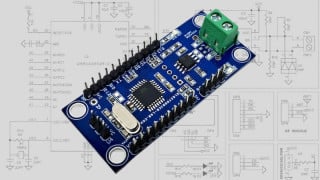
Ok, here's my plan, before resourcing to a mechanical modification. I'm going to independently PWM the stator and rotor, but with 220VAC instead of the rated 110VAC. All this while using an isolation transformer, or course. This will allow me to more widely affect its rpm output, I think. Either way, the amount of money and work involved will be much less than designing and fabricating the couple of gear substitutes that I think it will need.
Thanks for the spindle links, BTW. But I feel more comfortable modifying a robust-proven commercial brand than a highly specialized industrial one.
I foresee smoke in your future. Since the motors are of the 'universal' type, wouldn't it be better to do the PWM with DC instead of AC? Sorry your not comfortable with an industrial solution, but I thought this was an industrial machine? You do know a drill type motor isn't meant to be used continuous for 8 hours a day. Stop and think how they are normally used, drill a hole and then put in a bolt or screw then move on to the next hole. There is a 'cool down' time involved with normal hand drill use, and the motor your using is just a glorified hand drill. But in the end it is your machine and decision. Or maybe how the machine works is not coming across in the discussion.
That said, I'll put out the other things I've worked out, in case you or someone else needs them in the future. By using one of those spindles or one similar, and a C frame motor of the correct HP the drill head can be made self contained. Using a 3PH motor and a VFD would get a wide range of speeds to suit the drill bit size and work materials.
The spindle housing would need to be drilled and taped on the input end, a pretty simple thing, and the shaft cut down in length just another simple thing with either a band saw or hack saw. No need to disassemble the spindle for either of those operations. The shaft may not even need to be shortened depending on the flex coupling. Without having the physical parts, these are just guesses.
The drilling and tapping of the spindle housing is to be able to mount a motor adapter to allow use of the C frame motor, using one of this type adapter - https://www.surpluscenter.com/Hydraulics/Hydraulic-Pump-Mounts/ . Just one of the places selling them, a place I look first when needing a motor. The drilled and tapped holes in the spindle housing would need to be the same as in the adapter. And depending on the bearing boss size on the spindle the pilot hole in the adapter would need to be modified to suit, or maybe an adapter would even be the correct size.
From there it's just a matter of bolting the pieces together, using a flex coupling between the spindle and motor.
I'm going to independently PWM the stator and rotor, but with 220VAC instead of the rated 110VAC. All this while using an isolation transformer, or course. .
I don't see a way of PWM as a series motor for both field and rotor, particularly using AC?
Unless using it as a shunt motor, still would need DC, why PWM the field also?
Max.
I foresee smoke in your future. Since the motors are of the 'universal' type, wouldn't it be better to do the PWM with DC instead of AC? Sorry your not comfortable with an industrial solution, but I thought this was an industrial machine? You do know a drill type motor isn't meant to be used continuous for 8 hours a day. Stop and think how they are normally used, drill a hole and then put in a bolt or screw then move on to the next hole. There is a 'cool down' time involved with normal hand drill use, and the motor your using is just a glorified hand drill. But in the end it is your machine and decision. Or maybe how the machine works is not coming across in the discussion.
Rather where I am at now. Without knowing the duty cycle and typical drilling loads involved is impossible to tell what is most practical for such and application.
Wasn't there a similar discussion some time ago about trying to use high speed router motor units as CNC drill motors by slowing the way down to well below their designed working speeds?
Did we jump from trying to use a unnecessarily high speed power source for a job to now trying to use a unnecessarily low speed one at way higher than their designed range of function?
yeah, I forgot to mention the tiny detail that I planned to rectify the AC before pulsing it into the motor's coils... again, pretty much like the 90vdc motor driver that I've been working on the last few months.... my bad for lack of clarity in my previous message...
I don't see a way of PWM as a series motor for both field and rotor, particularly using AC?
Unless using it as a shunt motor, still would need DC, why PWM the field also?
Max.
Yeah, I said that in my post #42. "I was going to suggest separate excited armature and fields, then I did some reading in one of my motor books. They say the series motor fields need to be rewound before doing that. Seems that separate excitation has a different field."
One of the books I have on motors, by a guy named, Samuel Heller, talked about it. Seems like the fields on a series motor are a different size than a shunt motor.
Yeah, I said that in my post #42. "I was going to suggest separate excited armature and fields, then I did some reading in one of my motor books. They say the series motor fields need to be rewound before doing that. Seems that separate excitation has a different field."
One of the books I have on motors, by a guy named, Samuel Heller, talked about it. Seems like the fields on a series motor are a different size than a shunt motor.
Sure, don't forget that in a series motor the field current is constantly changing, not so with a shunt motor.
Also the field has a different magnetic make up, a solid iron pole .
Max,

 Facebook
 Google
 GitHub
 Linkedin