Making an AC drill motor run faster

shortbus

Joined Sep 30, 2009
10,049
I'll be cutting the gears out of D2 material, hardened to 60 Rc. I'll be drilling on wood and sheet metal, so the work load will be much lighter than the drill's original design. Which is to drill 1/2" diam holes on metal plates of up to 3/4" thick.
Without having it in front of me, not knowing how much room you have to work with, here's a guess on how I would attack doing it.

Since your stuck with the first gear set in the train being part of the shaft you pretty much need to keep that first reduction. By measuring the center to center distance of the next two gears you may be able to find a pair of gears that are the same tooth count to fit the center distance. That in turn would give you a 1:1 from the first reduction to the output shaft.

To save time and machining "money" you might have a look at either Boston or Browning for gears, then have them case hardened. I'd never make them from D2, not really suitable for gears since it through hardens. If you really need to make them 4140 prehardened would be a more likely candidate. But I'd be willing to bet the original gears aren't hardened, check with a file to see.

Would it be possible to get a photo of all the gears?
 

Thread Starter

cmartinez

Joined Jan 17, 2007
8,794
If you really need to make them 4140 prehardened would be a more likely candidate.
That's an interesting suggestion ... and coming from someone as experienced as you are, I'll give it serious consideration. Question, how do you feel about prehardened 1045? It's easier for me to get around here.

I'll post a pic of all the gears in a little while. Thanks for your input.
 

shortbus

Joined Sep 30, 2009
10,049
The 1045 would also be good. I really don't think those original gears would be all that hard, even O-1 in it's as purchased state would probably hold up. D2 is used in medium to high speed die work or was, they have some better steels now though. D2 is more for cutting and shearing operations than gears though.

Another reason I suggested purchasing gears instead of making them is, milled gears, and I made quite a few over the years, don't have the clearances in them like a hobbed gear. Couldn't remember the correct term for that clearance, so googled it, it's called, " an epicycloidal shape". A milled gear will work and work good in low speed applications, but not so good in high speed use. Here's a good explanation of the differences between cut and hobbed gears -
http://www.gearsolutions.com/article/detail/5362/face-off-face-hobbing-vs-face-milling
 

Thread Starter

cmartinez

Joined Jan 17, 2007
8,794
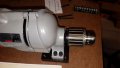
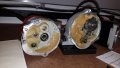
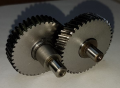
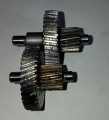
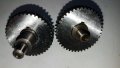
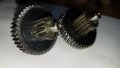
Here are the pics that you've asked for, shortbus.

Image00001.jpg

Image00003.jpg

Gears 01.PNG

Gears 02.PNG

Image00004.jpg

Image00002.jpg


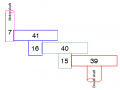
And this is the way that the gears are arranged, with their corresponding number of teeth.

Gears 00.PNG

The plan is to substitute the gears with 16 and 40 teeth, with a couple having 31 and 25 teeth. Since the teeth differential is the same for both original gears (that would be 16+15, and 40-15) the distance between centers should remain the same.

That arrangement should roughly triple the output RPMs, according to my calculations

worksheet.PNG
 
Last edited:

shortbus

Joined Sep 30, 2009
10,049
Looks good to me. To make things easier I'd probably make a new shaft for both of those steps. Doing that you wouldn't need to destroy the pinions on the shaft. But you need to watch with those gears in the drill, from the looks of them they are not a standard type of gear, look more like what some call 'stub' gears. Gears not made to full depth of a normal gear. So you still need to measure center to center distance of the shaft positions and look in a catalog to get the correct pitch distance. By that I mean just buying a random pitch gear of 31 and 25 has to be thought out, because of the C/C distance being fixed. A little loose is better than a little tight.

Off the shelf straight tooth gears would probably be fine for this instead of helical. The angle on that helix isn't that high and the gears would be bigger than the pinions used so strength wouldn't be compromised.
 

shortbus

Joined Sep 30, 2009
10,049
I have a Boston and a Browning catalog if you don't, old ones but part numbers are usually the same. If you want me to look for gears that fit c/c distance.
 

Thread Starter

cmartinez

Joined Jan 17, 2007
8,794
Oh, your going about the gear thing different than I would have. Since you were having to re use the gears from the first and third reduction, they would already be correct. Then by having the center to center distance of the second and third reduction, you would just pick what ever gears that make up that distance. And by picking those gears they would be the correct pitch for that pair. Almost any seller of gears gives the pitch diameter of the different pitches and tooth sizes. Over the years I've made many things work by doing this without having to buy or make special gears.

Most gears in drills like that are stub tooth for some reason, and stub tooth gears are not listed in a lot of catalogs.
Normally, I would've gone that same way too. But it's important that I don't destroy or alter the original gears in any way, for backup purposes. That's why right now I'm trying to reverse engineer gears 1 and 4. After that, I'll just design my own gears 2 and 3, whose center distances can easily and precisely be adjusted by altering the helix angle, until it's a perfect fit to what's already installed.
 

shortbus

Joined Sep 30, 2009
10,049
Sorry didn't mean to highjack your energy thread that way.

Normally, I would've gone that same way too. But it's important that I don't destroy or alter the original gears in any way, for backup purposes. That's why right now I'm trying to reverse engineer gears 1 and 4.
I thought the larger gears were pressed/keyed to the pinions? If they are like they look like, you would only need to make one"intermediate" shaft, to hold the gears that are numbered '16' and '41'.

#41 would be reused since it needs to mesh with the motor pinion. #16 would be a replacement, larger gear to fit the new shaft along with #41.

#40 would be a new gear to mesh with the new #16 and they would have to fit the center/center distance of the originals.

#15 and #39 would be reused.
 

Thread Starter

cmartinez

Joined Jan 17, 2007
8,794
Sorry didn't mean to highjack your energy thread that way.


I thought the larger gears were pressed/keyed to the pinions? If they are like they look like, you would only need to make one"intermediate" shaft, to hold the gears that are numbered '16' and '41'.

#41 would be reused since it needs to mesh with the motor pinion. #16 would be a replacement, larger gear to fit the new shaft along with #41.

#40 would be a new gear to mesh with the new #16 and they would have to fit the center/center distance of the originals.

#15 and #39 would be reused.
Yes, that's more or less my plan too. The motor shaft (gear with 7 teeth) has to stay and cannot be changed. Same goes for the output shaft (gear with 39 teeth). That being said, gears 41 and 15 will remain the same, except that I have to replicate them because I do not want to disassemble or destroy the original 41/16 and 40/15 pairs, which as you've just said are pressed together. Once I get gears 41 and 15 right, the rest will be a piece of cake, since I can redesign 16 and 40 (which will end up as 25 and 31) any way I want, as long as the distance between their centers is unaltered.
 

Tonyr1084

Joined Sep 24, 2015
9,744
The numbers of the teeth are a good reference point, but the final outcome is the diameters of the gears. One can have coarse teeth on the input and fine pitch teeth on the output and both can have the same number of teeth, but the changes in diameter are where you're going to find the change in ratios. A 3 to 2 gear ratio is the same as 6 to 4 or 12 to 8 (and so on). You need to change the ratio of the diameters. There's where it may get tricky.
 

MisterBill2

Joined Jan 23, 2018
27,714
Really I was joking, it's a weakness of mine.

But (a bit more) seriously, the short, boring answer is:no.

Those drill motors are voltage dependant, but the typical do-it-yourself attempted trick of attempting to run something like that by "hooking it up to 220" only results in smoking, burning parts, as does any use of frequency control devices.

Seriously, sell them to help finance the purchase of the correct tool.
It certainly is right about smoking the motors. I worked at a place where I had to put 240 on one cord with a 120 outlet on it. SEVERAL FOLKS IGNORED MY BIG RED WARNING SIGN and burned up a shop vac and a drill motor. BOTH of them did run much faster before they burned out. The drill motor took almost a minute to burn up, the shop vac took about 15 seconds.
 

shortbus

Joined Sep 30, 2009
10,049
The numbers of the teeth are a good reference point, but the final outcome is the diameters of the gears.
That is what I was saying earlier. You can't just pick random teeth numbers. It all goes back to something called DP, diametral pitch. A Boston Gear or Browning catalog will have all of the different sizes in it. Once the C/C is known it just comes down to picking the gears that will fit. The gears being replaced will basically just be "idler" gears not a reduction or speed change. But in cases like this it is a good idea to have gears the are not matched tooth numbers, one gear should have an even number and the other an odd number of teeth, when possible. This makes noise and wear over time less of a problem, but when working with a already decided C/C distance it can't always be done.
 

Thread Starter

cmartinez

Joined Jan 17, 2007
8,794
Higher chuck speed will result in lower torque. How much faster do you want to turn the chuck? 10% faster? 20? 50? 200% faster?
300% ... but lower torque is alright, because it'll be drilling smaller holes than it's designed to drill anyway.
 

Thread Starter

cmartinez

Joined Jan 17, 2007
8,794
I'm baaaaaackkkk!!!!

I've finally solved my problem (I think) in a straightforward, no-nonsense and practical way ... just the way @shortbus likes it :D

Anyway, the reason for this thread was trying to make a standard, Milwaukee-brand drill motor run faster than the 600 rpm that it normally runs at. That's because I intend to drill very thick wood with it, and 600 rpm are way too low for a good hole finish. At that velocity, wood splinters and cracks. At least at the hole diameters that are being drilled, which are in the range of between 3/8" and 3/4" approximately. I wanted to use that motor, btw, because of its compact size and sleek appearance.

After some calculations, I concluded that simply applying more voltage to the motor was not a workable solution, since internally the motor is already running at more than 20,000 rpm (and to think at first I guessed it should be running at 4k rpm ... geesh, how stupid can one be? :oops:) So upping the revs through electrical means was quickly discarded.

I then explored the possibility of changing a couple of gears in its gearbox so as to change its ratio, and sure enough, I found that it was quite possible to do that. BUT then I realized that what I needed was a reliable, dependable and easy to replace motor. And those are points that couldn't be met with my gear-replacement plan.

So, after more than a year since my last post, and with the deadline right on top of me, I found what seems to be an extremely affordable solution:

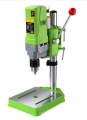
upload_2018-9-22_14-3-30.png

A Chinese drill running exactly at the RPM range that I want, with adjustable speed, and of the overall same dimensions of the Milwaukee one. And at a fraction of the price. I just hope this tool proves to have the reliability that I'm looking for. Either way, I'll be back with my report in the next few weeks.
 
Last edited:

jpanhalt

Joined Jan 18, 2008
11,087
Came late to this thread. Perhaps you have mentioned it. What size hole and how deep? I saw something to the effect of 3/8" to 3/4".

Have you considered just using a different style bit? At 3/8" with a standard 118° drill, it may wander, depending on the grain. I would consider a Forstner or auger style drill bit at slow speed. The Forstner style in that size will have a relatively large and stiff shaft, but may not provide the depth you need. An auger will provide more depth.

Here's a Forstner:
upload_2018-9-22_16-45-5.png

Here's an auger style:
upload_2018-9-22_16-46-34.png

The sharp point will help keep either type going straight through hard grain sections. They run well at low speeds, and the auger type provides particularly good chip clearance.

John
 

MisterBill2

Joined Jan 23, 2018
27,714
The type of drill bit depends entirely on the depth of hole, for any given speed. You must have an escape path for the chips to avoid burning problems and possible drill breaking, though. I would not consider a type with that threaded point that pulls the bit into the wood, but there are lots of options, depending on how long the bit needs to be. For really shallow holes you might even be able to use a milling machine bit, which is very stiff, but for more average depths a regular drill bit is more reasonable. My big concern is the bearing supporting the chuck on that Chinese drill motor. As soon as you have bearing play you may get drill wander. That is why milling machines all have spindles with really solid bearings. Actually, an old milling machine would be a perfect drill press, except for being quite big and very heavy.
 

MaxHeadRoom

Joined Jul 18, 2013
30,699
@cmartinez Drill presses are notable for some run out, that is why they are no good for converting to a small mill, Here is a 'belt and braces' method of testing run out,


If possible I prefer to use a Morse taper drill if your drill stand has this option with the chuck removed.
Max.
 
Top