Voltage across 100ohm resistor is always 0.6V. So current thru 100ohms is 0.6/100=6mA. The same current flows thru zener.
If you change 100ohm to 47ohm the current will be 0.6/47=12mA.
So by picking this resistor you can set the current thru zener.
What is purpose of 1k resistor? Also what zener diode has 3V real model and what should the current be? I cant find any Ltspice model breakdown voltage of 3v.
1k is for supplying the base of transistor.
Most used is 3v3 zener, but 3v exist also. I don’t use a models.
Pick the current according datasheet VI-chart at what current the zener voltage is most constant.
When you look at 3v3 curve the voltage starts to be out of knee at 10mA and more. Maybe 7mA is usable.
1k is for supplying the base of transistor.
Most used is 3v3 zener, but 3v exist also. I don’t use a models.
Pick the current according datasheet VI-chart at what current the zener voltage is most constant.
1k sets the current flowing thru two 1n4148 also , so it’s good to be at least few mA (strong biased). The base current flows thru 1k also, so another current is added. It’s better to use lower resistance to base current doesn’t affect the two diode bias.
(To hold 2xVf=1.2V most constant).
The base current is Ib=Ic/Hfe=10mA/100=100uA
Together with 2mA (empirically picked) of two diode bias current the overall current thru R_bias is 2.1mA.
So R_bias=(Vcc_min-2*Vf)/I_bias=(5-1.2)/2.1mA=1809ohm,
so I choose 1k.
1k is for supplying the base of transistor.
Most used is 3v3 zener, but 3v exist also. I don’t use a models.
Pick the current according datasheet VI-chart at what current the zener voltage is most constant.
When you look at 3v3 curve the voltage starts to be out of knee at 10mA and more. Maybe 7mA is usable.
1k sets the current flowing thru two 1n4148 also , so it’s good to be at least few mA (strong biased). The base current flows thru 1k also, so another current is added. It’s better to use lower resistance to base current doesn’t affect the two diode bias.
(To hold 2xVf=1.2V most constant).
The base current is Ib=Ic/Hfe=10mA/100=100uA
Together with 2mA (empirically picked) of two diode bias current the overall current thru R_bias is 2.1mA.
So R_bias=(Vcc_min-2*Vf)/I_bias=(5-1.2)/2.1mA=1809ohm,
so I choose 1k.
Ib=100uA is current needed to flow 10mA thru collector-emitter junction.
The Ib is almost constant no matter what Vcc is, Vce also (in this circuit).
From equation Ib=Ic/Hfe you can see if Ic=const the Ib=const also.
Datasheets show all the ranges of part specs. Simulators show only "typical" specs but not the range of specs from minimum to maximum.
Datasheets of zener diodes show that their voltage drops when heated when their zener voltage is below about 5,6V and their voltage increases when heated when their voltage is above about 5.6V.
The datasheet for a 3.0V at 20mA 1N5225B (through-hole) shows that its voltage drops 0.075%/degrees C.
Ib=100uA is current needed to flow 10mA thru collector-emitter junction.
The Ib is almost constant no matter what Vcc is, Vce also (in this circuit).
From equation Ib=Ic/Hfe you can see if Ic=const the Ib=const also.
Ahhh your good . What about the supply voltage drops below 5vdc 1vdc to 5vdc and want to keep 3V constant voltage supply?? I dont think you can keep voltage constant between 0V to 1vdc.
Datasheets show all the ranges of part specs. Simulators show only "typical" specs but not the range of specs from minimum to maximum.
Datasheets of zener diodes show that their voltage drops when heated when their zener voltage is below about 5,6V and their voltage increases when heated when their voltage is above about 5.6V.
The datasheet for a 3.0V at 20mA 1N5225B (through-hole) shows that its voltage drops 0.075%/degrees C.
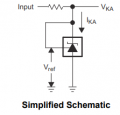
That's why I suggested the TL431, which acts as a stable Zener, largely independent of current (above 1mA) and temperature.
If you configure it as shown below, you can use it in place of a 2.5V Zener (Vref voltage) for the rest of your circuit:
Ahhh your good . What about the supply voltage drops below 5vdc 1vdc to 5vdc and want to keep 3V constant voltage supply?? I dont think you can keep voltage constant between 0V to 1vdc.
When Vcc is below zener voltage the Vout follows the Vcc (approximately).
To circuit be working when Vcc is below zener voltage you need a boost converter or charge pump.
That's why I suggested the TL431, which acts as a stable Zener, largely independent of current (above 1mA) and temperature.
If you configure it as shown below, you can use it in place of a 2.5V Zener (Vref voltage) for the rest of your circuit:
The IC in a Solar Garden Light boosts the 0.9V to 1.5V from a rechargeable Ni-MH battery cell to 3.5V for a colored LED.
You might be able to copy the circuit in the cheap IC with many transistors.

 Facebook
 Google
 GitHub
 Linkedin




 . What about the supply voltage drops below 5vdc 1vdc to 5vdc and want to keep 3V constant voltage supply?? I dont think you can keep voltage constant between 0V to 1vdc.