LTSpice Vd-Id characteristic

Thread Starter

kalemaxon89

Joined Oct 12, 2022
389
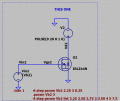
I am trying to simulate the characteristic of an IRLZ44N before testing it in some project in order to make sure I am using the right model.

The results I got apply to both the SPICE model downloaded from infineon website and the spice model I already had from LTSpice.
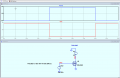
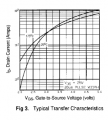
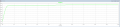
I do not understand why with Vgs=3V the current reaches 16A ... in the figure it should come to 20A!
Am I doing something wrong?
1682340448881.png

1682340464920.png
 

Attachments

ericgibbs

Joined Jan 29, 2010
21,439
hi k89,
Are you using this graph as the data for the Id =20A at 3V.?
If yes, that is a Gate pulse parameter of 20uSec, with a Vd =25V.

E
EG57_ 786.pngEG57_ 785.png
 

Thread Starter

kalemaxon89

Joined Oct 12, 2022
389
hi k89,
Are you using this graph as the data for the Id =20A at 3V.?
If yes, that is a Gate pulse parameter of 20uSec, with a Vd =25V.

E
View attachment 292689View attachment 292690
Thank you! I hadn't noticed 20us pulse width!
Why you set a 200us period? What if I set 500us?

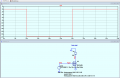
I forgot to say that I was referring to the Id-Vds curve ... not Id-Vgs.
It is Id-Vds that I was trying to plot.
How do I do it? Still Vgs pulse 20us? And Vds?
 

Audioguru again

Joined Oct 21, 2019
6,826
The datasheet lists a 2V maximum Vgs threshold voltage where some IRLZ44 Mosfets draw only 0.25mA. Then with 3V for its Vgs there is no way for these ones to conduct 16A to 20A.
 

ericgibbs

Joined Jan 29, 2010
21,439
Hi agu,
Here is a copy of the datasheet, I suggest you learn how to read it and stop belittling the efforts of other members who are trying to help the TS

E
EG57_ 789.png
 

Attachments

Thread Starter

kalemaxon89

Joined Oct 12, 2022
389
Hi agu,
Here is a copy of the datasheet, I suggest you learn how to read it and stop belittling the efforts of other members who are trying to help the TS

E
View attachment 292753
Hi eric.
I take this opportunity to ask you for another piece of information.

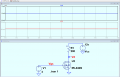
1) Assuming a resistive load on the drain (say 200 ohms) and a Vcc supply, when the MOSFET is on (Vgs>Vgs,th) it behaves like a small resistor Rds .. so at its ends there will be Vds=Rds*Id. Am I wrong?

2) If I am correct, assuming Vs at GND:
• Id(max)=Vcc/200 = 12/200=60mA
• Id=(Vcc-Vd)/200 = (12-Vd)/200 because Vds is not 0 (as in the ideal case) but exit a Rds (as I said in 1)).
But what if I want a higher Id? ..because maybe it is not enough for my load to work :(If my maths isn't wrong, I either increase the Vcc or choose a mosfet that gives me a lower Vd .. so that the ratio (Vcc-Vd)/200 is higher. Am I wrong?

I would like feedback on all this reasoning.
 

ericgibbs

Joined Jan 29, 2010
21,439
1) Assuming a resistive load on the drain (say 200 ohms) and a Vcc supply, when the MOSFET is on (Vgs>Vgs,th) it behaves like a small resistor Rds .. so at its ends there will be Vds=Rds*Id. Am I wrong?
hi k,
The d/s gives the Rds On for two values of Id current, refer clip.

As a rough example, the d/s shows 20A, with a 25V supply and Vgs of 3V, so you could say 25V/20A = 1.25R equivalent Rds.

So when you used a 20v supply it measured as 16A, so 20V/1.25R = 16A Id, at Vgs =3V.

Have you run a simulation for the 200R Drain load, with a Vcc=20V and measured the Id and voltage drop across the MOSFET Drain/Source.?
EEG57_ 791.png

EG57_ 790.png
 

Thread Starter

kalemaxon89

Joined Oct 12, 2022
389
hi k,
The d/s gives the Rds On for two values of Id current, refer clip.

As a rough example, the d/s shows 20A, with a 25V supply and Vgs of 3V, so you could say 25V/20A = 1.25R equivalent Rds.

So when you used a 20v supply it measured as 16A, so 20V/1.25R = 16A Id, at Vgs =3V.

Have you run a simulation for the 200R Drain load, with a Vcc=20V and measured the Id and voltage drop across the MOSFET Drain/Source.?
EView attachment 292756

View attachment 292755
So the datasheet's Rds(on) values are for certain reported conditions. It should always be simulated on a case-by-case basis depending on Vcc, Id required, etc.

But what about the 2)?
 

ericgibbs

Joined Jan 29, 2010
21,439
2) If I am correct, assuming Vs at GND:
hi k,
No sure which point you are referring too with Vs at GND.?

If you mean Vdrain=0V, with a Vccsupply =12V and a 200R Drain resistor, that is Id= 12V/200R = 60mA.

You say I either increase the Vcc or choose a mosfet that gives me a lower Vd .

You cannot have a Vdrain lower than 0V, so you need a higher Vcc or a lower value Drain resistor.
Is that what you are asking.?

E
 

Thread Starter

kalemaxon89

Joined Oct 12, 2022
389
hi k,
No sure which point you are referring too with Vs at GND.?

If you mean Vdrain=0V, with a 12Vsupply =12V and a 200R Drain resistor, that is Id= 12V/200R = 60mA.

You say I either increase the Vcc or choose a mosfet that gives me a lower Vd .

You cannot have a Vdrain lower than 0V, so you need a higher Vcc or a lower value Drain resistor.
Is that what you are asking.?

E
I'm assuming Vs at 0V so I can consider in the calculations Vds=Vd.
 

Thread Starter

kalemaxon89

Joined Oct 12, 2022
389
hi k,
No sure which point you are referring too with Vs at GND.?

If you mean Vdrain=0V, with a Vccsupply =12V and a 200R Drain resistor, that is Id= 12V/200R = 60mA.

You say I either increase the Vcc or choose a mosfet that gives me a lower Vd .

You cannot have a Vdrain lower than 0V, so you need a higher Vcc or a lower value Drain resistor.
Is that what you are asking.?

E
The fact is this:
I understand now that with Vcc=12V and Rload=200ohm the Id(max)=12/200=60mA .. regardless of the type of mosfet I have. On LTspice I simulated the circuit with many different mosfets (IRLZ44N, IRF7811, NDS9943 etc.) and the Id(max) was always the same.

So the only thing I can do is to increase Vcc ... I don't understand what is meant by "decrease Vds" ... get a mosfet with lower Rds(on) (as you confirmed to me(?))
But in any case, even if I select an ideal mosfet with Rds(on)=0 .. I'll always have Id(max)=12/200=60mA .. so if my load requires much current than 60mA and I can't increase Vcc .. then I have no choice but to change circuit solution (possibly think of an opamp, DC-DC, bjt or other .. I gave examples)

@ericgibbs
 
Last edited:

Thread Starter

kalemaxon89

Joined Oct 12, 2022
389
Hi k,
Explain what purpose the project is intended to perform, perhaps I can suggest some ideas.
E
Thank you in the meantime for your helpfulness.

I don't have to do a project, I'm interested to see if my reasoning and understanding of mosfets is correct. In particular, if the conclusions I arrived at in post #13 are correct
 

ericgibbs

Joined Jan 29, 2010
21,439
Hi k,
When using MOSFET's for Switching or as Linear amplifiers, their operation requires a different circuit design procedure
E

I should add, that the datasheets parameters are for typical devices, but there can be a wide variation from the stated parameters.
 
Last edited:

ericgibbs

Joined Jan 29, 2010
21,439
hi k,
I would consider a temperature controlled ducted hot air blower to heat the fabric across its underside width and a ducted extraction fan to monitor the exit air temperature.
E
 

Thread Starter

kalemaxon89

Joined Oct 12, 2022
389
hi k,
I would consider a temperature controlled ducted hot air blower to heat the fabric across its underside width and a ducted extraction fan to monitor the exit air temperature.
E
The fabric is tied around the wrist. I have to warm it up by powering it with wires
 
Top