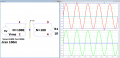
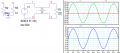
LTSpice schematic

Thread Starter

denison

Joined Oct 13, 2018
334
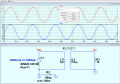
Hi all, I have a problem with an LTspice schematic. When you show a 240vac sine wave source it is not displayed properly unless you show a ground symbol where neutral would be in real life. Then you see, on running, a sine wave with a peak of 336v and negative peak of 336.
How do you then distinguish this ground from your circuit ground?
 

ericgibbs

Joined Jan 29, 2010
21,425
Hi den
Use F4 'COM'.
E

BTW:
240vac sine wave source , LTSpice requires the Vpeak for it set value.
So 240Vrms * 1.414 = 339Vpk.
 

Attachments

Last edited:

WBahn

Joined Mar 31, 2012
32,783
Hi all, I have a problem with an LTspice schematic. When you show a 240vac sine wave source it is not displayed properly unless you show a ground symbol where neutral would be in real life. Then you see, on running, a sine wave with a peak of 336v and negative peak of 336.
How do you then distinguish this ground from your circuit ground?
You're not giving us much to go on. What is it displaying that is not proper? Where else are you putting the ground symbol? Or are you talking about not putting a ground symbol in the schematic at all?

What source are you actually using? If you are using a voltage source, then to get 240 Vrms, you need to specify an amplitude of 339.4 V.

You put the LTSpice ground symbol (which is merely a shorthand way of designating the attached node as Node 0 in the netlist) at whatever point in the circuit you want all other voltages to be measured relative to.

Every netlist has to have a Node 0 in order for the simulator to work properly. Some simulators will fail to converge if you do not have a Node 0, others will arbitrarily pick a node, such as the first node in the netlist, and reassign it as Node 0. I'm pretty sure that LTSpice will throw an error if there is no Node 0.

It would be helpful if you provided a schematic of the circuit that you think is misbehaving and one for the schematic that you think is working as it should.
 

crutschow

Joined Mar 14, 2008
38,435
How do you then distinguish this ground from your circuit ground?
If the AC source is connected to a circuit with a ground connection then you don't need to ground the source (only one ground connection is needed per circuit).
But if the source is then floating (not directly connected to ground through the circuit), you can still see its voltage by left-clicking on one of the source nodes and, keeping the left button pressed, go to the other source node and release the button.
That will plot the difference voltage between the two nodes, i.e. the source voltage.
 
Last edited:

xblitz

Joined May 2, 2021
17
Just for clarify: LTSpice assume that every node is connected to GND with a resistor (it's helpful for convergence). Every SPICE engine I see until now fails if GND node in not defined.
 

Bordodynov

Joined May 20, 2015
3,430
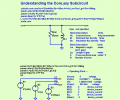
I showed a line transformer. AL is the inductance per turn. The transformer consists (in this case) of three parts - two windings and one core. The winding is connected to ground (node 0) through a small capacitor and a very high resistor. The real circuit has these parasitic parameters. I have more different cores.
Here's some more information:
I have a transformer of winding Winding_RC or WINDING_LCR
(Just Winding not use.)
The hubs are not linear (nonlinear) or linear.
Non-linear Core, Coreja.
Coreja-Model Jiles-Atherton. Parameters can be taken from files magmod.txt.
Linear Core Two: Corelin_al, the parameter is AL, i.e., induction for one spiral (turn) and
The CORELIN_A_Lm parameter is the
Section area, length of the average magnetic line and effective magnetic permeability.
Use linear lines before using non-linear Core.
And the most important thing. All elements must have a shared point (Connected via wires ).
But you can also post the coils and the core. The main thing to do is to pin one name to the PIN.
For this, there is a third pin in the winding. One pin on the core.
The simplest transformer consisting of a primary, a secondary, and a core can just move together
to pines fit (connected).
I prefer to use TR1, TR2, etc.
The cores allow for the loss of the eddy. For this, there is a boundary frequency of Fe (Feddy).
WINDING_RC has the parameters of Rser and Cpar and the number of turns.
WINDING_LCR is the additional leakage inductance.
I prefer not to clutter the diagram.
You can get the dissipation power of the core (non-linear) in the normal way using ALT.
 
Last edited:

WBahn

Joined Mar 31, 2012
32,783
More generally, every node must have a DC path to ground, not necessarily a resistor (for example, through an inductor).
Plus, a node need not have a DC path to ground if initial conditions are established that enable the simulator to converge on a DC bias point solution.
 

Ian0

Joined Aug 7, 2020
13,126
Don't forget that in real life neutral is connected to earth. So node zero can be the point at which the supply enters the building. Then, for a completely realistic simulation, you need to add the inductances and resistances of the earth and neutral wiring between there are the point you to which the rest of your circuit connects.
For a UK supply, the voltage source should be 325.3V in series with 0.23Ω and 750uH.
 

crutschow

Joined Mar 14, 2008
38,435
Plus, a node need not have a DC path to ground if initial conditions are established that enable the simulator to converge on a DC bias point solution.
Yes, it would appear that as long as the circuit has one ground point, the other nodes don't necessarily need a DC path to that ground (a capacitor, for example).
 

Ian0

Joined Aug 7, 2020
13,126
That seems oddly specific for a connection with an arbitrary length of wire and gauge going from the load to the source.(?)
It's an "official" figure, and I didn't expect it to be accurate for where I live - which might be described as a rural location. My supply is two wires from 3-phase 11kV Δ supply which go 600m to a 46kVA transformer which supplies two properties, and then 150m of 25mm^2 coax to the house. The supply drops 9.3V when I connect a 9.5kW electric shower, so the impedance measures at 0.23Ω, which is suspiciously close to the official figure of 0.23+0.23jΩ , and I certainly didn't expect it to be lower.
 
Top