LTSPICE Model for an EL Panel

Thread Starter

graybeard

Joined Apr 10, 2012
118
I am working on the design of an inverter power supply for an EL panel. None of the off-the-shelf inverters I have found will generate enough voltage to drive the panel to full brightness.

I have been trying to find an LTSPICE model for an EL panel without any luck, so it looks like I will have to make my own model.

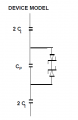
I have found a diagram of a model of an EL panel in this paper: https://ch00ftech.com/wp-content/uploads/2012/05/mrsnf98.pdf
1700029484067.png

It makes sense. The Zener diodes represent the energy used to product the light.

I have no idea how to determine the cap and Zener values for the model.

I have a working panel and inverter (no longer in production) and have tried to do a little characterization. At full brightness, the inverter drives the panel with a touch over 300VAC P-P per my HP scope. When I measure RMS AC voltage with my Fluke 77, I see about 126VAC. I tried measuring the AC current draw with the Fluke 77, but it loaded the circuit too much so it wouldn't work.

I tried measuring the resistance of the EL panel, but the resistance kept going up until it read an open circuit. I was not surprised by this.

I put my capacitance meter on it and got 0.038uF. I put my inductance meter on it, just for giggles and got 10.5mH.

My question is, how can I make a valid LTSPICE model for my EL panel?

Any guidance or advice would be greatly appreciated.

Mark
 

eetech00

Joined Jun 8, 2013
4,705
I am working on the design of an inverter power supply for an EL panel. None of the off-the-shelf inverters I have found will generate enough voltage to drive the panel to full brightness.

I have been trying to find an LTSPICE model for an EL panel without any luck, so it looks like I will have to make my own model.

I have found a diagram of a model of an EL panel in this paper: https://ch00ftech.com/wp-content/uploads/2012/05/mrsnf98.pdf

View attachment 307574

It makes sense. The Zener diodes represent the energy used to product the light.

I have no idea how to determine the cap and Zener values for the model.

I have a working panel and inverter (no longer in production) and have tried to do a little characterization. At full brightness, the inverter drives the panel with a touch over 300VAC P-P per my HP scope. When I measure RMS AC voltage with my Fluke 77, I see about 126VAC. I tried measuring the AC current draw with the Fluke 77, but it loaded the circuit too much so it wouldn't work.

I tried measuring the resistance of the EL panel, but the resistance kept going up until it read an open circuit. I was not surprised by this.

I put my capacitance meter on it and got 0.038uF. I put my inductance meter on it, just for giggles and got 10.5mH.

My question is, how can I make a valid LTSPICE model for my EL panel?

Any guidance or advice would be greatly appreciated.

Mark
The model behavior should target a specific device. Do you have electrical specifications for the EL panel you are using?
Or a part number?
 

Sensacell

Joined Jun 19, 2012
3,785
I would imagine the EL could be emulated with a single capacitor, with a resistor in series and another in parallel.

The Zener diodes create a very non-linear behavior, I cannot imagine the EL panel is that non-linear, more like a lossy and leaky capacitor.
 

Thread Starter

graybeard

Joined Apr 10, 2012
118
Ford used EL panels for lighting in their Mustang Cobra cars and Lightning trucks in 2003 and 2004 and no longer sell parts for those vehicles. There are no specs for the panels. I am trying to make replacement inverters. I will read about your project with interest.
 

eetech00

Joined Jun 8, 2013
4,705
I have a working panel and inverter (no longer in production) and have tried to do a little characterization. At full brightness, the inverter drives the panel with a touch over 300VAC P-P per my HP scope. When I measure RMS AC voltage with my Fluke 77, I see about 126VAC. I tried measuring the AC current draw with the Fluke 77, but it loaded the circuit too much so it wouldn't work.
Can you provide the inverter drive frequency?
 

Thread Starter

graybeard

Joined Apr 10, 2012
118
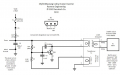
Here are the schematics of the Ford inverter:

1700114905315.png
I am really weak when it comes to understanding how to engineer blocking oscillator circuits, but really want to learn how to design them. It looks like I could use a Coilcraft FL2015-4L transformer to implement a similar circuit. I would love to be able to simulate this design before I build it, but I have no idea how to model the EL panel. Everything else should be pretty straight forward.

eetech00, I was on your blog which is where I found the cap/Zener model...
 

BobTPH

Joined Jun 5, 2013
11,527
I would think all you need to know is the frequency voltage and current draw. If the meter will not measure the current without stopping it, use a low Ohm resistor in series and measure the voltage across it. You only need to know a rough current estimate and make sure your circuit is capable of more.
 

wayneh

Joined Sep 9, 2010
18,110
I tried in my project to model the EL strip but never really got anywhere with that. So instead I focused on producing the voltage and frequency required to drive an EL device and hoped for the best. My strip is not a huge load and it all worked out. I have no idea how many strips I could drive in parallel before my wall-wart transformer would get hot.
 

Thread Starter

graybeard

Joined Apr 10, 2012
118
I measured 15mA RMS. That gives me a reactance of about 8400 ohms at 525Hz. From my Electrodroid calculator, I get about 0.036uF.

Interestingly, that correlates with what I read on my capacitance meter (0.038uF). It looks like that will be a good way to model the EL panel.

Thanks guys for the tips. Now I am off to set up some simulations.

BTW, I have had a healthy respect for high voltages since we lost a fellow grad student to an accidental electrocution in 1976. I am very careful to this day...
 

Thread Starter

graybeard

Joined Apr 10, 2012
118
I am trying to understand how the EL panel inverter works in 2003/4 vintage Ford Mustang Cobra and Lightning instrument clusters. I have one working panel, one working inverter and one dead inverter. I also got to do a little testing on a functional loaner inverter that I had to return, I was hoping that getting a simulation working would help me to better understand how this circuit works and what it may take to repair or redesign it. The system works on the bench, but I can't get the transistor to switch in the LTSPICE model.

The dead inverter is dead because of an open circuit in the primary winding of the pulse transformer. I have removed the transformer and transistor from the dead inverter. I do not want to remove components from the working inverter because the inverters are very hard to find and I don't want to risk damaging it.

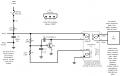
Here are the schematics for the system:

1702097351105.png
Using an inductance meter, I have measured the inductances of the functional transformer in-circuit and have measured the inductances of the secondary and feedback windings out of the circuit with the dead transformer. The in-circuit readings for the secondary and feedback windings correlate with the out-of-circuit readings for the same windings. That leads me to have a little hope that the measured primary winding inductance may be accurate, but it could be a source of error. I have tried a lot of different inductance values for the primary with no luck getting the simulation to work.

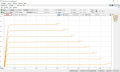
I have no specs for the Zetex FST837 NPN transistor, but it seems like a regular small signal NPN transistor. Here is the curve trace for the transistor from the dead inverter:

1702098307325.png

It looks like a pretty generic NPN transistor to me. I tried all of the LTSPICE transistors associated with the npn model and none of them would turn on in the simulation. But this may also be a problem for my simulation. I don't know how to make an LTSPICE model for a transistor from these curves.

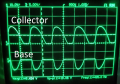
With my scope I can see that the output is a pretty clean looking 300V P-P signal. The green wire has a very clean, flat 10V on it when the inverter is running. Here are the scope traces for the collector and base of the transistor in the working inverter:

1702098934605.png

These signals make sense to me when it comes to the transistor turning on and off. I just can't get the transistor in the simulation to turn on.

Another thing that I can't understand is what sets the ~500Hz frequency of this circuit. My college textbook shows a tuned collector blocking oscillator circuit with an LC tank on the collector where L is the inductance of the transformer . The frequency of that circuit is 1/(2Pi*SQRT(LC)). This circuit looks a little like a tuned collector circuit, but the Primary L and any combination of the caps values don't give me a frequency anywhere near 500Hz. What am I missing.

I have attached a zip file with my simulation in it.

Any help I can get to get this simulation running would be greatly appreciated as would any explanation of how this circuit works would be.
 

Attachments

eetech00

Joined Jun 8, 2013
4,705
Hi
The changes are shown in dotted rectangles.
There should only be one "K" statement since the coils share one core. When specified correctly, the phase dots will appear automatically.
Its easier to troubleshoot if you label the nets.
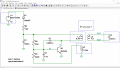
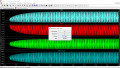
The frequency is roughly 570 Hz

1702136504951.png


1702136444213.png
 

Attachments

Thread Starter

graybeard

Joined Apr 10, 2012
118
Thanks guys! I really appreciate your help. As you can see, I am a neophyte when it comes to LTSPICE. I earned my EE degree long before tools like that were invented and clearly didn't keep up. Again, really appreciate the help.

Now, can anyone explain why this circuit runs at about 500Hz? That's my next puzzle...
 

Thread Starter

graybeard

Joined Apr 10, 2012
118
The time constant of L2*C4 makes sense. That gets us to about 600Hz. That leads me to ask if C1 and C2 add a bit to the capacitance via the transformer to push it down to about 500Hz? Also what do C1 and C2 do? I can see that C1 is probably just a filter, but C2 looks like it provides a feedback path in addition to the feedback winding.
 

Alec_t

Joined Sep 17, 2013
15,121
Also what do C1 and C2 do?
C1 seems redundant. The output waveform looks less distorted without it. It makes virtually no difference to the operating frequency (~570 Hz). I did wonder if it assisted start-up, but the sim starts fine without C1.
Removing C2 increases the operating frequency to ~590 Hz.
 
Top