Audioguru again
- Joined Oct 21, 2019
- 6,826
Years ago constant current diodes (a Jfet with a resistor) were available and maybe still today.
I wonder what the manufacturing process is that causes such large variations?One possible disadvantage of that circuit is that there can be a significant difference in the constant-current from unit to unit, due to the large variation in the JFET's Vgs control voltage (see below for the 2N3819 values, which shows a 15:1 difference).
This would require adjusting the source-resistor value to get the desired current.
View attachment 248931

It seems to inherent in the process used to make JFETs (which likely hasn't changed much in years).I wonder what the manufacturing process is that causes such large variations?
Thanks for your reply !The datasheet for the UMZ12K zener diode says that it is not recommended for new designs. It is 12V +/-10% at a current of 5mA and its datasheet shows a "typical" curve of it only a little less than 12V (about 11.9V) at a current of 1uA.
Hello,hi,
I always to try to use the same circuit the TS has posted, unless he asks for a design modification.
They are usually interested in how their circuit performs, not my version of it.
E
Update:
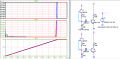
Look at these two sims, with and without R5
View attachment 248918
Can you use an IC or does it need to be built from discrete parts?Could you please suggest any other solutions here ?
Just to have provision of RC delay upto 1sec.
Hello,Can you use an IC or does it need to be built from discrete parts?
Hi C,
A 555 timer which is dirt cheap, likely less than the cost of the Zener and JFET.Discrete circuit will less cost.
Which IC are you talking about ?
I need transistor to be turned on after some delay.A 555 timer which is dirt cheap, likely less than the cost of the Zener and JFET.
Do you specifically need that transistor to turn on, or do you just need a signal?
That circuit won't tolerate 36V.

Here's a delay circuit using an LM339 or LM393 comparator.
The comparator has an open-collector transistor output, so I don't think an added transistor is needed.
Note that the delay is independent of supply voltage.
The pulse delay after power application is ≈R1*C1 as determined by the resistor and capacitor tolerances.
The LED serves two purposes; it gives an indication that the power is applied, and it reduces the supply voltage by about 2V since the LM339/393 is rated for a maximum of 36V.
View attachment 249114
Hello C,Here's a delay circuit using an LM339 or LM393 comparator.
The comparator has an open-collector transistor output, so I don't think an added transistor is needed.
Note that the delay is independent of supply voltage.
The pulse delay after power application is ≈R1*C1 as determined by the resistor and capacitor tolerances.
The LED serves two purposes; it gives an indication that the power is applied, and it reduces the supply voltage by about 2V since the LM339/393 is rated for a maximum of 36V.
View attachment 249114
| Thread starter | Similar threads | Forum | Replies | Date |
|---|---|---|---|---|
| M | Simulation help needed | Power Electronics | 6 | |
| M | Gate Driver simulation help needed | Power Electronics | 14 | |
| M | Simulation help needed | Power Electronics | 4 | |
| M | LT Simulation Help Needed | Analog & Mixed-Signal Design | 2 | |
| M | 3-Phase Bridge Rectifier Simulation help needed | Analog & Mixed-Signal Design | 8 |