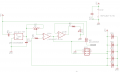
Can somebody please advise if the attached circuit would be correct to switch OFF a load when a threshold voltage set by the pot is reached ? max current is 10A, powered by Li-ion 18650 cells i n parallel.
Not knowing what SV1 is all about it looks like the output will be switched off when the battery voltage exceeds a threshold that would be set by R2.
There may be issues with startup time of the reference and the common mode range of the opamps.
IC3B appears to be at the mercy of its input offset voltage. It would make things more certain if the inverting input were connected to a small positive voltage.
Thank you Externet. that is indeed helpful. but i wanted to learn to use the opamp which is becoming harder as i dig-in. Theory helps to an expend but when it comes doing stuffs things are a bit different. Some say hysteresis which is a window that the opamp uses to trigger its output but in essence it just a positive or a negative feedback depending on the value of the resistor.
So what would be wrong in my circuit ? couple of resistors in the input and negative feedback for IC3A and B ? it that all ? i haven't tested this because its hard source the components here locally.
hi anish,
Hysteresis in the comparator is required so that as the Vthreshold is reached, the Comparator output does not rapidly switch Hi/Lo at that point.
Consider when you are discharging the battery and then remove the load at the Vth point, the battery voltage will rise and the comparator output will change state.
The hysteresis applies a voltage to the comparator input so the threshold Set point is raised and the MOSFET remains Off.
E
Not knowing what SV1 is all about it looks like the output will be switched off when the battery voltage exceeds a threshold that would be set by R2.
There may be issues with startup time of the reference and the common mode range of the opamps.
IC3B appears to be at the mercy of its input offset voltage. It would make things more certain if the inverting input were connected to a small positive voltage.
SV1 is a harting connector. This pcb would be stacked one on top of the other so these connectors would be connected in parallel along the edge of the pcb.
hi anish,
Hysteresis in the comparator is required so that as the Vthreshold is reached, the Comparator output does not rapidly switch Hi/Lo at that point.
Consider when you are discharging the battery and then remove the load at the Vth point, the battery voltage will rise and the comparator output will change state.
The hysteresis applies a voltage to the comparator input so the threshold Set point is raised and the MOSFET remains Off.
E
Thank you Eric. The comaparator explanation helped.
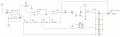
I moved the MOSFET to the low side Is this how it is intended to be ? is there an rule of thump when deciding on the resistor values for R1, R4, R6, R5 ?
hi,
This PDF explains hysteresis.
Where and what value is the Load discharge resistor connected on your circuit.?
What is the intend Load disconnect Vlow-threshold voltage.?
E
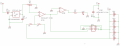
Both IC3A and IC3B are configured as gain of 2 linear inverting amplifiers, not comparators with hysteresis. Also, the IC3A output is connected directly to the battery. This will cause the part to fail.
Both IC3A and IC3B are configured as gain of 2 linear inverting amplifiers, not comparators with hysteresis. Also, the IC3A output is connected directly to the battery. This will cause the part to fail.
The IC3A and IC3B configuration was correct earlier i guess. Then reading further in the thread i thought it would require a hysteresis. The value are just guess. I just wanted to get the schematic correct and then figure out the values using LTSpice.
hi,
So what value of battery discharge current are you expecting thru that 'load'.?
Please mark your circuit diagram showing the discharge path.
I am assuming that BT1 thru BT5 are the batteries being discharged.?
Where is the MOSFET BAT- connected too.?
What are the voltages powering the OPA's.?
What are the initial/starting voltages of BT1..5.?
I have made a draft LTSpice circuit, which I can test and post ,when I have the above information.
Please mark your circuit diagram showing the discharge path.
I am assuming that BT1 thru BT5 are the batteries being discharged.Where is the MOSFET BAT- connected too.??
The voltage powering the opamp will 4v2 initially which is the max voltage the 18650 will be charged up to and will be discharged to the votlage set by R2.
hi,
So the discharge current for the BT1 thru BT5 is thru a 'working load', your circuit is just a voltage monitor.
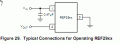
The d/s for the REF2933 specifies a 1mV drop out voltage as 'typical' but it can be a maximum of 50mV.
Are you wanting to use the MOSFET to disconnect the BT1>5 batteries from the 'working load' when the battery voltage falls to <= 3.3V .?
initially yes i thought of doing it so but then i would need another pad to charge them as well. So droped the idea, i would be using a BMS also so a MOSFET wouldn't be necessary.
Most battery monitor circuit require at least a little hysteresis because one of the inputs (the battery voltage) changes very slowly. The problem is that hysteresis is a form of positive feedback, so it always is applied to the non-inverting (+) input. You added feedback to the inverting (-) input, which configures the amp for linear gain, not non-linear switching.
Since it is a comparator, it must be the case that at some point its output will go low. If it does, the output stage will attempt to dead-short the battery output to GND. poof. flame. death. not the end of civilization as it know it, but ... bad.

 Facebook
 Google
 GitHub
 Linkedin