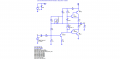
It just the LTSpice .asc file for that nice amplifier circuit that you posted earlier.
At this point I have only simulated the circuit but I intend to breadboard it soon.
It looks like the current through R6 is only 961 uA.
I mentioned the original circuit that has R1 connected to VCC.
The idle current (with no input signal) of the entire amplifier circuit is mostly from the output transistors. Then at low signal levels the output transistors operate at class-A producing no crossover distortion.
Probably. The 10ma refers to the total current with no input signal which is mostly the output transistors as mentioned previously.
Have you tried using different values for R5 up to 1K in the simulator?
Probably. The 10ma refers to the total current with no input signal which is mostly the output transistors as mentioned previously.
Have you tried using different values for R5 up to 1K in the simulator?
Probably. The 10ma refers to the total current with no input signal which is mostly the output transistors as mentioned previously.
Have you tried using different values for R5 up to 1K in the simulator?
The current drain on the supply is only 1.5 mA (per simulation) with R5 at 500 ohms. The value of R5
doesn't seem to affect the cuurent drain at all.
M
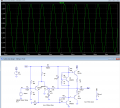
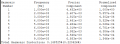
For your interest, below is the sim of a perhaps more elegant circuit, that uses a differential input stage (Q1 and Q2) with both AC and DC negative feedback from the output to bias the output at 1/2 the supply voltage largely independent of transistor or diode variations, establish the gain and reduce distortion (around 0.2% in the sim).
I think it's one of the better simple AB audio amp designs, due to the negative feedback that stabilizes the DC output operating point at 1/2 the supply voltage and gives low output distortion.
For your interest, below is the sim of a perhaps more elegant circuit, that uses a differential input stage (Q1 and Q2) with both AC and DC negative feedback from the output to bias the output at 1/2 the supply voltage largely independent of transistor or diode variations, establish the gain and reduce distortion (around 0.2% in the sim).

 Facebook
 Google
 GitHub
 Linkedin