That would be the cutoff frequency for a first order RC filter. the circuit in post #5 is a 2nd order filter and it has a 2nd order transfer function. The poles of the filter are a complex conjugate pair.
The gain affects the filter Q which affects the -3dB point.
You need to look at the equation for the filter response to determine the actual -3dB value.
There are Sallen-Key filter on-line design tools which will calculate the component values for a desired response and filter Q such as this.
Scroll down to the fourth example in the website where it shows the filter with gain and says "Calculate the R and C values for the Sallen-Key filter at a given frequency and Q factor".
G is the gain.
Scroll down to the fourth example in the website where it shows the filter with gain and says "Calculate the R and C values for the Sallen-Key filter at a given frequency and Q factor".
G is the gain.
Once you get used to the Okawa-Denshi tool it comes in quite hand on many occasions. I'm actually a big fan of it.
It has been a while since I bought a textbook, but Van Valkenburg, M.E., Analog Filter Design, 1982 edition should be available on the used book market by now.
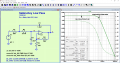
I decided to show you how to do this with a simulator I am familiar with. On the Okawa-Denshi site I set the Q to 0.707. The damping factor is not updated when you do this. Additionally, a Q of .707 also means the damping ratio is also 0.707. You use the radio button to make your choice, but the other one does not change. Then you can also select the Capacitor Sequence as E24, and the Resistor Sequence as E96. These choices allow the program to get much closer to the desired result because they ARE the standard values!
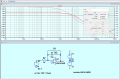
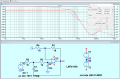
You can see the results of the .meas(ure) statements that the results are quite good at 200 Hz and 5kHz.
So if you were building a low pass filter from scratch without the website say for 1khz cut off with a gain of 2, How would you go about picking random different sized resistors or is R2 always 0.5 x R1
The solution for a given set of filter parameters is NOT unique. Van Valkenburg in his book gives several examples of potential strategies. Among them are:
Choose equal value resistors and compute appropriate capacitor values.
Choose equal value capacitors and compute appropriate resistor values.
Choose one RC pair and compute the other.
Because 1% resistors have 96 values per decade and capacitors usually have only 24, I would tend to choose standard capacitor values and compute the resistors to the nearest 1% value.
If you look at the Okawa-denshi page carefully you will note that there may be some additional conditions. Underneath the box where you can optionally choose values for C1 & C2 is the following condition:
\( G-1\lt\cfrac{C_2}{C_1}\le\zeta^2+G-1 \)
In our case the gain G was 2 so this becomes
\( 2-1\lt\cfrac{C_2}{C_1}\le\zeta^2+2-1 \)
Substituting the value 0.707 for zeta, we get
\( 1<\cfrac{C_2}{C_1}\le 1.5 \)
We can see that the ratio of the capacitors chosen meets this condition since
All that being the case, it is still possible that some grizzled analog design veteran may come up with some additional condition, but until that happens, you'll just have to be satisfied that the are a large number of solutions that will be close enough for government work.

 Facebook
 Google
 GitHub
 Linkedin