Low Pass filter and Open Collector Input

Thread Starter

Vihaan@123

Joined Oct 7, 2025
226
1766986470512.png

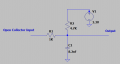
The input to the circuit is the open collector output from another device. I want to understand the time constant raise and fall time and also the cutoff frequency. I do not know much on the open collector when i read it says it can only pull the line low and it cannot pull the line high and need pull up resistor. Analysing the actual circuit
If initially the line is at 3.3V for it to go to Low the time constant will be R2 * C1 = 4.7K * 8.2nF = 38.54uSec.
Again when the open collector output is floating the time for it to go high is tau = 38.54uSec.
The signals beyond the frequency = 1/(2*pi*R2*C1) =4.12Khz.
1766987460258.png
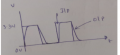
As usual i am confused of whether to use R1 or R2 for Tau calculations, or both?
 

WBahn

Joined Mar 31, 2012
32,777
Think about whether your claims make sense.

Let's say that R1 was very small, like 1 Ω, so that C1 was essentially directly connected to the LO input. Why would R2 have much effect at all on how fast C1 discharges through R1?

Your sketch shows the output going all the way to 0 V. Is that where it's going to end up?

To determine what the time constant is, reduce the circuit to a Thevenin equivalent circuit driving the capacitor.

You have been learning all of these tools for circuit analysis, you need to start using them.
 

Thread Starter

Vihaan@123

Joined Oct 7, 2025
226
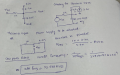
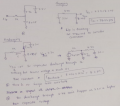
Thank you for the quick support, yes it is like one step forward and 100 steps back but atleast i have confidence you people are there to help. This is the work i have done, i am not sure why i can't understand the things at first time when i see new circuit, my mind gets into a mess

1766997882835.png
I am not sure the reasoning i gave is correct.

Your sketch shows the output going all the way to 0 V. Is that where it's going to end up?
I have not got the answer for this yet, need to work it out.
 

ericgibbs

Joined Jan 29, 2010
21,420
hi V123,
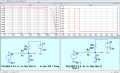
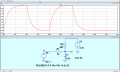
This simulation assumes the Open Collector source is Ideal and switches between an Open Circuit and a Short Circuit.
Use it to check your Calculations.
E
EG 1933.png
EG 1935.png
 
Last edited:

MrAl

Joined Jun 17, 2014
13,686
View attachment 361278

The input to the circuit is the open collector output from another device. I want to understand the time constant raise and fall time and also the cutoff frequency. I do not know much on the open collector when i read it says it can only pull the line low and it cannot pull the line high and need pull up resistor. Analysing the actual circuit
If initially the line is at 3.3V for it to go to Low the time constant will be R2 * C1 = 4.7K * 8.2nF = 38.54uSec.
Again when the open collector output is floating the time for it to go high is tau = 38.54uSec.
The signals beyond the frequency = 1/(2*pi*R2*C1) =4.12Khz.
View attachment 361280
As usual i am confused of whether to use R1 or R2 for Tau calculations, or both?
Hi,

I have to recommend solving for the output in the usual way in the frequency domain, and that gives you a function:
Fs1=f(R1,R2,C1,Vin,V1,vc0)

where Vin is the input voltage from the open collector when the collector is grounded (usually considered to be 0v).
then take the function 'f' and find the limit as R1 goes to infinity. That gives you the function you need for when the input Vin is 'open'. Note Vin is actually an open circuit when the collector is 'off', and you can calculate the new function by simply removing R1 from the circuit, and for the function that means it goes to an infinite resistance so no conductance when the collector goes 'open'.
That gives you your second function for when the collector is open:
Fs2=limit(Fs1,R1,inf) which means take the limit of Fs1 as R1 goes to infinity.
That is usually not that hard to calculate, especially with math software.
Sometimes the collector voltage could be considered to be something like 0.2 to 1.2 volts when 'on', but here is is probably ok to assume 0v.

Once you have the two functions Fs1 and Fs2, you can then go on to take the inverse Laplace Transform of each one giving you Ft1 and Ft2. You can then go on to assign some arbitrary values for the components and sources and see if it looks right. You can even start with R1=1 and R2=1 and C1=1, and also Vin=1 and V1=1, then take time steps of 1 second each. Start with Ft1 and vc0=0, and that gives you vc1, then use Ft2 and vc0=vc1, and that gives you vc2, then go back to Ft1 with vc0=vc2, etc., etc.

Once you have that you can start using real values or just do some symbolic calculations, depending on what you need.

This is a very interesting circuit because it opens the door to rectifier circuits that convert AC to DC voltage. When the diode(s) open, the input has to be thought of as going to an infinite input impedance which also means disregarding the voltage of the input source. That's what makes rectifier circuits so special because there is no real Laplace function for an open circuit, it's just a change of topology again. It makes calculations a lot more difficult because of that, and that's why we usually only see COMPLETE solutions for full wave rectifier circuits that contain only a limited number of parts. The sine wave input makes it even more difficult too because it is harder to solve for the diode on and off times with a constantly changing input unlike with a square wave. It is actually possible to solve any of these rectifier circuits, but it is still a lot of work in the general case. Being able to handle the open circuit input is the first step though.

Once you solve this problem you should literally pat yourself on the back :)
 
Last edited:

Thread Starter

Vihaan@123

Joined Oct 7, 2025
226
I calculated manually the 3dB frequency as per Thevenin equivalent, it is not matching with the simulation result why?

1767067499085.png
1767067574982.png
1767067598250.png
As per the simulation it is 14KHz.
 

Thread Starter

Vihaan@123

Joined Oct 7, 2025
226
One other question i have is iam simulating this circuit in isolated condition like not connecting with other sections, is it ok? does it also have impact to which it is connected, for example if it is connected to microcontroller pins, what are the things i need to verify with respect to the pins for example resistance etc?
 

WBahn

Joined Mar 31, 2012
32,777
You are assuming that the cutoff frequency is identical for a circuit driven by an open-collector output and one driven by a symmetrically driven output.

Does that make sense?
 

WBahn

Joined Mar 31, 2012
32,777
One other question i have is iam simulating this circuit in isolated condition like not connecting with other sections, is it ok? does it also have impact to which it is connected, for example if it is connected to microcontroller pins, what are the things i need to verify with respect to the pins for example resistance etc?
Depends on what you are trying to do, exactly.

Since we normally don't know what the circuit will be driving, we often are seeking to characterize it in such a way that it is relatively easy to take the effect of different loads into account once we know them. This is a big part of the idea behind two-port networks.
 

MrAl

Joined Jun 17, 2014
13,686
I calculated manually the 3dB frequency as per Thevenin equivalent, it is not matching with the simulation result why?

View attachment 361351
View attachment 361352
View attachment 361353
As per the simulation it is 14KHz.
Hi,

This is because the simulation is displaying the cut relative to the input voltage. Since the input voltage is ALWAYS higher than the output (even at DC) the simulation will show a cut that is lower than what the filter is really doing.

The cutoff is not always relative to the input voltage directly it often depends on some reference point other than 0dB.
For a low pass filter, it is relative to the f=0 point amplitude, which for this filter is not zero.
In other words, when we solve for the -3dB point with a filter function F(w) we don't solve this:
F(w)=-3dB

we have to solve this (everything in dB):
F(w)=-3dB-F(0)

so to see what you really want to see you would have to display:
F(w)-F(0)

and that would set the reference point at 0dB like you probably want to see. Then the -3dB point will appear at the 23.5kHz frequency or whatever you calculated with the parallel resistors and the capacitor.

That extra cut F(0) comes from the two resistors alone acting as a simple resistive voltage divider. The cutoff has to be lower than that by 3dB, not lower than 0dB by 3dB. That means that if the resistors alone create a cut of -1.5dB then the actual simulation would show a cut of 4.5dB at 23.5kHz which is the right frequency for the so-called -3dB frequency.

This is because it is a low pass filter, and a low pass filter starts at w=0 and for zero frequency the cut is not always 0dB.
If it was a regular high pass filter we would consider the reference to be at infinite frequency.
It is also easy to imagine that for a bandpass filter we would consider the reference frequency to be the center frequency which is usually the highest AC amplitude over all frequencies of interest.
 
Last edited:

MrAl

Joined Jun 17, 2014
13,686
I calculated manually the 3dB frequency as per Thevenin equivalent, it is not matching with the simulation result why?

View attachment 361351
View attachment 361352
View attachment 361353
As per the simulation it is 14KHz.

Hello again,

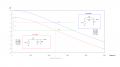
Here is an illustration of what we calculate by computing the two resistors in parallel and what we simulate when we simulate the actual circuit.
We can see that they both have the same -3db point, but the reference is different for the two circuits.

The green scale shows how the red plot ends up 3db down from the amplitude at f=0.
The blue plot seems normal because there is no extra attenuation from the second resistor.

There may be times when we need to know the complete attenuation, but that is not the way we usually do calculations for filters. For example, there may be a resistance R2 that cannot be removed from the circuit and we need to calculate a value for R1. In that case the complete attenuation may be an important specification to know as it would be another 1.9db or so down.
 

Attachments

Top