Low pass filter calculation help

Thread Starter

gte

Joined Sep 18, 2009
363
I have a low pass filter that isn't adjusting the voltage enough. It's 0 to 1vDc sine wave into the RC and it's outputting 0.95v out most of the time. I'd like to have it output average of around 0.6v with a floor of 0.2v and ceiling of 0.8v.

Is there a formula I can use to calculate the output voltage high and low, knowing the input voltage and to adjust the capacitor and resistor values to see the output I should get?

I found the formula below but I'm not sure how calculate Xc (the capacitive reactance of a capacitor) so if someone could provide a formula with real input numbers and a sum, I'd appreciate that.

https://www.electronics-tutorials.ws/wp-content/uploads/2018/05/filter-fil71.gif

From https://www.electronics-tutorials.ws/filter/filter_2.html
 

Thread Starter

gte

Joined Sep 18, 2009
363
A DC voltage sinusoidal wave, it doesn't cross below 0, if I'm referring to it incorrectly let me know what I should describe it as.

I don't know, I guess I need to start with scoping it?

I was trying to think this through and I'm wondering if the frequency oscillation of my low pass filter is too fast? Because my meter reads the average of 0.49v, however the data interface is reading differently from what my DMM reads, it's reading a constant 0.99v. Could this be due to the sample rate?

What is a 0 to 1VDC sine wave?
Filters are frequency dependent. What is the signal frequency?
 

schmitt trigger

Joined Jul 12, 2010
2,027
In other words; a sinewave with a DC offset.
Thus a few questions;
What is the peak to peak voltage
What is the DC offset
What is the sinewave frequency
What is the filter’s -3db frequency and what order
 

Thread Starter

gte

Joined Sep 18, 2009
363
I am not sure where my scope is so I used the Hz feature on my meter and it read 5khz. I will look for my scope later.

It's been a while since I have done this and the rest of the questions I'm not sure how to answer. I think peak to peak is 5v, it's DC voltage in and out, so it's not like in class where we had AC voltage (with a positive and negative) that had a DC offset. If that's not enough information, I'll try to provide more if you let me know.
 

MrChips

Joined Oct 2, 2009
34,628
There are two usages of the terms DC and AC.
The first usage is, DC means Direct Current; the current does not change direction, for example, current coming from a 12 V automotive battery.
AC means Alternating Current; the current periodically changes direction, for example, 120 VAC @ 60 Hz supplied by the electricity company.

The second usage is to label the frequency of a signal. DC refers to zero frequency whereas AC refers to any non-zero frequency.
(Note that here, the terms DC and AC no longer refer to current only. They can be used when referring to voltages.)

A sinewave is a sinewave, is a sinewave. There are no ifs, ands or buts. A voltage sinewave is represented mathematically by the formula:

v(t) = a sin(ωt)

where v is the instantaneous voltage at time t
a is the amplitude
ω is the angular frequency, where frequency f = ω / 2π

If you wish, you can add two additional parameters to the formula,
v(t) = v0 + a sin(ωt + φ)

where v0 is a DC voltage offset
φ is a phase angle, which is not important for this discussion.

So how to descibe a 0 to 1 V sine wave?
The voltage swings from 0 to 1 V, which means that the peak-to-peak voltage is 1 V.
The amplitude is half the peak-to-peak voltage, i.e. a = 0.5 V.
The sine wave has been offset by the same amount, i.e. v0 = 0.5 V.

Thus a 0 to 1 V sine wave is

v(t) = v0 + a sin(2πft)

where v0 is 0.5 V and a is 0.5 V. We still need to put a value on the frequency f.
You could describe it as a sinewave of unknown frequency f, amplitude 0.5 V and DC offset of 0.5 V.

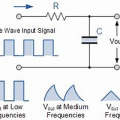
You are working with an RC low-pass filter.

1738535746781.png

When the input signal is a sinewave, the shape and frequency of output stay the same and the amplitude will be lower.

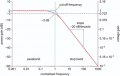
The amplitude of the output of the RC low-pass filter is dependent on the frequency. Below is the frequency response of a 1st order low-pass filter. The cut-off frequency fc can be calculated using the formula:

ω = 1 /RC
or fc = 1 / (2πRC)

1738535927685.png


Since the DC component (v0) is not attenuated, the output will still have an offset of 0.5 V.
At the cut-off frequency, the signal amplitude has a voltage gain of 0.707.
Hence the original amplitude of 0.5 V becomes 0.35 V.
Thus your signal low value is (0.50 - 0.35) V = 0.15 V
Your signal high value is (0.50 + 0.35) V = 0.85 V

In order to obtain different values at the same frequency, you have to alter the R and C values to give the desired attenuation.

If you want to change the DC offset to a lower value you can add a resistor voltage divider.
 

LowQCab

Joined Nov 6, 2012
5,101
A cheap DMM Meter is probably not going to be of much assistance in solving your problem.

The first step is to describe the problem.
Describe how You have come to the conclusion that You need a Filter, and this will solve your problem.

Start by showing, ( with an attached picture ), what the Waveform is, You will need an Oscilloscope.
You could possibly give a detailed verbal description of the Oscilloscope display.

An accurate and complete Schematic-Diagram would be a HUGE bonus.

Describe why this particular 'Scope-Trace is a problem for your intended purpose(s).

Describe your Power-Supply or Input-Signal-Source.

Describe the Circuit or device You are powering, or providing a Signal to.

All the "little" details matter.
.
.
.
 
Top