Facebook
 Google
 GitHub
 Linkedin
I am currently developing a low noise preamp for a new piezo sensor that should be used as a hydrophone. Since I am actually from the signal processing domain the topic was quite hard to get into for me. The sensor is relatively new and not well characterized. The only specifications I have are the following:
- Capacitance of 7nF
- Voltage of about 100 to 500 nV (no information of the type of excitation given so far)
- \( D_{33}=5.7 \) pm/V
As a ADC and DAC I am using consumer sound interfaces like the Steinberg UR44C, Focusrite Scarlett 4i4 or an RME Fireface UC. Here are the (from what I think) most relevant parameters:
- Max. Input Lvl.: +10 to +22 dBu = about 2 to 10 V
- Input Impedance: about 10 kOhm
- Max. Output Lvl.: +15 to +20 dBu = about 4 to 8 V
- Output Impedance: 75 to 430 Ohm
- SNR: About 110 dB according to their datasheets - might be a little bit lower in practice
The signals I desire to obtain can go up to 100 kHz.
Coming from the ADC side I would by that think, that *theoretically* I could measure signals down to a couple micro volts - right?
As a possbile solution many sources are recommending charge amplifiers for piezo sensors. My current design of the amplifier consists the following "idea": One charge amplifier directly and closely connected to the actual sensor amplifying the signal by 26 dB to then amplify this signal with a voltage amplifier with a gain of 44 dB - makes 70 dB total.
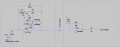
When I simulate this I get the results desired: Flat frequency response from 10 Hz (cutoff set with the highpass) to 100 kHz.
Spice prompt: .ac dec 100 0.1 100k
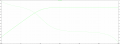
So I made the PCB and evaluated the amplifier isolated from the sensor element. I do this by connecting the sound interface in series with a capacitor of 7 nF to the input of the preamp and put the output of the preamp in the input of my sound interface. To characterize the system I use white noise, take the PSDs of in- and output signals and look if they are getting distorted by the amp. They don't look as in the simulation but they are pretty flat in my opinion.
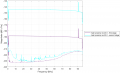
The purple psd is hereby obtained by picking up the signal after the charge amp and the magenta psd by pickung up the signal at the overall output of the preamp. The solid line is the signal (white noise) and the dashed line is the measured noise. The absolute y scaling is wrong but relatively it should at least be correct.
When connecting this to the sensor I get a lot of noise and distortion. But since that would also be a lot to explain here I'd like to focus on my approach with this problem and my circuit for now.
The overall question is roughly: How can I improve this circuit?
Meaning:
1. Do you see any errors regarding my basic approach to this circuit?
2. Are there fundamental errors in the circuit design?
3. What measures can I take to make the circuit more robust against interference/lower noise?
4. Any other remarks/ tips? Anything I need to reconsider?
Your help is highly appreciated.
Edit #1:
Link to the LTSpice .asc file
- Capacitance of 7nF
- Voltage of about 100 to 500 nV (no information of the type of excitation given so far)
- \( D_{33}=5.7 \) pm/V
As a ADC and DAC I am using consumer sound interfaces like the Steinberg UR44C, Focusrite Scarlett 4i4 or an RME Fireface UC. Here are the (from what I think) most relevant parameters:
- Max. Input Lvl.: +10 to +22 dBu = about 2 to 10 V
- Input Impedance: about 10 kOhm
- Max. Output Lvl.: +15 to +20 dBu = about 4 to 8 V
- Output Impedance: 75 to 430 Ohm
- SNR: About 110 dB according to their datasheets - might be a little bit lower in practice
The signals I desire to obtain can go up to 100 kHz.
Coming from the ADC side I would by that think, that *theoretically* I could measure signals down to a couple micro volts - right?
As a possbile solution many sources are recommending charge amplifiers for piezo sensors. My current design of the amplifier consists the following "idea": One charge amplifier directly and closely connected to the actual sensor amplifying the signal by 26 dB to then amplify this signal with a voltage amplifier with a gain of 44 dB - makes 70 dB total.
When I simulate this I get the results desired: Flat frequency response from 10 Hz (cutoff set with the highpass) to 100 kHz.
Spice prompt: .ac dec 100 0.1 100k
So I made the PCB and evaluated the amplifier isolated from the sensor element. I do this by connecting the sound interface in series with a capacitor of 7 nF to the input of the preamp and put the output of the preamp in the input of my sound interface. To characterize the system I use white noise, take the PSDs of in- and output signals and look if they are getting distorted by the amp. They don't look as in the simulation but they are pretty flat in my opinion.
The purple psd is hereby obtained by picking up the signal after the charge amp and the magenta psd by pickung up the signal at the overall output of the preamp. The solid line is the signal (white noise) and the dashed line is the measured noise. The absolute y scaling is wrong but relatively it should at least be correct.
When connecting this to the sensor I get a lot of noise and distortion. But since that would also be a lot to explain here I'd like to focus on my approach with this problem and my circuit for now.
The overall question is roughly: How can I improve this circuit?
Meaning:
1. Do you see any errors regarding my basic approach to this circuit?
2. Are there fundamental errors in the circuit design?
3. What measures can I take to make the circuit more robust against interference/lower noise?
4. Any other remarks/ tips? Anything I need to reconsider?
Your help is highly appreciated.
Edit #1:
Link to the LTSpice .asc file
Last edited: