LoRa communication with arduino

Thread Starter

onurdnz95

Joined Oct 27, 2021
15
I want to set up a communication system with lora module using arduino. The lora module is said to have a high range (<15km), but when I go about 50-100 meters away, my connection drops. Also, when I integrate a sensor into this system, I can't get an output from my sensor. When I try the same things with the hc-12 module, I don't have a problem with communication. Does anyone have any ideas why I'm having such a problem with lora?
 

Ya’akov

Joined Jan 27, 2019
10,226
OK, antenna is critically important here. Could you link to the specific module you are using? I don't see an Ra-01 with an internal antenna, and, if there is one it will be entirely inadequate.

If you haven't seen videos from Andreas Speiss, you should take a look he's a great resource.


Thread Starter

onurdnz95

Joined Oct 27, 2021
15
OK, antenna is critically important here. Could you link to the specific module you are using? I don't see an Ra-01 with an internal antenna, and, if there is one it will be entirely inadequate.

If you haven't seen videos from Andreas Speiss, you should take a look he's a great resource.

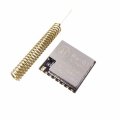
The module and antenna I use are as seen in the photo. Thanks for the resource, but it didn't contain the information I was looking for. I need information about the relationship between arduino nano and lo-ra ra-01, the relationship between multiple lo-ra modules. There are many resources on this, I looked at almost all of them, but could not find what I was looking for. Thanks
 

Attachments

Ya’akov

Joined Jan 27, 2019
10,226
I've used LoRa32u4 II modules from BSFrance which are Adafruit Feather 32u4 clones. I have been able to communicate reliably from indoors to outdoors at least 500m.

Because you are dealing with a very low powered transmitter, the antenna is crucial. I suspect it is the crux of your problem. There are much better antenna options which you can even adapt to that module. If you do buy antennas, be sure they actually operate on the frequency they are using.

Ideally, you should get a Nano VNA to ensure they are resonant where you need them to be, many antennas are simply non-functional at their labeled frequencies.
 

Thread Starter

onurdnz95

Joined Oct 27, 2021
15
I've used LoRa32u4 II modules from BSFrance which are Adafruit Feather 32u4 clones. I have been able to communicate reliably from indoors to outdoors at least 500m.

Because you are dealing with a very low powered transmitter, the antenna is crucial. I suspect it is the crux of your problem. There are much better antenna options which you can even adapt to that module. If you do buy antennas, be sure they actually operate on the frequency they are using.

Ideally, you should get a Nano VNA to ensure they are resonant where you need them to be, many antennas are simply non-functional at their labeled frequencies.
I'll take your advice on the antenna into consideration. Thanks
 

mckenney

Joined Nov 10, 2018
125
To get the really long ranges they talk about, you'll want to adjust parameters of the protocol. Generally, longer range is associated with lower bandwidth (BW), higher spreading factor (SF), and lower code rate (larger FEC size). This will slow your data (bps) rate, but increase range.

Beyond that, you can gain range by turning up the transmission power (dBm). This means higher power consumption per time on-air. At your slower data rate, you'll spend more time on-air, so keep your messages short.

Here's a lab test adjusting these parameters. (There are other such reports floating around.) They claim 2.8km. Note particularly Sections 3.2 and 3.4:

https://www.mdpi.com/1424-8220/16/9/1466
 

Thread Starter

onurdnz95

Joined Oct 27, 2021
15
To get the really long ranges they talk about, you'll want to adjust parameters of the protocol. Generally, longer range is associated with lower bandwidth (BW), higher spreading factor (SF), and lower code rate (larger FEC size). This will slow your data (bps) rate, but increase range.

Beyond that, you can gain range by turning up the transmission power (dBm). This means higher power consumption per time on-air. At your slower data rate, you'll spend more time on-air, so keep your messages short.

Here's a lab test adjusting these parameters. (There are other such reports floating around.) They claim 2.8km. Note particularly Sections 3.2 and 3.4:

https://www.mdpi.com/1424-8220/16/9/1466
Thank you for advice, i will look
 

blue_coder

Joined May 7, 2016
37
It might not be any help, but at work we use the The Things Industries (part of The Things Network https://www.thethingsnetwork.org/) for LoRa (as a WAN) over several miles for environmental monitoring. In the early days we tested with Arduino Pro-Minis and RFM95 chips which are similar to the one you linked to.
 
Top