Looking for IR LED circuit,

Thread Starter

LAOADAM

Joined Nov 21, 2018
956
hi Adam,
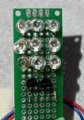
He has 9, IR emitters on that panel.!
You will get a longer range with that level of IR at 200Hz.

E
View attachment 259288
Thank you ericgibbs,
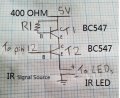
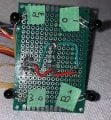
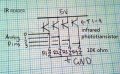
I made the parts as pictures shown below.
1. unfortunately I din't get as excepted IR emitter distance, just got ~50cm, I guess some thing wrong, but can't find where;
2. why the 4 PT's readings from Arduino serial monitor like this (picture3-readings ) when there is no input yet, the emitter not on yet;
3. the 2 BC547 got little hot some time.

emitter:
20220202.JPG20220202.123.jpg
phototransistor:
20220202.1.JPG20220202.12.jpg
readings:
sm20220202.JPG
 
Last edited:

sparky 1

Joined Nov 3, 2018
1,218
Some led flashlights will focus the beam giving it distance, in the same way optical focus improves detection distance
The light can have a specific frequency, an LM567 can be set to detect center frequency that helps eliminate anomalous error from stray light.
 

k1ng 1337

Joined Sep 11, 2020
1,038
thanks.
What I mean is can a IR LED emitter a semicircle beam, like the #31's first picture from 0 - 180.
I'm not sure if they make an LED with a maximum angle of 180 degrees. I believe the practical solution is to use two or more LEDs to cover your effective area so you would have to do some research on this. I'm fairly certain you can manipulate the infared to some degree by passing it through lenses to focus or scatter the light as well as using concave/convex reflective surfaces. Note that each surface will absorb / reflect / transmit (let them pass through) photon wavelengths differently so do not assume a mirror you look at yourself with will reflect infared in the same way. If you haven't already, you can use a cell phone camera to view infrared light which will appear purple to carry out some observations. In addition, modulating the infrared output will yield much greater selectivity at the receiver (such as TSOP1838) because there exists significant ambient infrared all around us. Also, modulating a carrier signal (38khz) with a low duty cycle will save power and may allow you to use more LEDs for a given power source which can increase your effective area. Receivers such as TSOP1318 don't need a high duty cycle as long as the carrier frequency is compatible.

I have not used any modules, discrete photodiodes and phototransistors (only discrete LEDs and 38khz receiver IC packages) so I cannot speak to their efficacy.
 
Last edited:

Ya’akov

Joined Jan 27, 2019
10,240
I'm not sure if they make an LED with a maximum angle of 180 degrees. I believe the practical solution is to use two or more LEDs to cover your effective area so you would have to do some research on this. I'm fairly certain you can manipulate the infared to some degree by passing it through lenses to focus or scatter the light as well as using concave/convex reflective surfaces. Note that each surface will absorb / reflect / transmit (let them pass through) photon wavelengths differently so do not assume a mirror you look at yourself with will reflect infared in the same way. If you haven't already, you can use a cell phone camera to view infrared light which will appear purple to carry out some observations. In addition, modulating the infrared output will yield much greater selectivity at the receiver (such as TSOP1838) because there exists significant ambient infrared all around us. Also, modulating a carrier signal (38khz) with a low duty cycle will save power and may allow you to use more LEDs for a given power source which can increase your effective area. Receivers such as TSOP1318 don't need a high duty cycle as long as the carrier frequency is compatible.

I have not used any modules, discrete photodiodes and phototransistors (only discrete LEDs and 38khz receiver IC packages) so I cannot speak to their efficacy.
You are right that a 180° IR emitter would be impractical. It would have to be a very high powered diode, and it is much easier to use more than one than to handle the larger device.

The angle of the optics in an LED are very similar to the beamwidth in a directional antenna. They create “gain” over the same emitter in an omnidirectional pattern by taking the avaialble power and narrowing the field in which it radiates.

Of course, the “gain” is purely relative to the same emitter witrout the directional optics and the tradeoff is the narrower angle is visible only from where it is focused. This can be a very good thing when you need it but in a case like this it is a problem to overcome. All the commercial remotes that I have seen that need better coverage use more than one emitter to get it.

One problem with having wide angle IR remotes is that the codes are not unique and without some directionality unintended operation of other devices is possible.

In any case, the practical answer to a wider coverage is, as has been said and can be observed in all the practical devices, multiple narrow beam devices with overlapping beams.
 
Top