Looking for help choosing a transistor

Thread Starter

gte

Joined Sep 18, 2009
363
I will try and do that, to make them more readable from now on.

Here is my latest attempt, please grade on readability and functionality :D

Also, which software did you use to simulate it? I'm still trying to keep up with your math


Assuming the Vf of the LED would be about 1.8v, the BE junction would be around 0.7v:
12v-(1.8+0.7)=12-2.5 = 9.5; 9.5v/2.2k Ohms = 4.32mA base current.

Meaning that the voltage forward of the LED is 1.8v (voltage traveling through it?)

Then at the Base, .7v is "consumed" (how did you know it was .7? because that is what it takes to trigger the NPN?)

With those two figures, you calculated 9.5v where?


Then, figure the transistor is pretty well saturated, so Vbe will be very low - maybe 100mV or less. Anyway, we'll thrown it in there.
12v-(1.8+.1)=12-1.9 = 10.1; 10.1v/1k Ohms = 10.1mA.
So, 4.32mA + 10.1mA equals...
14.42mA.


On bjt orientation:
Have the arrow in the emitter pointing towards the bottom portion of the schematic.
For a PNP transistor, the emitter arrow points towards the base; so in order for the arrow to point down, the emitter needs to be on top.
For an NPN transistor, the emitter arrow points away from the base, so the emitter goes down.

Whenever possible, orient the base towards the left side of the schematic.

When drawing schematics, you should always try to keep the more positive voltages towards the top, more negative voltages towards the bottom.
Inputs come from the left, outputs go towards the right.

This makes it easier to understand the schematic, as most are drawn that way.
 

SgtWookie

Joined Jul 17, 2007
22,230
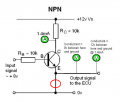
Here is my latest attempt, please grade on readability and functionality :D
It's more readable, but you have a number of mistakes in it.

For one, your "output signal" is connected to the ground side. It will never read anything other than 0v/ground.

You say the supply is +12v, so how did you calculate that you would get 1.4mA through Rc, a 10k Ohm resistor? Even if the collector-emitter junction of the transistor were a dead short, you wouldn't be able to get 1.4mA through Rc unless you raised the supply to 14v.

However, if you measured the voltage on the collector, it would be less than 100mV when the input signal was 8v, and nearly 12v when the input signal was less than about 0.5v.

Also, which software did you use to simulate it? I'm still trying to keep up with your math
I used an obsolete, discontinued product called Circuitmaker Student. I started using it years ago, but I would suggest that you use LTSpice instead.
Google "LTSpice download"

There is a Yahoo LTSpice group that has lots of models for components that don't come with LTSpice.

Assuming the Vf of the LED would be about 1.8v, the BE junction would be around 0.7v:
12v-(1.8+0.7)=12-2.5 = 9.5; 9.5v/2.2k Ohms = 4.32mA base current.
Meaning that the voltage forward of the LED is 1.8v (voltage traveling through it?)
No, the voltage measured across it. Current travels through components, voltage is dropped across components.

Then at the Base, .7v is "consumed" (how did you know it was .7? because that is what it takes to trigger the NPN?)
It's a forward-biased PN junction, like a silicon diode. The actual Vf (Vbe) of the base-emitter junction will vary depending on how much current is going through the base.

With those two figures, you calculated 9.5v where?
12v-(1.8+0.7)=12-2.5 = 9.5
That's the voltage remaining to be dropped across the resistor.

Please attach images using the "Go Advanced", "Manage Attachments" feature and upload them to AAC, instead of hosting them elsewhere; Imageshack and other sites like it will delete your images after a period of time.
 

Thread Starter

gte

Joined Sep 18, 2009
363
Sgt,

I'm not sure where I calculated the 1.4mA from, maybe because my car gets 14v out of the alternator, and then I labeled it with 12v accidentally?

If I put another transistor into the circuit where I've circled it with a red circle, and this transistor would then be conductant when the first transistor was blocking, and blocking, when the first transistor was conductant, would that work?

What I'm looking to do is provide a connection to battery minus when there is < 7vdc coming from the "input signal" through the transistor being conductant from collector to emitter and when the input signal eclipses 7vDC, for the transistor to become blocking of the connection to battery minus from the collector to emitter, and possibly have a high resistance resistor as a pull up resistor on the output signal to the ecu so it can definitely tell when it has a connection to battery minus or not.

What do you think?


It's more readable, but you have a number of mistakes in it.

For one, your "output signal" is connected to the ground side. It will never read anything other than 0v/ground.

You say the supply is +12v, so how did you calculate that you would get 1.4mA through Rc, a 10k Ohm resistor? Even if the collector-emitter junction of the transistor were a dead short, you wouldn't be able to get 1.4mA through Rc unless you raised the supply to 14v.

However, if you measured the voltage on the collector, it would be less than 100mV when the input signal was 8v, and nearly 12v when the input signal was less than about 0.5v.


I used an obsolete, discontinued product called Circuitmaker Student. I started using it years ago, but I would suggest that you use LTSpice instead.
Google "LTSpice download"

There is a Yahoo LTSpice group that has lots of models for components that don't come with LTSpice.


No, the voltage measured across it. Current travels through components, voltage is dropped across components.


It's a forward-biased PN junction, like a silicon diode. The actual Vf (Vbe) of the base-emitter junction will vary depending on how much current is going through the base.


12v-(1.8+0.7)=12-2.5 = 9.5
That's the voltage remaining to be dropped across the resistor.

Please attach images using the "Go Advanced", "Manage Attachments" feature and upload them to AAC, instead of hosting them elsewhere; Imageshack and other sites like it will delete your images after a period of time.
 

Attachments

Last edited:

SgtWookie

Joined Jul 17, 2007
22,230
I'm not sure where I calculated the 1.4mA from, maybe because my car gets 14v out of the alternator, and then I labeled it with 12v accidentally?
OK, I'll take that for an explanation. ;)

If I put another transistor into the circuit where I've circled it with a red circle, and this transistor would then be conductant when the first transistor was blocking, and blocking, when the first transistor was conductant, would that work?
OK, something happened to your image; it didn't attach, or you decided to delete it after you made the post. Note that images have to be a certain type, and there is a size restriction. .PNG format files are the best to use, because they are relatively compact, and can be edited many times without losing image quality like with .jpg format files.

"conductant" is not a word. Perhaps you meant "conducting" instead.

We don't generally use the phrase "blocking" with transistors. They are turned on, turned off, conducting, not conducting, partially conducting, etc.

Sometimes diodes/rectifiers are referred to as "blocking diodes", but I prefer to say "reversed biased".

What I'm looking to do is provide a connection to battery minus when there is < 7vdc coming from the "input signal" through the transistor being conductant from collector to emitter and when the input signal eclipses 7vDC, for the transistor to become blocking of the connection to battery minus from the collector to emitter, and possibly have a high resistance resistor as a pull up resistor on the output signal to the ecu so it can definitely tell when it has a connection to battery minus or not.

What do you think?
I'm going to have to interpret that.

You're looking for the output to sink current to ground (battery -) when there is < 7v on the input, and when the output is >= 7v, that the output is floating, or pulled to Vcc (+14v, give or take a few volts)

What you really need is a comparator circuit. A simple transistor won't be accurate enough for you. You will also need a voltage reference, provided by a Zener diode with a current flowing through it.

An LM2903 is a dual comparator that is rated for automotive use. I would not recommend an LM339, as it is not rated for such use.

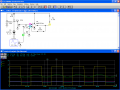
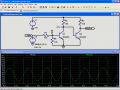
See the attached schematic and simulation. The green sine wave is your input signal varying between 6v and 8v. The yellow is the output of the circuit. The range of where the circuit trips can be adjusted by potentiometer R3, but in the beginning you set it for about 2.5v.
 

Attachments

Thread Starter

gte

Joined Sep 18, 2009
363
I swear I attached it and it listed it as an attachment :confused:

My teacher uses conductant and blocking.

One thing I should have mentioned, and you can tell me if the comparator circuit is still needed, I used >7v and <7v because I thought it was a good dividing point, but I now see how I could have explained it better. The input for my circuit only has 2 states, either 1.3v or 8.5v. It is a flattened PWM signal, so there is a little ripple, but I've never seen the first state eclipse 1.3x vdc. I've also never seen the second state drop below 8.x vdc.

Upon your direction, I will try and build the circuit that you created tomorrow, that is if I can find an lm2903 locally, hopefully radio shack carries them? Thank you for building/simulating that circuit, I appreciate that. I like that software that you screen captured, are you sure it is not a better option than LTspice, I can't even find a price on LTspice?
http://www.linear.com/designtools/software/#Spice


ps - I have a few lm358's lying around if they can be substituted?


OK, I'll take that for an explanation. ;)


OK, something happened to your image; it didn't attach, or you decided to delete it after you made the post. Note that images have to be a certain type, and there is a size restriction. .PNG format files are the best to use, because they are relatively compact, and can be edited many times without losing image quality like with .jpg format files.

"conductant" is not a word. Perhaps you meant "conducting" instead.

We don't generally use the phrase "blocking" with transistors. They are turned on, turned off, conducting, not conducting, partially conducting, etc.

Sometimes diodes/rectifiers are referred to as "blocking diodes", but I prefer to say "reversed biased".


I'm going to have to interpret that.

You're looking for the output to sink current to ground (battery -) when there is < 7v on the input, and when the output is >= 7v, that the output is floating, or pulled to Vcc (+14v, give or take a few volts)

What you really need is a comparator circuit. A simple transistor won't be accurate enough for you. You will also need a voltage reference, provided by a Zener diode with a current flowing through it.

An LM2903 is a dual comparator that is rated for automotive use. I would not recommend an LM339, as it is not rated for such use.

See the attached schematic and simulation. The green sine wave is your input signal varying between 6v and 8v. The yellow is the output of the circuit. The range of where the circuit trips can be adjusted by potentiometer R3, but in the beginning you set it for about 2.5v.
 

SgtWookie

Joined Jul 17, 2007
22,230
I swear I attached it and it listed it as an attachment :confused:
Odd; sometimes that happens though. The BBS isn't perfect, but it's usually pretty functional.

My teacher uses conductant and blocking.
I'm wondering where they are from? By the way, where are you? Put your general location in your profile; you don't have to be overly specific.

One thing I should have mentioned, and you can tell me if the comparator circuit is still needed, I used >7v and <7v because I thought it was a good dividing point, but I now see how I could have explained it better. The input for my circuit only has 2 states, either 1.3v or 8.5v. It is a flattened PWM signal, so there is a little ripple, but I've never seen the first state eclipse 1.3x vdc. I've also never seen the second state drop below 8.x vdc.
I see. Well, I suppose you might use an LED in line with the base resistor; that will delay the turn-on of an NPN transistor. You'd then need a PNP transistor, too.

Upon your direction, I will try and build the circuit that you created tomorrow, that is if I can find an lm2903 locally, hopefully radio shack carries them?
They don't; they carry the LM339 quad comparator. They DO carry 5.1v Zener diodes, and just about everything else in the schematic. You could use it to test the circuit.

I omitted the fact that you should ground all unused comparator inputs, or you will have odd problems.

You will also require a 0.1uF capacitor across the Vcc and GND terminals of the IC.

Thank you for building/simulating that circuit, I appreciate that. I like that software that you screen captured, are you sure it is not a better option than LTspice, I can't even find a price on LTspice?
http://www.linear.com/designtools/software/#Spice

It's free.
Download it here: http://www.linear.com/designtools/software/

ps - I have a few lm358's lying around if they can be substituted?
LM358's are opamps. Opamps can be used as comparators "in a pinch", but that's sort of like using a hammer when you really needed a screwdriver.

An LM393 is a commercial-grade version of the LM2903, but it is not rated for automotive use.

By the way, what are you trying to accomplish with this modification?
 
Last edited:

SgtWookie

Joined Jul 17, 2007
22,230
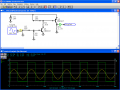
Here's what I started rambling on about; see the attached.

It's a bit different than what I'd started off with. When I started, I was using a couple of LEDs on the base of Q1 as a voltage threshold; then I decided to just use a resistive divider to get the threshold set.

When SigIn is higher than about 5.6v, Q1 turns on Q2, which pulls SigOut high.
When SigIn falls below about 5.6v, Q1 turns off, which turns off Q2, so R4 pulls SigOut low.

Nothing fancy.
 

Attachments

Thread Starter

gte

Joined Sep 18, 2009
363
Sweet, I can't wait to build this circuit ... can the 2222 and 2907 be bought at radio shack?

It's like the 2 transistors form a DPST relay? What's the maximum amperage rating these transistors will support per your software?

My calcs are still shaky, but I believe series resistance is always greater than the value of any single resistor, so it'd be 20k resistance or .7mA going to or through the collector of Q1 and 6.36mA going through the collector/emitter of Q2?

My teacher is from Germany, I'm from MD.

I will download the software you recommended and play with it, hopefully it's somewhat intuitive.

So the transistor circuit > the comparator circuit in this case? I am trying to build something that will simulate an oil pressure pressure sensor that is a mechanical switch that is either NC or NO.


When the ecu sends a pwm signal to a solenoid on the engine, it allows oil pressure into a part of the engine, so that it changes cam profiles and this oil pressure sensor provides feedback to the ecu, as to if oil pressure is sensed as expected, or not.

I'd like to activate this change of cam profiles earlier, manually, and let the pwm signal that the ecu sends out, be converted into the feedback signal that is required for the ecu to sense, so that it doesn't get a check engine light?

Does that make sense?


Here's what I started rambling on about; see the attached.

It's a bit different than what I'd started off with. When I started, I was using a couple of LEDs on the base of Q1 as a voltage threshold; then I decided to just use a resistive divider to get the threshold set.

When SigIn is higher than about 5.6v, Q1 turns on Q2, which pulls SigOut high.
When SigIn falls below about 5.6v, Q1 turns off, which turns off Q2, so R4 pulls SigOut low.

Nothing fancy.
 

SgtWookie

Joined Jul 17, 2007
22,230
Sweet, I can't wait to build this circuit ... can the 2222 and 2907 be bought at radio shack?
Yes. They stopped carrying individual 2N2907's, but they still come in the assortment packs. If you get one PNP and one NPN assortment, you'll have several different types to experiment with.
PNP assortment: http://www.radioshack.com/product/index.jsp?productId=2062585&filterName=Type&filterValue=Transistor
NPN assortment: http://www.radioshack.com/product/index.jsp?productId=2062586&filterName=Type&filterValue=Transistor

Usually, the assortments contain around:
NPN - five 2N2222, five 2N3904, five 2N4401
PNP - five 2N2907, five 2N3906, five 2N4403

They're all useful for various applications. One of the big differences is their current ratings (Ic max), but don't judge a transistor on current ratings alone.

It's like the 2 transistors form a DPST relay?
Ahh - not really. ;) It's more of a threshold detector.

What's the maximum amperage rating these transistors will support per your software?
Well, it's not my software... and you have to realize that simulations are great and help to save time, but you need to make sure that you are not exceeding the ratings of the real-world components.
For example, the 2N2907 and 2N2222 have a maximum Ic of 800mA, but their practical limit is around 500mA. There are also package power dissipation limits; TO-92 plastic cases are 625mW. That applies to anything in that package.

However, I'm using resistors of high enough value in the circuit that the limits should be OK - unless the ECU has a limit on how high you can pull a signal. Right now, you better let me know if it's OK for SigOut to go all the way to 14v. If it's only supposed to be a logic-level signal, inputting 14v might kill your ECU.

My calcs are still shaky, but I believe series resistance is always greater than the value of any single resistor, so it'd be 20k resistance or .7mA going to or through the collector of Q1 and 6.36mA going through the collector/emitter of Q2?
OK, you're not looking at that quite right. With R2 and R3, you're forgetting about the base of Q2.

The idea of R2 is to keep the base of Q2 pulled high when Q1 is not conducting. This makes sure that Q2 is turned off.

When Q1 turns on, it starts sinking current from the base of Q1 via R3. There is also some current sunk from R2, but it's minimal - because the Vbe of Q2 won't fall more than about 0.7v below the supply voltage.
So roughly, I(R2) = (14v-13.3v)/10k Ohms = 0.7v/10k = 70uA.
Then roughly, R3's current will be 13.3v/10k = 1.33mA

You got the Ic of Q2 right through. :)
My teacher is from Germany, I'm from MD.
I see. It appears that some terms are different in Germany, or perhaps your teacher simply picked it up incorrectly, I don't know.

I will download the software you recommended and play with it, hopefully it's somewhat intuitive.
I've ported the circuit over to LTSpice; I've attached the .asc file. You can download it and put it in your:
c:\Program Files\LTC\SwitcherCad directory

So the transistor circuit > the comparator circuit in this case? I am trying to build something that will simulate an oil pressure pressure sensor that is a mechanical switch that is either NC or NO.
OK, you need to explain about that more. Does the switch connect the signal to ground when it is actuated, or connect to 14v, or to 8v?

It would be a very bad thing to connect an improper circuit to your ECU and burn it up. ECU's are very expensive nowadays.

When the ecu sends a pwm signal to a solenoid on the engine, it allows oil pressure into a part of the engine, so that it changes cam profiles and this oil pressure sensor provides feedback to the ecu, as to if oil pressure is sensed as expected, or not.

I'd like to activate this change of cam profiles earlier, manually, and let the pwm signal that the ecu sends out, be converted into the feedback signal that is required for the ecu to sense, so that it doesn't get a check engine light?
What vehicle are you working on, a BMW?

I hope you understand that by telling the ECU that the oil pressure is OK when it really isn't, you risk damaging your engine. The ECU will change profiles for the modified cam profile setting, even if it's not there yet.

I don't know why you would have to do this, unless you are using much thicker oil than recommended.

So ends my 10,000th post.
 

Attachments

Last edited:

Thread Starter

gte

Joined Sep 18, 2009
363
Thanks for the part numbers, I'll pick some up tonight.

I don't see an attachment, where is it attached to, this post?

The sig out just needs to see a 0 or 1 I believe, below 6800rpms it needs to see a 0 and above 6800rpms it needs to not see a 0, and I believe there is a pull up resistor inside of the ecu that brings it to 14v, when there is no place to sink the tiny amount of current it has.

It's a Toyota with a variable cam lift setup that is hydraulically controlled via oil pressure. The solenoid allows oil pressure, which actuates the higher lift cam. If that makes sense and you want to read a little about it, check out this link http://en.wikipedia.org/wiki/VVTL-i#VVTL-i
It will explain how oil pressure to the rest of the engine is still present always, and give a better idea about why I would like to actuate the higher lift cam earlier in the rpms.

Congrats on your 10000th post, it was a good one, you are very helpful and this site is fortunate to have you! I'll let you know how the circuit building goes, as I'm going to try and get that stuff tonight if the local RS has it, and build that circuit for testing :)


Yes. They stopped carrying individual 2N2907's, but they still come in the assortment packs. If you get one PNP and one NPN assortment, you'll have several different types to experiment with.
PNP assortment: http://www.radioshack.com/product/index.jsp?productId=2062585&filterName=Type&filterValue=Transistor
NPN assortment: http://www.radioshack.com/product/index.jsp?productId=2062586&filterName=Type&filterValue=Transistor

Usually, the assortments contain around:
NPN - five 2N2222, five 2N3904, five 2N4401
PNP - five 2N2907, five 2N3906, five 2N4403

They're all useful for various applications. One of the big differences is their current ratings (Ic max), but don't judge a transistor on current ratings alone.


Ahh - not really. ;) It's more of a threshold detector.


Well, it's not my software... and you have to realize that simulations are great and help to save time, but you need to make sure that you are not exceeding the ratings of the real-world components.
For example, the 2N2907 and 2N2222 have a maximum Ic of 800mA, but their practical limit is around 500mA. There are also package power dissipation limits; TO-92 plastic cases are 625mW. That applies to anything in that package.

However, I'm using resistors of high enough value in the circuit that the limits should be OK - unless the ECU has a limit on how high you can pull a signal. Right now, you better let me know if it's OK for SigOut to go all the way to 14v. If it's only supposed to be a logic-level signal, inputting 14v might kill your ECU.


OK, you're not looking at that quite right. With R2 and R3, you're forgetting about the base of Q2.

The idea of R2 is to keep the base of Q2 pulled high when Q1 is not conducting. This makes sure that Q2 is turned off.

When Q1 turns on, it starts sinking current from the base of Q1 via R3. There is also some current sunk from R2, but it's minimal - because the Vbe of Q2 won't fall more than about 0.7v below the supply voltage.
So roughly, I(R2) = (14v-13.3v)/10k Ohms = 0.7v/10k = 70uA.
Then roughly, R3's current will be 13.3v/10k = 1.33mA

You got the Ic of Q2 right through. :)

I see. It appears that some terms are different in Germany, or perhaps your teacher simply picked it up incorrectly, I don't know.


I've ported the circuit over to LTSpice; I've attached the .asc file. You can download it and put it in your:
c:\Program Files\LTC\SwitcherCad directory


OK, you need to explain about that more. Does the switch connect the signal to ground when it is actuated, or connect to 14v, or to 8v?

It would be a very bad thing to connect an improper circuit to your ECU and burn it up. ECU's are very expensive nowadays.


What vehicle are you working on, a BMW?

I hope you understand that by telling the ECU that the oil pressure is OK when it really isn't, you risk damaging your engine. The ECU will change profiles for the modified cam profile setting, even if it's not there yet.

I don't know why you would have to do this, unless you are using much thicker oil than recommended.

So ends my 10,000th post.
 

SgtWookie

Joined Jul 17, 2007
22,230
Thanks for the part numbers, I'll pick some up tonight.

I don't see an attachment, where is it attached to, this post?
Sorry, I was tired and forgot to attach them. :rolleyes: They're attached to it now.

The sig out just needs to see a 0 or 1 I believe, below 6800rpms it needs to see a 0 and above 6800rpms it needs to not see a 0, and I believe there is a pull up resistor inside of the ecu that brings it to 14v, when there is no place to sink the tiny amount of current it has.
In that case, all you need is R1, R5, and Q1. Move SigOut to the collector of Q1. For testing, you could use a 10k pull-up resistor to +14v.

It's a Toyota with a variable cam lift setup that is hydraulically controlled via oil pressure. The solenoid allows oil pressure, which actuates the higher lift cam. If that makes sense and you want to read a little about it, check out this link http://en.wikipedia.org/wiki/VVTL-i#VVTL-i
It will explain how oil pressure to the rest of the engine is still present always, and give a better idea about why I would like to actuate the higher lift cam earlier in the rpms.
I see. Hadn't read the WIKI article, but I'm not unfamiliar with cam profiles.
 

Thread Starter

gte

Joined Sep 18, 2009
363
Ok, so no need for both transistors?

To see if I understand the functionality of the circuit does it provide a path to the battery minus when the PWM voltage is present, or is not present? I need the sigin 1.5/8.5 to break the sigout's path to battery minus.

Forgive my ignorance if this circuit does this, but I'm having a hard time figuring out how it will do that.

I thought .6 or .7v at the base of the NPN would allow current from the collector to the emitter, but this would only get >.6v to allow the transistor to be conducting, when the PWM was at 8.5v, correct?

Or maybe you meant to keep the circuit exactly the same with both transistors, only changing the location of sigout?

I got some transistors tonight :)


Sorry, I was tired and forgot to attach them. :rolleyes: They're attached to it now.


In that case, all you need is R1, R5, and Q1. Move SigOut to the collector of Q1. For testing, you could use a 10k pull-up resistor to +14v.


I see. Hadn't read the WIKI article, but I'm not unfamiliar with cam profiles.
 

SgtWookie

Joined Jul 17, 2007
22,230
Ok, so no need for both transistors?
Probably not, if what you've described is accurate.

To see if I understand the functionality of the circuit does it provide a path to the battery minus when the PWM voltage is present, or is not present? I need the sigin 1.5/8.5 to break the sigout's path to battery minus.
No, just one NPN would invert the logic. :rolleyes:

Forgive my ignorance if this circuit does this, but I'm having a hard time figuring out how it will do that.
Yeah, I don't blame you for being confused. Sorry about that.

I got some transistors tonight :)
Good deal. Now if I can only get you a good design, you'll be in like Flynn. ;)
 

Thread Starter

gte

Joined Sep 18, 2009
363
Hey Sgt,

I'm still feeling like a Private Second Class Newb. I have the circuit modded as you instructed, but I'm trying to figure out how the transistor provides a path to battery minus, when the sig in is less than 1.5v?


I was trying to read http://www.allaboutcircuits.com/vol_3/chpt_2/8.html

The 2222 is an NPN, so that means that current at the base controls where the transistor is blocking or conducting. How will the 2222 be conducting when sigin is 1.5v or less?


Probably not, if what you've described is accurate.


No, just one NPN would invert the logic. :rolleyes:


Yeah, I don't blame you for being confused. Sorry about that.


Good deal. Now if I can only get you a good design, you'll be in like Flynn. ;)
 

SgtWookie

Joined Jul 17, 2007
22,230
Sorry, I still "owe" you a re-designed circuit. Don't have it at the moment; I've been mighty distracted today. Give me a bit.
 

SgtWookie

Joined Jul 17, 2007
22,230
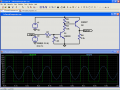
OK, see the attached.

I'm using a couple of NPN transistors. The 10k and 1.5k resistors (R1, R5) on Q1's base establish the threshold of when to trip. Q2 simply inverts the output of Q1. R3 provides the base current for Q2. R3 represents the ECU internal pull-up resistor.

[eta]
Deleted .asc file; re-attached to subsequent post.
 

Attachments

Last edited:

Thread Starter

gte

Joined Sep 18, 2009
363
Thanks! I found a pretty good site that made understanding this beautiful circuit a little more clear!

http://www.kpsec.freeuk.com/trancirc.htm

If I understand correctly, 9v @ .9mA will go through R1. When it is not at ~9v, but instead at roughly 1.3v, R5 keeps the lower voltage of < 1.5 from tripping Q1 because it eats up approximately 1.35v and sinks it to ground. (that calc I'm not 100% on)

Then when voltage is up to 8 or 9 volts, net voltage at the base of Q1 is 9-1.35?

R2 is triggering Q2 to be conducting and allowing R3's voltage/current to be sunk to ground.

When Q1 becomes conducting, this gives a path for the +14v out of R2, to sink to ground, and because the current is so low (1.4mA?) it brings the base of Q2 to almost 0v and Q2 becomes blocking.

When Q2 is conducting, it sinks the sigout 14v low current wire to ground.

Have I grasped it yet?


OK, see the attached.

I'm using a couple of NPN transistors. The 10k and 1.5k resistors (R1, R5) on Q1's base establish the threshold of when to trip. Q2 simply inverts the output of Q1. R3 provides the base current for Q2. R3 represents the ECU internal pull-up resistor.
 

SgtWookie

Joined Jul 17, 2007
22,230
Thanks! I found a pretty good site that made understanding this beautiful circuit a little more clear!

http://www.kpsec.freeuk.com/trancirc.htm

If I understand correctly, 9v @ .9mA will go through R1. When it is not at ~9v, but instead at roughly 1.3v, R5 keeps the lower voltage of < 1.5 from tripping Q1 because it eats up approximately 1.35v and sinks it to ground. (that calc I'm not 100% on)

Then when voltage is up to 8 or 9 volts, net voltage at the base of Q1 is 9-1.35?
Actually, it's the ratio of R1 to R5 vs the transistor cutoff that determines when it'll turn on. 5V/(R1+R5) * R5 = 0.65v; which is about the point the transistor begins sinking current from R2. This will vary from transistor to transistor, and unfortunately will also vary over temperature. The higher the temperature, the lower the transistor cutoff voltage will be.

R2 is triggering Q2 to be conducting and allowing R3's voltage/current to be sunk to ground.
Ahh, R2 sources current to Q2's base, unless Q1 is conducting to the point where the Vce of Q1 is less than Q2's cutoff.

When Q1 becomes conducting, this gives a path for the +14v out of R2, to sink to ground, and because the current is so low (1.4mA?) it brings the base of Q2 to almost 0v and Q2 becomes blocking.
When Q1 conducts current, the voltage drop across R2 increases. When the Vce of Q1 drops below around 0.6v, Q2 cannot conduct; it's in cutoff.
 

Thread Starter

gte

Joined Sep 18, 2009
363
Sgt,

Even though I don't understand exactly how this circuit works, I built it and it does work on my test bench :) . Maybe I'll take DMM measurements and then post up a pic of how many volts each component connection is seeing?

I have been trying to get the .asc file to work, and it keeps causing LTspice to crash every time I hit the play/run button?
 

SgtWookie

Joined Jul 17, 2007
22,230
I don't know why your LTSpice is crashing; it works just fine on my installation.

There is nothing "special" about the simulation; it's very basic.

Perhaps it got damaged during the upload or download; I will re-upload the file.
Try downloading the one I've attached to this message.

Note that for "the real thing", you may need to adjust the value of R5. I suggest a fixed resistor of 1k and a 1k 10- or 21-turn trim pot in series with it.
 

Attachments

Last edited:
Top