Looking for a schematic for 1 pulse in, 2 pulse out

Thread Starter

stillgrowingup

Joined Jul 15, 2015
219
PNP transistors should be fine. Don't think you ever mentioned the current needed, but it should be low if you're just shorting a switch input
300mA ground pulse is more than sufficient to activate my LED controller.

Don't use rectifier diodes; the forward voltage drop is too high to protect the diode in the one shots.
You are saying that all the diodes in the circuit should be schottky diodes, EXCEPT the first diode that supplies the 12v to the circuit. I spec out schottky diode STPS0520Z for the circuit.

You should use a TVS diode instead of a zener and put a fuse upstream of the diode.
Hows this TVS diode ... ESDH12VD1-TP
https://www.digikey.com/product-det...-co/ESDH12VD1-TP/ESDH12VD1-TPMSDKR-ND/6004875

Thank you
TONY
 

dl324

Joined Mar 30, 2015
18,362
300mA ground pulse is more than sufficient to activate my LED controller.
Guessing could cause you to over design the circuit.
You are saying that all the diodes in the circuit should be schottky diodes, EXCEPT the first diode that supplies the 12v to the circuit. I spec out schottky diode STPS0520Z for the circuit.
Any diode would be better than a rectifier diode.
Won't work. The stand off voltage is too low. When the vehicle is operating, the voltage will be around 13.8V.

Digikey prices tend to be high. They have a wide variety of parts, and I hear they have inexpensive shipping options, but that convenience comes with higher prices.
 

ArakelTheDragon

Joined Nov 18, 2016
1,366
Sorry for being absent for a long time. Can you please remind me this: you need to double the frequency or you need 2 pulses out subsequently, with the same frequency? Is this all you need from this circuit?

I intend to carry an optimisation on your circuit. I do not have much time to read all the posts.
 

Thread Starter

stillgrowingup

Joined Jul 15, 2015
219
Guessing could cause you to over design the circuit.
How would I find the true answer out? ... I do not have the LED controller schematic to look at. ... Is there a way to limited the mA to the On and Off circuits of the LED controller ... And see at what mA the LED controller responds.

TONY
 

eetech00

Joined Jun 8, 2013
4,709
How would I find the true answer out? ... I do not have the LED controller schematic to look at. ... Is there a way to limited the mA to the On and Off circuits of the LED controller ... And see at what mA the LED controller responds.

TONY
As a test, you could measure with an ammeter. Set the meter to read max current, then connect ammeter +Terminal to the mcu input and ground the -terminal. If no reading, slowly reduce the scale till you get a reading. A digital auto-scaling meter would be easier.

eT
 

dl324

Joined Mar 30, 2015
18,362
How would I find the true answer out? ... I do not have the LED controller schematic to look at.
You could determine experimentally by inserting a small value resistor (around 10 ohms) in series with the switch. Close the switch to ground the input and measure the voltage across the resistor. If the voltage is too low to measure, the current required in the switch will be low.

Or you could determine the minimum current in the transistor switches you're using that will trigger the device.

I don't recommend measuring the current directly. Resistance is likely to be in the 200-1000 ohm range; with the highest resistance on the lowest range (200uA).
 

Thread Starter

stillgrowingup

Joined Jul 15, 2015
219
As a test, you could measure with an ammeter. Set the meter to read max current, then connect ammeter +Terminal to the mcu input and ground the -terminal. If no reading, slowly reduce the scale till you get a reading. A digital auto-scaling meter would be easier.

eT
That's right ... the LED controller will only draw the amperage it needs to activate. Good Call!

TONY
 

Thread Starter

stillgrowingup

Joined Jul 15, 2015
219
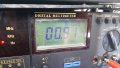
Looks like 0.91mA to me...
I first thought that too ... Until I looked in the upper right hand corner of the display. It says 00.9 A ... Of course I may be completely wrong. It's my uncles benchtop meter. I am used to my 73 series hand held fluke.

TONY
 

eetech00

Joined Jun 8, 2013
4,709
I first thought that too ... Until I looked in the upper right hand corner of the display. It says 00.9 A ... Of course I may be completely wrong. It's my uncles benchtop meter. I am used to my 73 series hand held fluke.

TONY
hmmm...that’s a lot of current. I would’ve thought it would be more like what dl324 mentioned..can you confirm with your Fluke?
 

dl324

Joined Mar 30, 2015
18,362
I first thought that too ... Until I looked in the upper right hand corner of the display. It says 00.9 A ... Of course I may be completely wrong. It's my uncles benchtop meter. I am used to my 73 series hand held fluke.
The meter range is set to mA, so the reading on the main part of the display is in mA. I can't read the upper right portion of the display.
 

Thread Starter

stillgrowingup

Joined Jul 15, 2015
219
Oops...wait. Didn’t see the image on your post.

Looks to me it’s displaying 0.91 milliamperes ....(or 910 microamps)..that’s more like it;)
The meter range is set to mA, so the reading on the main part of the display is in mA. I can't read the upper right portion of the display.
It .91 mA than. Sweet!! .. So what does this mean for the circuit? .. Everything is still ok?

TONY
 

eetech00

Joined Jun 8, 2013
4,709
It means you
It .91 mA than. Sweet!! .. So what does this mean for the circuit? .. Everything is still ok?

TONY
Yes...all ok.
But it means you can simplify the Interface between the circuit and the MCU. you might not need a transistor interface anymore.

If you still want LED indicators remember you only have about 4 ma to play with or you’ll need to put transistors back in.

Good job !
 
Last edited:

Thread Starter

stillgrowingup

Joined Jul 15, 2015
219
We need another measurement.
Measure the voltage at the input Of the mcu.
Without the button pressed and report back
I misspoke. It's NOT a MCU, it is a PIC chip that controls the LED controller. My bad. The voltage at the PIC chip is a steady 4.95V. Does NOT change when controller is on or off. There is also a 7805 Voltage reg on-board the LED controller that gives the PIC the 4.95V from 12v.

TONY
 

eetech00

Joined Jun 8, 2013
4,709
I misspoke. It's NOT a MCU, it is a PIC chip that controls the LED controller. My bad. The voltage at the PIC chip is a steady 4.95V. Does NOT change when controller is on or off. There is also a 7805 Voltage reg on-board the LED controller that gives the PIC the 4.95V from 12v.

TONY
Hi

Ok...so the input levels are 4.95v and GND.
You’ll need to use NPN transistors (not PNP) to correctly interface to the PB input of the PIC. They can be type 2n2222 or just about any general purpose NPN. The collector will connect to PIC PB input, emitter to GND, base thru resistor to Q output. When Q goes high, the NPN will turn on and short the input pin to GND.

Update:
After thinking about it...NMOS mosfets would be better. The thru hole 2N7000 version
has the same footprint as a 2N2222. See Attached schematic.


eT
 

Attachments

Last edited:
Top