Look closer. I can't recall reading any datasheet that didn't give the ratio as 10.Because of rule of thumb, that's why I cannot find the information from datasheet.
.MODEL ZTX690B NPN IS=1.5p NF=1 BF=1000 IKF=3 VAF=60 ISE=4E-13 NE=1.37 NR=1 BR=123 IKR=1 VAR=14.5 ISC=4E-13 NC=1.34 RB=0.1 RE=0.045 RC=0.027 CJE=250p VJE=0.68 MJE=0.36 CJC=59p VJC=0.49 MJC=0.36 TF=0.77n TR=18n RCO=0.93 GAMMA=5n QUASIMOD=1 XTB=1.4 TRE1=0.002 TRB1=0.002 TRC1=0.002 Vceo=45 Icrating=2 mfg=ZetexThose values of hFE are when you are using the transistor as a linear amplifier, not as a switch.
When using it as a switch, an hFE value of 10-20 is typically used to insure the transistor is fully saturated.
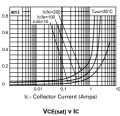
Notice that, for the saturation voltage measurement @4A, they use an hFE of 10.
View attachment 163528
I would use a value of about 20 for the maximum startup current, since that's well below 4A and its gain is significantly higher at lower currents.
That will insure good saturation at the running current.
Bordodynov, do you have an LTspice model for that transistor?
.MODEL FCX690B NPN IS=1.5p NF=1 BF=1000 IKF=3 VAF=60 ISE=4E-13 NE=1.37 NR=1 BR=123 IKR=1 VAR=14.5 ISC=4E-13 NC=1.34 RB=0.1 RE=0.045 RC=0.027 CJE=250p VJE=0.68 MJE=0.36 CJC=59p VJC=0.49 MJC=0.36 TF=0.77n TR=18n RCO=0.93 GAMMA=5n QUASIMOD=1 XTB=1.4 TRE1=0.002 TRB1=0.002 TRC1=0.002 Vceo=45 Icrating=2 mfg=Zetex
Edit: The ZTX690B that Bordodynov posted looks like a good option.
They use an hFE of 200 for the saturation tests.
Bordodynov, do you have an LTspice model for that transistor?
The ZTX690B uses a value of 200 (below), which is unusual for a non-Darlington transistor (it's obviously not a Darlington given the low saturation voltages).I can't recall reading any datasheet that didn't give the ratio as 10.


Obviously darlingtons use higher betas for saturation, but I had never seen a more typical transistor use a beta higher than 10. As with all things, there are exceptions.The ZTX690B uses a value of 200 (below), which is unusual for a non-Darlington transistor (it's obviously not a Darlington given the low saturation voltages).
It must use a special process to get such high gain.
I don't know if it's ten times, but the ZTX690B can be purchased ( from Mouser for example) for $0.89 US in 1ea quantities.It would be absurd to spend ten times as much money for a transistor and still treat it like an ordinary cheap part.
I think that's even worse than 10 times, though admittedly there isn't really a common device that has a comparable continuous collector current rating. In any case, it is rather dear for small transistor.I don't know if it's ten times, but the ZTX690B can be purchased ( from Mouser for example) for $0.89 US in 1ea quantities.
That may be a factor in production quantities (40.5 cents in 1000 quantity) but 89 cents doesn't seem that significant for one-up hobby applications (as compared to about 25 cents for a PN2222 for example).In any case, it is rather dear for small transistor.
First of all.Dear dl324,
Sorry I don't understand the datasheet, do you mean 600mA is the maximum rating for PN2222A transistor, so the maximum current to the load is better less than 600mA but the transistor maximum allow current will be 1.2A but it will be very hot.
What will happen if the load is over 600mA or 1.2A to the PN2222A?
Best regards,
Kelvin.
Dear TANDBERGEREN,First of all.
The parameters given in the datasheet is absolute maximum values.
There will be a voltage over this transistor wich makes the 600mA impossible to obtain, as 600mA and nearly a Volt hits the maximum power dissipation in the transistor.
To switch the power for this motor I would have chosen a MOSFET, as it is much easier to get it to give good enough function without the heating problem.
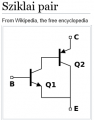
Google and I have never heard of a "split Darlington". Maybe you mean a Sziklai pair which is also know as a complementary feedback pair, compound transistor and pseudo Darlington? It also has a fairly high saturation voltage of 0.6V or 0.7V because the output PNP transistor is an emitter follower. 0.7V is almost a quarter of the 3V supply causing the motor to run slower.If you want to use a transistor, you can use a darlington configuration if base current is a limitation. If the high saturation voltage is an issue, you can use a split darlington.
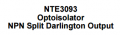
No, I mean split darlington:Google and I have never heard of a "split Darlington". Maybe you mean a Sziklai pair which is also know as a complementary feedback pair, compound transistor and pseudo Darlington?