Logic ICs 74LS36 and 08

Thread Starter

Rudy24

Joined Apr 10, 2025
12
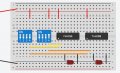
Hi everyone, I wonder if you can help. I am building a half-adder with my class like the one attached, except the ICs only work when fed a switched negative signal, not a positive. I’d like to use TinkerCAD simulation to help the students with design systems, prototyping and circuit design basics, but their simulation only works when the IC is fed a switched input from the positive rail as per the image. I’m not sure whether the problem is me or the system, can anyone help me identify what’s going on? The chips in the simulation are 74HC36’s and mine are 74LS36’s, but from what I can gather it’s only their power characteristics that differ and shouldn’t affect their operation I don’t think? Any help would be gratefully appreciated.
 

Attachments

Ian0

Joined Aug 7, 2020
13,131
Do you have pull-down or pull-up resistors so that the inputs meet the input voltage requirements as in the datasheet?
 

Ian0

Joined Aug 7, 2020
13,131
I'd only give TI 5 out of 10 for explaining their terms on the 74LS08 datasheet, but they managed somewhat better on the 74LS36.
Luckily, the inputs work the same on both devices.
So, refer to the 74LS36 datasheet.
You have IIH (low level input current) of 1.6mA. That current is coming out of the input pin.
You need to meet VIL (low level input voltage) for the device to see the input as logic zero, and that is 0.8V
So to make the device see a logic zero when there is nothing connected to the input, you need a resistor to 0V which is 0.8V/1.6mA.
Then your switch to 5V can produce a logic 1 when it is ON.
 

Thread Starter

Rudy24

Joined Apr 10, 2025
12
Thank you for taking the time to explain. I have increased the power supply to 6v (I cannot produce 5v, only 4v or 6v) and then attenuated the input to the DIP switches with a 4.7k resistor that feed the inputs to the gates, with no discernible change in operation. Interestingly, the AND gate outputs all light the LED, even with nothing connected at the inputs, as if it’s receiving two positive signals on every gate, which is odd. Even with the VCC at 2V and no other connections at all, the LED still lights on all four gates. The IC operates normally when I apply a signal from the negative rail instead of the positive though.
 

Ian0

Joined Aug 7, 2020
13,131
Thank you for taking the time to explain. I have increased the power supply to 6v (I cannot produce 5v, only 4v or 6v) and then attenuated the input to the DIP switches with a 4.7k resistor that feed the inputs to the gates, with no discernible change in operation. Interestingly, the AND gate outputs all light the LED, even with nothing connected at the inputs, as if it’s receiving two positive signals on every gate, which is odd. Even with the VCC at 2V and no other connections at all, the LED still lights on all four gates. The IC operates normally when I apply a signal from the negative rail instead of the positive though.
Look at the supply voltage specifications.
If you are using TTL then 5V is the ONLY supply voltage you may use.
TTL won’t work below 4.75V or above 5.25V and will break at 7V.
If you haven’t got a 5V supply, either get one or don’t use TTL.
 

Thread Starter

Rudy24

Joined Apr 10, 2025
12
Hi Rudy,
Please post a circuit diagram showing the IC supply voltages and the Logic level inputs you are using.
E
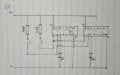
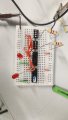
Apologies for the delay, I've finished work and am now home with the family (in Australia). Anyway, I attach a photo of the breadboard and a circuit diagram. The supply voltage was measured at 5.98V and the logic level voltage I think was 1.6, but I didn't note this down and am no longer with the circuit to retest sorry.

Sounds like I need a more accurate supply voltage, hey?
 

Attachments

Thread Starter

Rudy24

Joined Apr 10, 2025
12
Look at the supply voltage specifications.
If you are using TTL then 5V is the ONLY supply voltage you may use.
TTL won’t work below 4.75V or above 5.25V and will break at 7V.
If you haven’t got a 5V supply, either get one or don’t use TTL.
Thanks Ian, I’m home now, but will investigate a more accurate supply tomorrow. I’ll have to attenuate the 6v as we only have these PSUs at school so will see what I can do.

As another question though, how come it works when I provide a signal input from the negative rail? Everything works fine then, just backwards, but I’m not altogether sure why. Is there a simple explanation for this? Thanks for all your help, Andy
 

bertus

Joined Apr 5, 2008
22,921
Hello,


The supply voltage of 6 Volts will damage the chips.
You might feel that the chips are heating.
Also you will need resistors in series with the leds to limit the led current.

Bertus
 

LesJones

Joined Jan 8, 2017
4,511
This sounds like homework help with the restrictions on the supply voltage and logic levels. If it has to work with a supply of between 2 volts and 6 volts you must use the HC family of devices. You also caused confusion by specifying a 74LS 36 at the start of your thread.
Les.
 

Thread Starter

Rudy24

Joined Apr 10, 2025
12
Hi Rudy,
Why are you using 2, 74LS86 devices, when each IC has 4 XOR gates.?

Also use 5v for the supply, and 0v and +5v for the Logic inputs.

E
Update:

Is this the type of circuit you require?
https://en.wikipedia.org/wiki/Adder_(electronics)
I have one '86 (quad XOR) and one '08 (quad AND), and am using the quad ICs because this is the first step toward building a 4-bit adder which will use all of gates (and more besides). I am comfortable with the digital logic and have made successful half adders and 4-bit adders before using these ICs, but with the input coming from the negative rail instead of the positive. I'm trying to increase my analogue knowledge to make it work as it should from the positive input. I'll work on getting the supply more accurate tomorrow, thanks for the advice. :)
 

Thread Starter

Rudy24

Joined Apr 10, 2025
12
This sounds like homework help with the restrictions on the supply voltage and logic levels. If it has to work with a supply of between 2 volts and 6 volts you must use the HC family of devices. You also caused confusion by specifying a 74LS 36 at the start of your thread.
Les.
Thanks Les, sorry to cause confusion. It came about because the HC family are in the digital simulation, but the LS is what I have on the bench. Not homework help, I'm the teacher and have successfully made 4-bit adders this way using these LS ICs, but only with inputs from the negative rail. I'm trying to increase my analogue electronics understanding to make it work from the positive rail as it should.

By the sounds of the advice here, I just need to make my supply voltage more accurate. I'll work on that tomorrow. Thanks for your help.
 

sarahMCML

Joined May 11, 2019
697
You cannot use analogue theory when using 74 series type logic circuits. The series always default to their inputs in a normally High state (i.e. pulled towards the positive supply), and need to be pulled Low to change state. This applies to all the various Bipolar versions. The CMOS ones (HC, HCT etc) are the same, although they, having very high impedance inputs, need a pull-up resistor of some kind if not being driven.

You need to adapt your way of thinking about the logic of the operation.

The absolute maximum supply voltage for most 74 series is 7 Volts, so you should be fine at 6V, although the guaranteed specs are 4.75 to 5.25V for 74LS.
 

Thread Starter

Rudy24

Joined Apr 10, 2025
12
You cannot use analogue theory when using 74 series type logic circuits. The series always default to their inputs in a normally High state (i.e. pulled towards the positive supply), and need to be pulled Low to change state. This applies to all the various Bipolar versions. The CMOS ones (HC, HCT etc) are the same, although they, having very high impedance inputs, need a pull-up resistor of some kind if not being driven.

You need to adapt your way of thinking about the logic of the operation.

The absolute maximum supply voltage for most 74 series is 7 Volts, so you should be fine at 6V, although the guaranteed specs are 4.75 to 5.25V for 74LS.
Thank you for the additional insight. I was probably using the wrong terminology to say 'analogue theory', I just meant calculating resistor values and controlling the voltage required to run the ICs. The naturally high state is certainly something I am witnessing in the 'LS08 AND gates as they are all outputting a positive voltage with nothing connected to the inputs. Do I understand that I will need a pull-down resistor connected between this pin and the gnd, as well as the signal? Is there a best way to calculate the value of resistor for this task?
 

Alec_t

Joined Sep 17, 2013
15,117
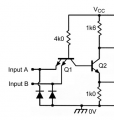
The 74 series logic has an internal input something like this :-
1744285567992.png
The Q1 base pull-up resistor accounts for the default logic-high input state in the absence of a low drive signal at the input.
 

sarahMCML

Joined May 11, 2019
697
Thank you for the additional insight. I was probably using the wrong terminology to say 'analogue theory', I just meant calculating resistor values and controlling the voltage required to run the ICs. The naturally high state is certainly something I am witnessing in the 'LS08 AND gates as they are all outputting a positive voltage with nothing connected to the inputs. Do I understand that I will need a pull-down resistor connected between this pin and the gnd, as well as the signal? Is there a best way to calculate the value of resistor for this task?
Ah, I see! If you wish to pull an input Low, with a switch for example, you need to add a pull-up resistor to the input of around 10k ohms.
However, if you wish to do the reverse, and start with the input at a Low level, and use a switch to set it High, you need to ensure that the input is pulled to a voltage which is seen by the gate as less than 0.8V at it's input sink current of 0.4mA. That means that the resistor can be no greater than 2k ohms in value, preferably somewhat less.
 

Ian0

Joined Aug 7, 2020
13,131
Due to the asymmetry and relatively high input current of TTL they are fairly low value resistors, much lower for the pull-down than the pull-up.
For CMOS (and HC), because there is effectively no input current, any old value will do, between about 330Ω and 1MΩ.
 
Top