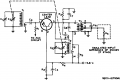
I saw that odd duck. Used in old transistors radios for the mixer and IF oscillator in the same transistor package.
Signal AGC on one emitter FROM T1 and oscillator feedback on the other emitter using feedback from T2.
For low-speed, switch operation you can leave an LS series TTL gate input open for a logic one and grounded for a logic zero.
That's not true for the CMOS series.
For low-speed, switch operation you can leave an LS series TTL gate input open for a logic one and grounded for a logic zero.
That's not true for the CMOS series.
There are a number of things wrong with your approach and you are going to teach your students to blindly do those same wrong things, now and down the road, because that will be how they were taught to do it.
Do not leave ANY logic inputs floating unless the data sheet explicitly says that it is okay to do so. This is especially critical with CMOS circuits. With TTL, they do have a weak pullup behavior when floating, but it is good practice not to rely on that. YOU are responsible for establishing the correct voltage levels at the inputs to establish valid logic levels that the chip will recognize. If you want to leave TTL inputs unconnected, then the onus is on you to ensure that they will behave reliably in your application. Almost always better just to established valid logic levels yourself. With CMOS, unconnected inputs will flail around unpredictably because they are so high-impedance, so the static charge on someone walking by the table can affect their state. Worse, they can float to an intermediate level which turns on both the pull-up and pull-down transistors in the gate, causing shoot-through between the power rails, quickly heating up and destroying the gate and/or the entire chip.
Notice that I said do not leave ANY logic inputs floating. You have four two-input gates on each of those ICs and you are only using one of them. That means that you have six unused inputs that you need to establish valid logic levels at., otherwise shoot-through in an unused gate can damage the gates you are using (they are, after all, on the same piece of silicon and separated by distances comparable to a human hair) Tie unused inputs either HI or LO, consistent with the behavior you want. In this case, it doesn't matter, so on your breadboard tie all of the inputs together that are on a given side of the chip and then tie one of them to the power rail that is on that side.
Do not drive LEDs directly from logic outputs. At the very least, you need proper current limiting resistors. Otherwise the LED will pull too much current from the output which can disrupt or even damage the IC. Also, take into account the current requirements of the LED and the current capabilities of the IC.
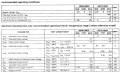
Notice that the outputs are only recommended to deliver 0.4 mA when the output is HI, but that they can sink 8 mA when the output is LO. Unless you are using LEDs that light up with less than half a milliamp, you are abusing your LS chips.
Look at the data sheet for the HC parts to see what their current capabilities are.
Also note that TTL outputs, even when driving no load at all, do not output 5 V, they are more commonly around 3.5 V.
If all you have is a 6 VDC power source, you can bring it down to 5.1 V with the correct series resistor and 5.1 V zener diode.
Do you know how to calculate the resistance and wattage of the resistor and the wattage of the zener diode?
If all you have is a 6 VDC power source, you can bring it down to 5.1 V with the correct series resistor and 5.1 V zener diode.
Do you know how to calculate the resistance and wattage of the resistor and the wattage of the zener diode?
In a pinch I've used a series silicon power diode to drop the voltage by 0.7 volts to get a TTL logic interface board using about 500mA working. The at chip voltage was about 5.25 after voltage drops on the connections and board traces.
There are a number of things wrong with your approach and you are going to teach your students to blindly do those same wrong things, now and down the road, because that will be how they were taught to do it.
Do not leave ANY logic inputs floating unless the data sheet explicitly says that it is okay to do so. This is especially critical with CMOS circuits. With TTL, they do have a weak pullup behavior when floating, but it is good practice not to rely on that. YOU are responsible for establishing the correct voltage levels at the inputs to establish valid logic levels that the chip will recognize. If you want to leave TTL inputs unconnected, then the onus is on you to ensure that they will behave reliably in your application. Almost always better just to established valid logic levels yourself. With CMOS, unconnected inputs will flail around unpredictably because they are so high-impedance, so the static charge on someone walking by the table can affect their state. Worse, they can float to an intermediate level which turns on both the pull-up and pull-down transistors in the gate, causing shoot-through between the power rails, quickly heating up and destroying the gate and/or the entire chip.
Notice that I said do not leave ANY logic inputs floating. You have four two-input gates on each of those ICs and you are only using one of them. That means that you have six unused inputs that you need to establish valid logic levels at., otherwise shoot-through in an unused gate can damage the gates you are using (they are, after all, on the same piece of silicon and separated by distances comparable to a human hair) Tie unused inputs either HI or LO, consistent with the behavior you want. In this case, it doesn't matter, so on your breadboard tie all of the inputs together that are on a given side of the chip and then tie one of them to the power rail that is on that side.
Do not drive LEDs directly from logic outputs. At the very least, you need proper current limiting resistors. Otherwise the LED will pull too much current from the output which can disrupt or even damage the IC. Also, take into account the current requirements of the LED and the current capabilities of the IC.
Notice that the outputs are only recommended to deliver 0.4 mA when the output is HI, but that they can sink 8 mA when the output is LO. Unless you are using LEDs that light up with less than half a milliamp, you are abusing your LS chips.
Look at the data sheet for the HC parts to see what their current capabilities are.
Also note that TTL outputs, even when driving no load at all, do not output 5 V, they are more commonly around 3.5 V.
Thanks so much for this response! Just to be clear, I am a high school physics teacher and not an electronics engineer. This is a short course designed to teach 15 year olds digital logic as an introduction to the basics of computing. Most (if not all) will probably never see another electronic component or use a multimeter again in their life. My predecessors stayed with the theory on the page using logic gates, but I wanted them to build something practical which is where the nuances of real life have come in! I haven’t personally done circuit design since my degree 25 years ago, and the conversations on this thread are way beyond the scope of the course. Nevertheless, I really appreciate the insights and detail and should be able to take the advice and create a working system that they will understand. I’ll be back in the lab later today and will work with all the comments here. Thanks again for the detail, it’s much appreciated.
Thanks so much for this response! Just to be clear, I am a high school physics teacher and not an electronics engineer. This is a short course designed to teach 15 year olds digital logic as an introduction to the basics of computing. Most (if not all) will probably never see another electronic component or use a multimeter again in their life. My predecessors stayed with the theory on the page using logic gates, but I wanted them to build something practical which is where the nuances of real life have come in! I haven’t personally done circuit design since my degree 25 years ago, and the conversations on this thread are way beyond the scope of the course. Nevertheless, I really appreciate the insights and detail and should be able to take the advice and create a working system that they will understand. I’ll be back in the lab later today and will work with all the comments here. Thanks again for the detail, it’s much appreciated.
I don't know what the full scope or intent of this course is, but you might be interested in looking at The Elements of Computing Systems (a.k.a., Nand-2-Tetris). It is a wonderful course that gives students a remarkably decent understanding of how computers work from the basic logic gates up through the entire software stack. At the high school level, it is normally taught as a one-year course with significant hand holding. Having said that, it has no hands-on component (by design, in order to make it cheap and accessible to the widest audience) and I really like your intention of incorporating some of that real-world experience. But, it would be very easy to incorporate some hands-on exercises into the first part of the course in parallel with the computer-based simulations.
But if you are going to do real-world stuff, do yourself a favor and do it right. You can decide how much you inform the students about the details and, for the scope and level you are shooting for, it's fine to leave it at the "just do this to make it work -- the physics is in the hand-waving" stage. So get your input circuits working correctly so that they establish proper voltage levels. Similarly, get your output circuits so that they don't violate the chip specs. Then be sure that all unused inputs are tied to defined logic levels. If you do those three things, then your students will have far fewer frustrating issues like you were having, making it a much more enjoyable and educational experience for them. As long as you are limiting things to breadboarding combinatorial logic, you can get away without putting bypass capacitors near each chip, but if you are going to have them work with sequential logic (i.e., flip flops), then you will want to have them put those in there to minimize the chances of getting odd behaviors because of droops in the supply voltage in conjunction with switching events.
But if you are going to do real-world stuff, do yourself a favor and do it right. You can decide how much you inform the students about the details and, for the scope and level you are shooting for, it's fine to leave it at the "just do this to make it work -- the physics is in the hand-waving" stage.
This is exactly why I am reaching out! Thanks for the tips on The Elements of Computing Systems too, I’ll check it out. I only have 1.5 hours a week for 18 weeks to do this, I take them through the history of computing, binary number base, counting, addition, then logic and finally to building the circuit, so there really isn’t a lot of time. If I can get this right though, as you say, I may not explain every element of the circuit in this much detail, but can at least provide them a real space to work in.
I did GCE 'O' Level and 'A' Level physics in high school. I know that this was many moons ago but there was nothing like this in our physics curriculum.
I am going to take the risk and assert that this is not physics, but more engineering. There are enough physics topics to cover in basic electricity and magnetism and no need to delve into computer systems. In my opinion, you are doing your students a disservice by introducing a subject about which you yourself as the teacher lack the fundamentals. I was not introduced to binary systems, logic, and digital circuits until my final year in a 4-year university level program in engineering.
Without coming across as being rude, I would suggest that you reconsider this entire approach.
Another way of saying this is, it is better not to teach something than to teach something incorrectly.
(For the record, I have been teaching electricity and magnetism, digital electronics and computer systems at the university level for over 50 years.)
One problem encountered with hands-on experiments in the lab or classroom is invariably, things will not work. You, as the teacher, have to be able to recognize instantly why the circuit fails to work. Only with proper knowledge and experience would you be able to do that, otherwise it only leads to much frustration and disappointment.
Even with perfectly functioning equipment and components, students have a way of challenging you to the max. I can give you a very long list of the most common errors students will make in the lab, many having nothing to do with the subject of science, engineering, or technology.
I did GCE 'O' Level and 'A' Level physics in high school. I know that this was many moons ago but there was nothing like this in our physics curriculum.
I am going to take the risk and assert that this is not physics, but more engineering. There are enough physics topics to cover in basic electricity and magnetism and no need to delve into computer systems. In my opinion, you are doing your students a disservice by introducing a subject about which you yourself as the teacher lack the fundamentals. I was not introduced to binary systems, logic, and digital circuits until my final year in a 4-year university level program in engineering.
Without coming across as being rude, I would suggest that you reconsider this entire approach.
Another way of saying this is, it is better not to teach something than to teach something incorrectly.
(For the record, I have been teaching electricity and magnetism, digital electronics and computer systems at the university level for over 50 years.)
Thanks MrChips, and I actually agree. The curriculum has changed so much, even since I was at school in the late 90s... they even have quantum mechanics, special relativity and nuclear reactors in there now, which I think should all be left to the tertiary institutions. Unfortunately I don't get to choose the curriculum.
I can revert back to teaching digital logic through gates in simulations and not let any of these 'real world' difficulties plague their mind just yet, but I would rather see the students with a hands on understanding if possible. A few years ago, a teacher tried to teach this by getting 15 year olds to solder relays together to make gates and create a half adder, but gave up citing it as too hard. I'm not altogether surprised, that would have been a mammoth task.
In short, I am aware of the classroom difficulties and realities of such a program, I may yet choose to leave the practical behind, but I do believe the students will get more out of it IF I can do the work to bring it in an appropriate manner. If not, I'll leave digital logic on paper... I don't bring anything into the classroom I'm not confident with, this is why I'm here.
I have time as well, I won't be dealing with this for a few months yet, so I'll do my work, research and testing, and see how I go. Thanks for your thoughts.
As an aside, it sounds like you're from the UK? Which university do you work at? I would be interested to hear if there are any key principles of electricity and magnetism you would expect new undergrads to know, and perhaps any that you feel aren't generally done justice at high school level? It's a wide topic I know, but our school is working a review of our syllabus at the moment and if you had any thoughts, I'd be interested to hear them. All the best.
If you are going to stick with this, I would suggest you dump the TTL and go with CMOS (74HC). TTL is very finicky and is obsolete. CMOS is much more forgiving, and operates over a large range of voltages.
I did GCE 'O' Level and 'A' Level physics in high school. I know that this was many moons ago but there was nothing like this in our physics curriculum.
I got my O-level in 1980 and A-level in 1982. We covered thermionic diode and triode valves, semiconductor diodes and bipolar transistors. We must have done something on logic (especially as Mr. Boole was a local chap), but the connection between logic gates and transistors was never mentioned, with nothing whatsoever on how logic gates actually work. I definitely remember Karnaugh maps, but it might have been in the Mathematics course. (I’ve never thought Karnaugh maps were any use!)
As an aside, it sounds like you're from the UK? Which university do you work at? I would be interested to hear if there are any key principles of electricity and magnetism you would expect new undergrads to know, and perhaps any that you feel aren't generally done justice at high school level? It's a wide topic I know, but our school is working a review of our syllabus at the moment and if you had any thoughts, I'd be interested to hear them. All the best.
I cannot reveal the name of the university and risk revealing my identity. It is interesting to observe when students in related courses at this university seek help here on the forums with their coursework.
As for the other questions, I would have to give these more thought.
Going back in years, the A-Level physics syllabus was organized into seven fundamental areas, as presented in the text Principles of Physics by Michael Nelkon:

 Facebook
 Google
 GitHub
 Linkedin

 .
.